The Italian Genesis of Velvet: From Silk Route to Sericulture Mastery
Velvet is not merely a fabric; it is a structural anomaly in the history of textiles—a material whose very construction demands excess, patience, and an almost architectural understanding of yarn. Its origin, however, is not Italian. The technique of weaving a cut-pile fabric with a supplementary warp—what we now recognize as velvet—first emerged in the ancient civilizations of China, Egypt, and the Byzantine Empire. Yet it was in the Italian peninsula, specifically within the workshops of Lucca, Florence, Genoa, and Venice, that velvet ceased to be an exotic import and became a codified art form. To study Italian velvet is to study the convergence of trade, technology, and theological ambition. The standalone study of this material reveals that Italy did not invent velvet, but it perfected the conditions under which velvet could become a language of power.
The Silk Road’s Silent Cargo
By the twelfth century, Italian merchants—particularly those from Lucca—had established direct access to the sericulture and silk-weaving techniques of the Byzantine and Islamic worlds. The key technical transfer was not the loom itself but the drawloom and the understanding of pile-on-pile weaving. Velvet’s production requires two distinct warps: a ground warp and a pile warp. The pile warp is woven over metal rods called ferri or wires; once the rod is withdrawn, the loops are cut with a special knife, creating the characteristic dense, upright tuft. This process is agonizingly slow. A single weaver on a drawloom could produce no more than a few centimeters per day. Consequently, Italian velvet became the most expensive textile in Europe, outpacing even gold thread in cost per square meter.
Lucca emerged as the first great center, but political instability drove weavers to Florence, Venice, and Genoa. Each city developed a distinct aesthetic. Venetian velvet favored deep, saturated colors—crimson from kermes, indigo from the Levant—and often incorporated metallic threads. Florentine velvet was more sculptural, employing alto e basso (high and low pile) to create three-dimensional figural patterns. Genoese velvet, by contrast, became renowned for its structural density and durability, often used for ecclesiastical vestments that needed to withstand centuries of liturgical use.
Materiality and the Economics of Excess
To understand Italian velvet is to understand that its materiality is inseparable from its economics. The production of one braccio (approximately 60 cm) of high-quality voided velvet required the labor of two skilled weavers for a full day. The raw silk itself—reeled from Bombyx mori cocoons cultivated in Calabria and Sicily—had to be thrown and dyed before it ever reached the loom. The dyeing process was itself a chemical art: alum mordants, madder root, cochineal, and woad were combined in precise ratios that were closely guarded trade secrets. A single misjudgment in the dye bath could ruin an entire batch of yarn worth more than a skilled artisan’s annual wage.
The Velvet Hierarchy: Voided, Brocaded, and Figured
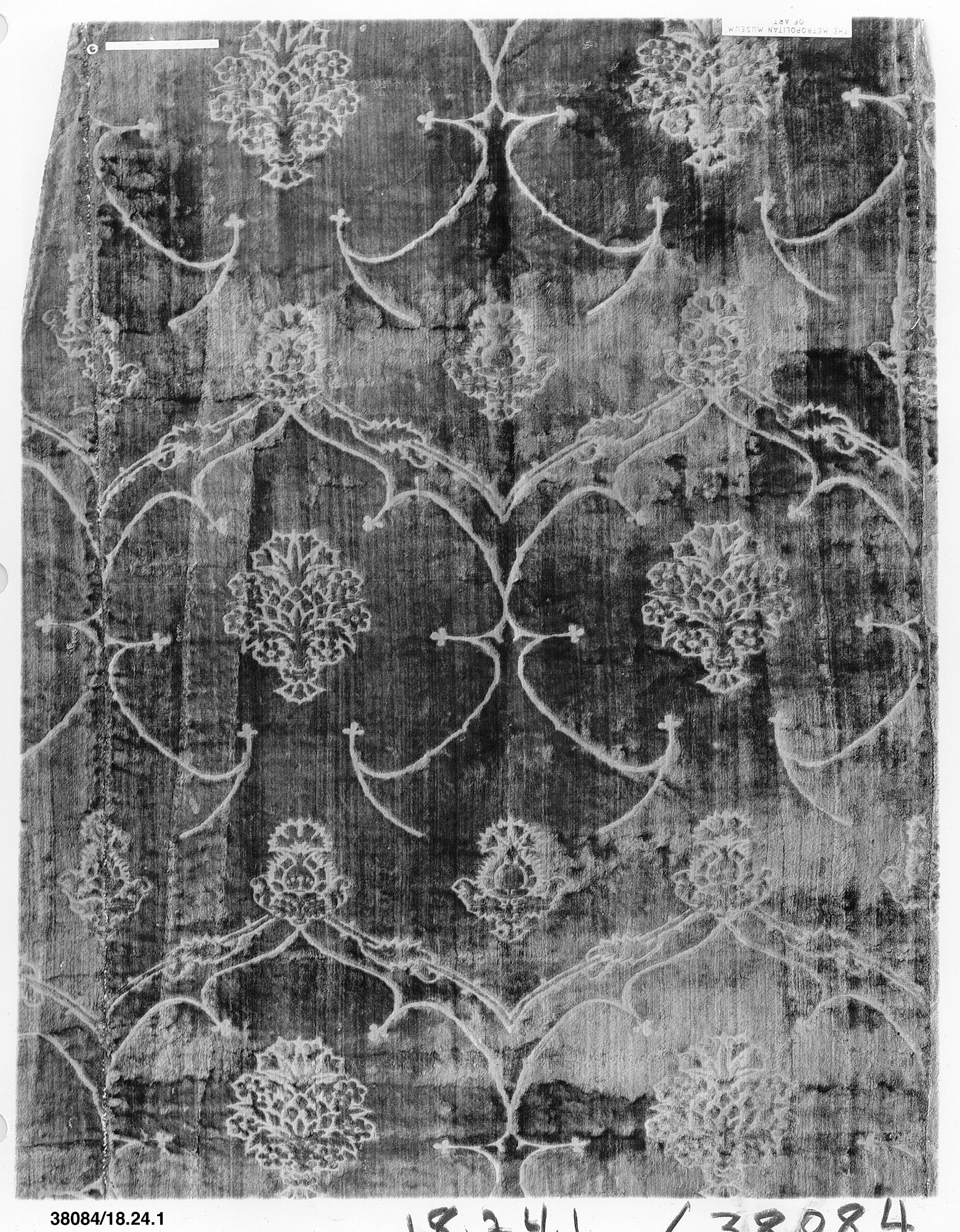
Italian velvet makers developed a taxonomy of techniques that remains the standard for couture analysis today. Voided velvet (or velours ciselé) involves cutting away the pile in certain areas to reveal the ground weave, creating contrast between the lustrous pile and the flatter, often metallic ground. Brocaded velvet introduces supplementary weft threads—gold or silver—that float across the surface, adding a layer of illumination that shifts with the wearer’s movement. Figured velvet uses multiple pile heights to create sculpted imagery, often heraldic or botanical. The most complex, velours à la reine, combined all three techniques in a single panel.
This technical hierarchy had a direct social corollary. In Renaissance Italy, sumptuary laws restricted velvet to specific classes and occasions. In Venice, only the Doge and certain magistrates could wear crimson velvet. In Florence, the Arte della Seta (Silk Guild) enforced quality standards so rigorously that a single flaw in a bolt could result in the public destruction of the entire loom’s output. Velvet was not just a luxury; it was a regulated instrument of statecraft.
From Italian Workshops to Global Couture
The decline of Italian velvet dominance began in the seventeenth century, as French Huguenot weavers established rival centers in Lyon and Tours. Yet the Italian legacy persists in the vocabulary of haute couture. The terms ferro, velluto, and alto e basso remain in use. More importantly, the Italian model of velvet production—integrating sericulture, dye chemistry, loom technology, and guild regulation into a single vertically integrated system—became the template for every subsequent luxury textile industry, from Lyon to Krefeld to Kyoto.
In contemporary couture, velvet has undergone a cyclical revival. When designers such as Fortuny in the early twentieth century or, more recently, houses like Dolce & Gabbana and Valentino seek to evoke historical depth and tactile opulence, they return to Italian velvet. The material’s unique property—its ability to absorb light and then release it in a soft, directional glow—remains unmatched. A silk velvet from a modern Italian mill like Taroni or Bevilacqua, still using modified drawlooms, carries a weight and drape that no synthetic pile can replicate.
The Standalone Study: Why Velvet Matters Now
This standalone study of Italian velvet is not an exercise in nostalgia. It is a reminder that material intelligence—the deep, tactile knowledge of how a fiber behaves, how a weave structure performs, how a dye interacts with light—is the true differentiator in luxury fashion. Velvet is the most demanding of all pile fabrics. It punishes haste. It reveals every error in tension, every impurity in the silk. In an era of digital design and rapid prototyping, Italian velvet remains a stubborn, analog counterpoint: a material that cannot be rushed, cannot be faked, and cannot be fully understood without touching it. That is its power. That is its permanence.