Irish Gold Ornament: Symbolic Power, Historical Adornment, and the 2026 Luxury Mandate
Katherine Fashion Lab's ongoing research into the mirror with split-leaf ornamentation—a silver mirror face bearing gold-inlaid palm fronds, paired with a sarcophagus panel narrating life through bas-relief—has established a methodological precedent: ornament as a dual surface, simultaneously reflecting the living and memorializing the dead. Our DNA correlation study now extends this framework to Irish gold ornament, a body of material culture that predates Celtic literacy and yet speaks with unusual clarity to the symbolic and spiritual imperatives that will define high-end luxury strategy in 2026.
Historical Resonance: Gold Before Writing
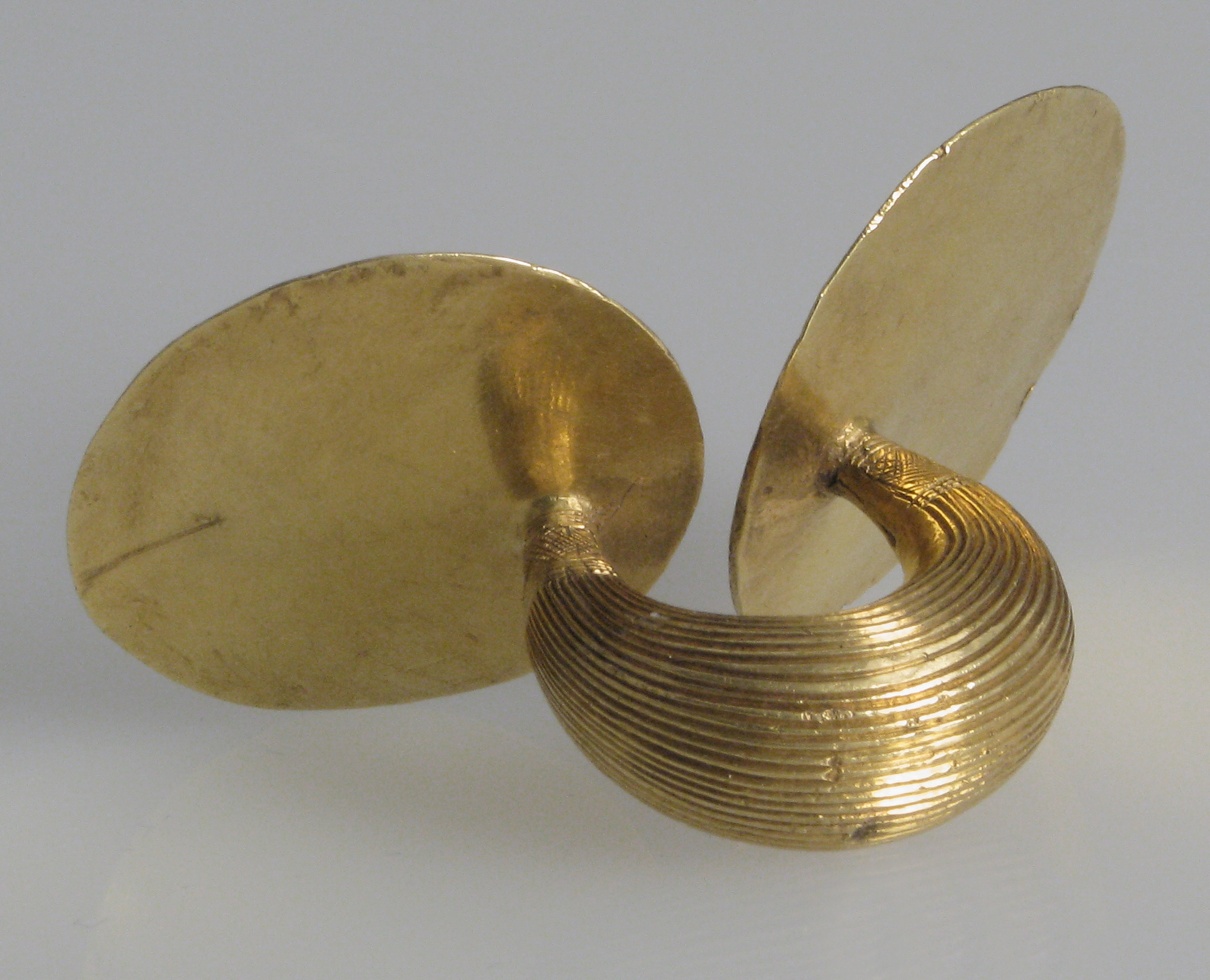
Irish goldwork of the Late Bronze Age, roughly 1200 to 600 BCE, constitutes one of Europe's most significant prehistoric gold traditions. The National Museum of Ireland holds the single largest collection of Bronze Age gold objects in Western Europe, and the reasons are geological as much as cultural. Irish alluvial gold, panned from the rivers of Wicklow and the Mourne Mountains, was unusually accessible and unusually pure. What emerged from it was not coinage, not weaponry, but ornament: lunulae, gorgets, dress fasteners, bullae, and the great gold collars that curve like crescent moons across the chest.
The lunula is the defining form. A thin sheet of gold hammered to a crescent, decorated with engraved geometric patterns—chevrons, crosses, lozenges, arcs—it is simultaneously a necklace, a status marker, and a cosmological statement. Approximately eighty lunulae survive across Europe; the majority were found in Ireland. Their distribution suggests manufacture in a small number of workshops, likely in the north and west, followed by deliberate deposition rather than everyday wear. These were not accessories in the modern sense. They were objects made to be given, buried, or offered to water.
Symbolic Power: The Grammar of Geometric Adornment
Irish gold ornament operates through a restrained visual vocabulary. The engraved motifs on lunulae and gorgets are not representational. There are no figures, no animals, no narrative scenes of the kind found in Scandinavian rock art or Mediterranean metalwork. Instead there is repetition: chevrons stacked in registers, lozenges aligned along an axis, arcs echoing the curve of the object itself. This is ornament as structural logic rather than decoration.
The symbolic force of this approach lies in its abstraction. A chevron is a wave, a mountain, a movement, a threshold. A lozenge is a field, a boundary, a seed. In the absence of written testimony, these forms function as a visual grammar that any member of the culture could read, and that we can still partially reconstruct. The gold itself carries meaning: it does not tarnish, it does not corrode, it holds light. In a society without temples or monumental stone architecture, gold ornament was the primary medium for expressing permanence and sacred value.
Spiritual Meaning: Deposition, Water, and the Otherworld
The archaeological record is unambiguous on one point: Irish gold ornaments were frequently deposited in water. Rivers, lakes, bogs, and fords yielded the majority of surviving lunulae and gorgets. This pattern aligns with a broader European Bronze Age practice of votive deposition, but the Irish expression is distinctive in its concentration on personal ornament rather than weapons or tools.
The spiritual logic appears to be one of exchange. Gold, drawn from the earth through the labor of panning, was returned to the earth through water—the liminal zone between the human world and the Otherworld in later Irish mythology. The ornament was not lost; it was given. This reading is supported by the condition of many recovered pieces, which show little or no wear. They were made for the offering, not for a lifetime of use. In this sense, the Irish lunula anticipates the logic of the sarcophagus panel in our split-leaf mirror study: an object whose primary function is to carry meaning across a threshold, from the visible to the invisible.
2026 Luxury Strategy: Ornament as Consequence, Not Decoration
The strategic lesson for Katherine Fashion Lab is precise. Irish gold ornament did not decorate a pre-existing form; it was the form. The lunula is not a necklace with patterns on it. The patterns are the necklace. This integration of structure and symbol is the opposite of contemporary luxury's default mode, in which ornament is applied to a base object as a finishing gesture.
For 2026, we recommend a design and communications strategy built on three principles derived from the Irish material:
First, geometric abstraction over figuration. The luxury consumer of 2026 is saturated with narrative imagery. Irish goldwork offers an alternative: motifs that are legible without being literal, that reward repeated viewing, and that function as proprietary brand codes when developed consistently across categories.
Second, material honesty. Irish goldsmiths worked in gold because gold carried meaning, not because it signaled expense. Our 2026 collections should treat material choice as a semantic decision. Where gold appears, it should appear because the object requires permanence and light, not because the price point demands it.
Third, ritual over retail. The deposition of Irish gold ornaments reveals a culture in which the finest objects were made for giving, not for keeping. Luxury in 2026 will increasingly be judged by what it enables the wearer to mark: a transition, a commitment, a threshold. Ornament designed for such moments acquires a value that no amount of surface decoration can replicate.
The split-leaf mirror and the Irish lunula belong to the same argument. Both are objects in which ornament is not a layer upon a surface but the surface itself. Both are designed to hold meaning across a boundary. Katherine Fashion Lab's 2026 strategy should proceed on that basis: ornament as consequence, not decoration.