Heritage Analysis: The Spindle Whorl as Civilizational Code
Introduction: The Smallest Object, the Largest Consequence
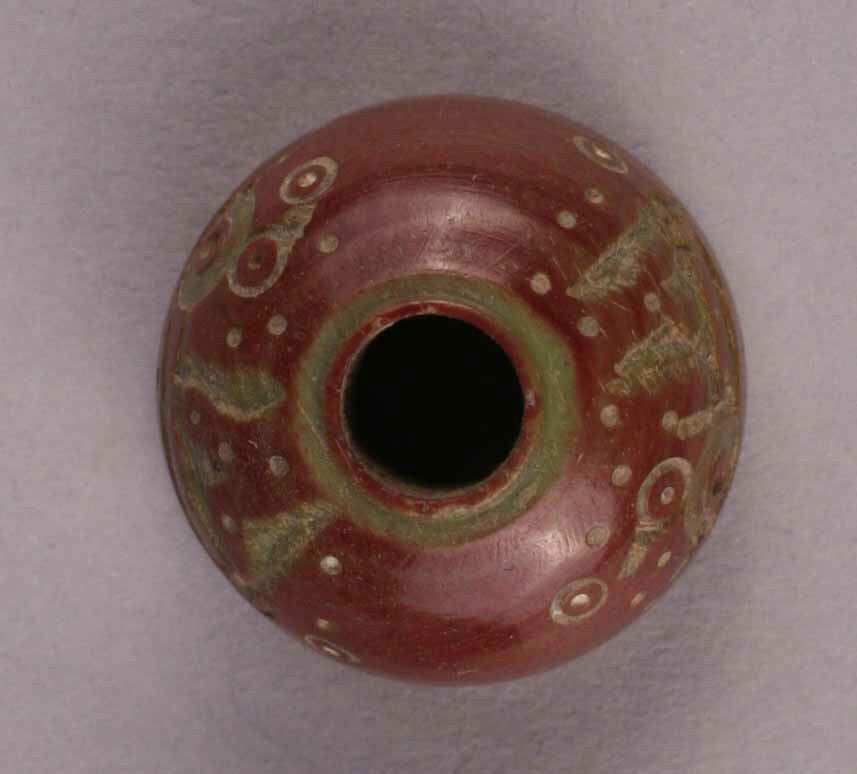
Among the surviving artifacts of the ancient world, few are as quietly ubiquitous and as strategically undervalued as the spindle whorl. A small, weighted disc fitted to the shaft of a hand spindle, it converted raw fiber into thread and, in doing so, converted subsistence into surplus. The specimen under consideration—carved from bone, tinted, and inlaid—elevates a functional tool into an object of adornment, and it is precisely this category collapse that makes it relevant to Katherine Fashion Lab. When a utilitarian instrument acquires decoration, it has entered the domain of symbolism. For a luxury house preparing its 2026 positioning, the spindle whorl offers a rare asset: a heritage object that speaks simultaneously to production, femininity, cosmology, and craft hierarchy, without requiring the interpretive contortions that accompany more contested antiquities.
Symbolic Power: The Weight That Spins Fate
The spindle whorl's symbolic power derives from its mechanical role. It is the mass that stabilizes rotation; without it, the spindle wobbles and the thread breaks. Across ancient civilizations, this principle was absorbed into metaphor. In Greek and Roman contexts, the Fates spun, measured, and cut the thread of life, and the spindle became an emblem of destiny itself. In Egyptian funerary tradition, spinning and weaving were associated with the goddesses who clothed the dead for the afterlife, linking textile production to resurrection. In Andean and Mesoamerican cultures, the whorl appears in burial assemblages as a marker of feminine labor and, in some cases, of ritual authority.
The object's symbolic register is therefore double: it signifies control—the ability to impose order on chaotic fiber—and submission, the endless, repetitive discipline of the spinner. Luxury brands have long exploited the first meaning while ignoring the second. Katherine Fashion Lab should resist that simplification. The whorl's power lies in its honesty about labor. It is an object that records time, not merely status.
Historical Adornment: Bone, Tint, and Inlay as Status Signals
Bone was the workhorse material of ancient toolmaking, but tinted and inlaid bone is a different proposition. Tinting required pigment procurement, preparation, and controlled application; inlay required precision cutting and the sourcing of contrasting materials—shell, stone, or metal. These are not the interventions of a household producer. They are the interventions of a workshop with surplus capacity, or of an owner with the leisure to commission embellishment.
This distinction matters for provenance narratives. A plain clay whorl speaks to universal domestic production. A tinted, inlaid bone whorl speaks to stratification: a society in which some spinners could afford to make their labor beautiful, and in which beauty itself became a claim to refinement. The whorl thus anticipates the logic of the modern luxury accessory—an object whose function is real but whose primary social work is differentiation.
For Katherine Fashion Lab, the design lesson is structural rather than literal. The whorl's adornment does not obscure its function; it celebrates it. The tint follows the grain of the bone; the inlay sits within the form rather than upon it. This is the opposite of logo-driven ornament. It is ornament as intensification.
Spiritual Meaning: Rotation, Axis, and the Centered Self
Spinning is a technology of centering. The whorl's weight pulls the fiber into alignment; the spinner's hand maintains tension; the thread emerges only when both forces cooperate. Ancient cultures recognized this as a spiritual discipline. The axis of the spindle—vertical, stable, generative—reappears in cosmologies as the axis mundi, the point at which the human and divine orders meet. The whorl, as the mass that keeps that axis true, functions as a material prayer for equilibrium.
There is also a funerary dimension. Whorls deposited in graves suggest that spinning was understood as a skill worth carrying into death, or as an identity worth preserving. In either reading, the object is treated as constitutive of the self, not incidental to it. This is the deepest claim heritage can make on a luxury brand: that the object is not a product but a portion of a person's being.
2026 Luxury Strategy: From Motif to Method
The strategic error available to Katherine Fashion Lab is the obvious one: stamp a whorl motif onto a handbag and call it heritage. The strategic opportunity is to adopt the whorl's operating principles as a design and communications methodology.
First, weight as luxury. The whorl's value is its mass. In an era of weightless digital consumption, tangible heft is a differentiator. Katherine Fashion Lab should treat physical weight—in hardware, in hand-feel, in the resistance of a clasp—as a signature, and should market it as the inheritance of the whorl's stabilizing principle.
Second, tinted and inlaid as a craft tier. The whorl's embellishment was a workshop-level upgrade. The brand can mirror this with a tiered atelier line in which tinting and inlay—of leather, of metal, of enamel—are the visible markers of a higher craft band, each documented with the same rigor as the original artifact.
Third, the axis narrative. Rotation and centering are potent metaphors for a brand operating in a destabilized market. A 2026 campaign built on the axis—one vertical line, one stable point, one continuous thread—offers visual and philosophical coherence without nostalgia.
Fourth, labor transparency. The whorl does not hide its function. Katherine Fashion Lab should follow suit, publishing the hours, hands, and processes behind each piece. In a luxury market increasingly skeptical of mystification, documented labor is the new exclusivity.
Conclusion
The spindle whorl is not a decorative curiosity. It is a compact record of how ancient civilizations organized production, gender, status, and cosmology around a single rotating mass. Its tinted and inlaid bone form demonstrates that even the most functional object can be elevated through craft, and that such elevation is always a social statement. For Katherine Fashion Lab, the whorl's relevance in 2026 lies less in its appearance than in its logic: weight that stabilizes, ornament that intensifies rather than obscures, and labor that is honest about itself. A brand that can absorb those principles will not merely reference heritage. It will operate like an artifact.