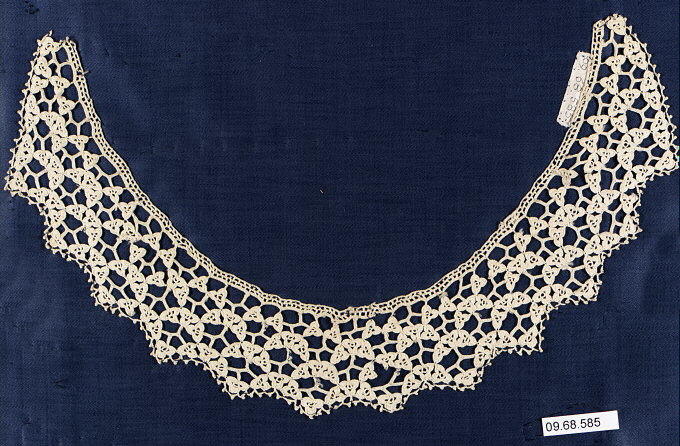
The Collar as Structural Protagonist: A Global Heritage Study in Crochet
Within the architecture of dress, few elements carry as much semiotic weight as the collar. It frames the face, governs the posture, and historically signaled rank, vocation, and cultural belonging long before it became a vehicle for avant-garde experimentation. At Katherine Fashion Lab, our standalone study of the collar examines this liminal garment component not as an accessory but as a structural protagonist. When executed in crochet—a textile technique born of domestic necessity and elevated through centuries of global heritage—the collar becomes a site of tension between softness and form, intimacy and armor, tradition and reinvention.
Historical Provenance: From Utility to Insignia
The collar's lineage is global and deeply stratified. In Renaissance Europe, the ruff evolved from a practical undergarment edge into a starched emblem of aristocratic excess, requiring starch, wire, and servants to maintain its geometry. Concurrently, in the Andean highlands, woven and looped collars served as protective layers against altitude and climate, encoding community identity through motif and color. In West Africa, the agbada's embroidered neckline communicated status and lineage, while in East Asia, the mandarin collar imposed a disciplined verticality that read as both restraint and dignity. Crochet enters this narrative later—emerging in 19th-century Europe but rapidly appropriated across cultures—yet its looped, knotless structure echoes far older techniques such as nalbinding and shepherd's knitting. The crochet collar therefore inherits a dual legacy: the precision of European lace and the communal, hand-driven rhythm of indigenous textile practices worldwide.
Material Logic: Why Crochet Reframes the Collar
Crochet is uniquely suited to collar construction because it is additive and modular. Unlike cut-and-sewn fabric, which requires darting and seam allowance, crochet builds shape stitch by stitch, allowing the maker to sculpt a curve, a point, or a scalloped edge with mathematical intent. The technique's inherent elasticity permits the collar to conform to the neck while retaining a crisp perimeter—a paradox that renders it ideal for both structural stand collars and fluid Peter Pan iterations.
At Katherine Fashion Lab, we treat yarn choice as a design decision with equal weight to silhouette. Mercerized cotton yields a lustrous, almost architectural finish suitable for evening collars; undyed linen introduces a matte, archaeological quality; silk-blend threads allow for gossamer transparency that reads as lingerie or ceremonial vestment depending on context. The gauge—the number of stitches per inch—determines whether the collar behaves as a rigid ring or a soft drape. This material intelligence is central to our thesis: crochet is not a decorative afterthought but a load-bearing textile system.
Global Heritage as Design Lexicon
Our study draws on three distinct crochet collar traditions, each reinterpreted through a contemporary couture lens.
Irish Crochet (19th Century, Ireland): Developed during the Great Famine as a means of economic survival, Irish crochet is characterized by detached motifs—roses, shamrocks, grapes—joined by a mesh ground. Applied to collars, this technique creates a three-dimensional, sculptural surface that sits away from the neck. For Katherine Fashion Lab, we isolate the motif and re-scale it, allowing a single oversized rose to anchor an otherwise minimal stand collar, thereby collapsing the distance between folk craft and sculptural abstraction.
Oya (Turkey and the Levant): Oya is a needle lace tradition in which floral edges carry coded messages—love, grief, jealousy. Though technically needle lace rather than crochet, its border logic informs our crochet interpretation: a collar whose scalloped edge functions as a sentence. We translate oya's narrative density into a monochrome cotton collar where the pattern of increases and decreases spells a private text visible only to the wearer. This is semiotic couture—garment as encrypted archive.
Amigurumi and Andean Loop Structures (Japan and Peru): While amigurumi is a Japanese term for crocheted stuffed figures, its tight, dense single-crochet spiral provides a structural model for collars that hold their shape without interfacing. We adapt this density to create a tubular stand collar that requires no boning, its rigidity emerging from stitch tension alone. Simultaneously, we reference Andean looped textiles, where the direction of the loop encodes gender and community, by alternating loop orientation to create a subtle directional sheen across the collar's surface.
Construction and Couture Application
In our atelier, each crochet collar begins as a hand-drawn diagram—a stitch map that specifies not only the silhouette but the behavior of every row. We prototype in cotton before executing in final yarn, testing the collar against three variables: neck circumference, shoulder slope, and garment weight. A collar that reads as delicate on a silk chiffon blouse may appear insubstantial on a wool coat; conversely, a dense crochet collar can overwhelm a lightweight dress. This calibration is the difference between a craft object and a couture component.
Finishing techniques are equally deliberate. We block aggressively—pinning and steaming the crochet into its final geometry—to ensure the collar retains its shape after wear. Where a collar meets the garment, we use a hand-stitched picot edge rather than a machine seam, allowing the crochet to transition into fabric without visual interruption. For detachable collars, we employ mother-of-pearl buttons or silk ribbons, treating the fastening as a design feature rather than a hidden necessity.
The Collar as Standalone Study
By isolating the collar from the garment, Katherine Fashion Lab asserts that this component deserves autonomous critical attention. A crochet collar is not merely a neckline treatment; it is a portable heritage artifact, a demonstration of structural engineering, and a canvas for global narrative. It can be worn as a statement piece over a plain shirt, framed as a textile object, or integrated into a larger couture ensemble where its handcrafted irregularity challenges the uniformity of industrial fashion.
Our standalone study concludes that the crochet collar occupies a unique position: it is simultaneously protective and ornamental, historical and contemporary, local and global. In an industry preoccupied with novelty, the crochet collar reminds us that heritage is not nostalgia—it is a living vocabulary. At Katherine Fashion Lab, we continue to conjugate that vocabulary, one stitch at a time.