Abstract
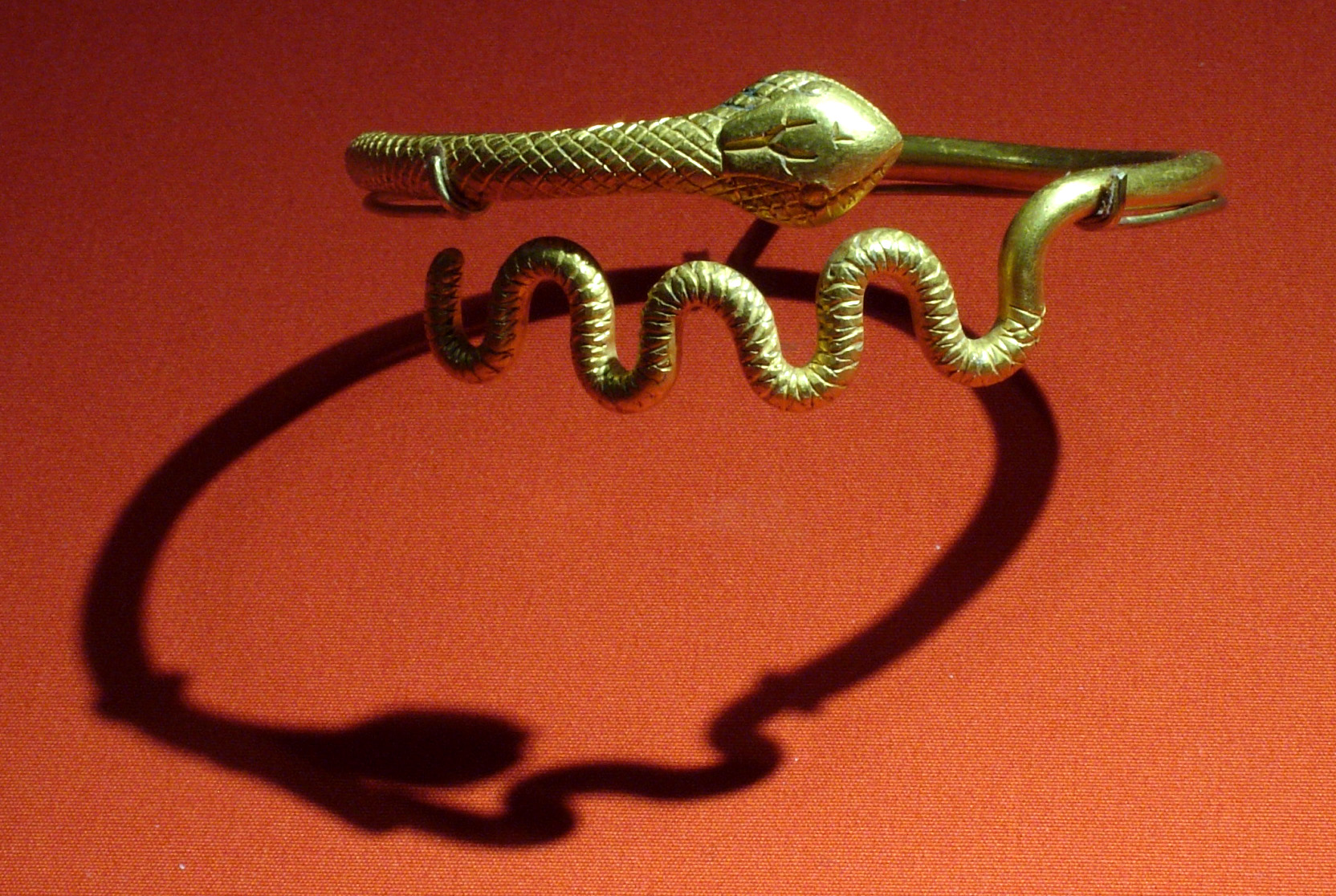
This heritage analysis examines the snake bracelet as a recurring artifact across ancient civilizations, with particular attention to its gold manifestations in Egyptian, Hellenistic, and Roman contexts. The study positions this object within the broader symbolic economy of luxury adornment, tracing how serpentine forms encoded sovereignty, regeneration, and spiritual guardianship. Drawing a direct DNA correlation with Katherine Fashion Lab's prior research on Mirror with Split-Leaf—where one face presents a polished silver mirror inlaid with golden palm fronds while the reverse narrates life through sarcophagus relief—this paper argues that the snake bracelet operates on an identical dual logic: surface luminosity concealing and revealing deeper existential narrative. The analysis concludes with a strategic framework for 2026 high-end luxury positioning.
Historical Provenance and Material Authority
Ancient Egyptian Origins
The gold snake bracelet emerges most prominently in the Egyptian Old Kingdom through the uraeus, the rearing cobra emblem worn by pharaohs as a sign of divine authority. Crafted in electrum and high-karat gold, these bracelets were not merely ornaments but instruments of statecraft. The serpent's body, coiled around the wrist, enacted a perpetual embrace of protection. Gold's resistance to tarnish carried metaphysical weight: it was considered the "flesh of the gods," a material that refused decay and therefore refused death.
Hellenistic and Roman Diffusion
Alexander's conquests transmitted Egyptian serpent iconography into Hellenistic jewelry workshops, where goldsmiths refined the form into the ophis bracelet—often with gemstone eyes and granulated scales. Roman expansion further democratized the motif, though its elite iterations retained strict material hierarchies. A first-century Roman gold snake bracelet from Pompeii, for instance, demonstrates the technical mastery of repoussé and filigree, transforming the serpent into a wearable cosmogram. The spiral of the snake around the arm mirrored the spiral of time, the ouroboros logic of renewal.
Symbolic Power: Sovereignty, Healing, and the Liminal
The Serpent as Sovereign Signifier
Across these civilizations, the snake bracelet functioned as a portable throne. To wear it was to claim proximity to regenerative power. The Egyptian pharaoh wore the uraeus to signal that his rule was sanctioned by Wadjet, the cobra goddess of Lower Egypt. The Hellenistic monarch adopted the ophis to align with Asclepius, god of healing, thereby framing political authority as therapeutic governance. In both cases, the bracelet's gold surface performed a double duty: it reflected light, drawing the eye, while its coiled form suggested hidden depth—a reserve of power not fully disclosed.
Spiritual Meaning and the Mirror Logic
Here the DNA correlation with Mirror with Split-Leaf becomes analytically productive. That artifact presents a silver mirror face inlaid with golden palm fronds—a surface of self-reflection adorned with symbols of victory and eternity—while its reverse bears sarcophagus relief narrating the passage from life to death. The snake bracelet inverts but preserves this structure. Its outer surface is the gold mirror: polished, luminous, socially legible. Its inner meaning is the sarcophagus: the serpent as psychopomp, guide of souls, guardian of the threshold between worlds. The wearer thus carries a split-leaf logic on the wrist—public radiance on one side, private eschatology on the other.
Historical Adornment and Craft Continuity
The technical lineage of the gold snake bracelet reveals a remarkable continuity of workshop knowledge. Egyptian goldsmiths developed cloisonné and granulation techniques that Hellenistic artisans adapted into naturalistic scale patterns. Roman jewelers introduced articulated joints so the snake could move with the wearer's arm, transforming the bracelet from static emblem to kinetic companion. This kinetic dimension is critical for luxury strategy: the object does not merely sit on the body; it responds to it. The snake bracelet is an early instance of what we might call responsive adornment—jewelry that participates in the wearer's motion and, by extension, the wearer's identity.
2026 High-End Luxury Strategy
From Artifact to Archetype
Katherine Fashion Lab's 2026 positioning should treat the snake bracelet not as a historical curiosity but as an archetypal luxury object with three strategic pillars. First, material integrity: gold remains the non-negotiable medium, but its treatment should reference ancient alloying knowledge—22-karat warmth, hand-finished patina, granulated scales. Second, narrative duality: each piece should ship with a split-leaf provenance card, one side documenting the mirror surface (craft, luminosity, public meaning) and the other the sarcophagus surface (symbolic lineage, spiritual function, private meaning). Third, kinetic ritual: the bracelet must articulate, move, and settle on the wrist as a daily act of adornment that echoes ancient practice.
Market Positioning and Client Psychology
The 2026 luxury client is not purchasing protection from cobra goddesses, but they are purchasing symbolic density. In a market saturated with logo-driven minimalism, the snake bracelet offers a counter-positioning: maximal meaning, minimal noise. It appeals to the collector who reads objects the way curators read archives. Pricing strategy should reflect scarcity of technique—limited annual production, named goldsmiths, archival documentation—rather than scarcity of materials alone.
Conclusion
The gold snake bracelet is a civilizational artifact that has never lost its symbolic charge. Its DNA—sovereignty, healing, liminality, and kinetic response—correlates precisely with the split-leaf logic of the mirror and sarcophagus: surface and depth, reflection and narrative, life and what lies beyond. For Katherine Fashion Lab, the strategic opportunity in 2026 is to reactivate this heritage not as pastiche but as living luxury—gold that coils, light that reflects, and meaning that endures.