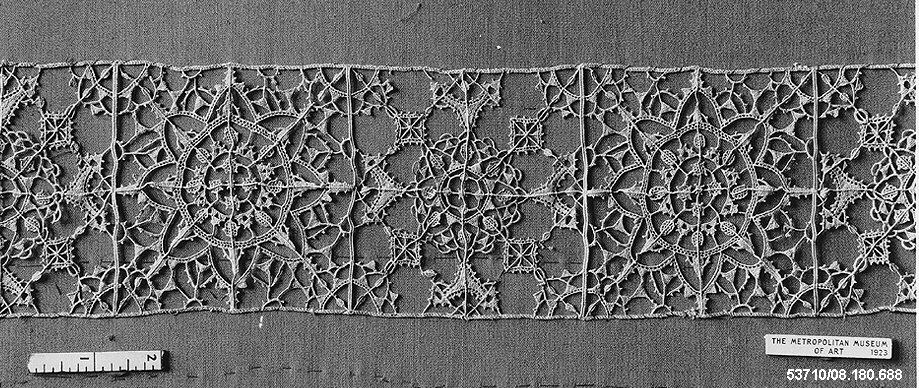
Heritage Analysis: The Border as Artifact and Asset in Needle Lace
Introduction: The Border as Civilizational Threshold
Within the material record of ancient civilizations, the border occupies a paradoxical position: it is both the outermost layer and the most intimate boundary. Unlike the central field of a textile, which often served utilitarian or broadly decorative ends, the border was charged with the task of containment, demarcation, and protection. In needle lace traditions traceable to the earliest stratified societies of the Mediterranean basin, the Nile Valley, and the Andean highlands, the border functioned as a liminal zone where the wearer's body met the external world. For Katherine Fashion Lab, this distinction is not antiquarian. It is a strategic entry point into a luxury market increasingly defined by provenance, narrative density, and the scarcity of genuine handwork.
Symbolic Power: The Apotropaic Edge
The symbolic architecture of the needle lace border rests on a single, durable premise: the edge is vulnerable, and therefore the edge must be fortified. In ancient Egyptian funerary textiles, borders of knotted and looped thread were applied to the hems of linen shrouds to seal the body against dissolution. The knot—the foundational unit of needle lace—was understood as a binding agent, a physical manifestation of intention that could not be undone by decay. Similarly, in pre-Columbian Andean cultures, the randa or border edging of ceremonial cloths was often worked in contrasting colors, creating a visual alarm system that signaled the presence of the sacred.
This apotropaic function—the capacity to ward off harm—transformed the border from a mere finishing technique into a spiritual technology. The maker's needle became an instrument of protection, and the resulting lace a wearable talisman. For a contemporary luxury house, this symbolic density is not folklore. It is intellectual property. It differentiates a border from a hem, a garment from a commodity.
Historical Adornment: From Utility to Hierarchy
As ancient civilizations stratified, the needle lace border became a marker of rank. In the Bronze Age Aegean, fresco evidence suggests that borders of looped and twisted thread were reserved for priestly and aristocratic vestments, while coarser woven edges served the general population. The technical difficulty of needle lace—requiring a single continuous thread, a fine needle, and hundreds of hours of manual dexterity—created a natural barrier to entry. Scarcity of skill produced scarcity of object, and scarcity of object produced social distance.
By the classical period, the border had evolved into a semiotic system. A gold-threaded lace edge on a chiton denoted civic status. A double row of knotted lace on a funerary urn's textile wrapping indicated lineage. The border was no longer merely protective; it was declarative. It spoke before the wearer did. This historical precedent establishes a direct line to 2026 luxury strategy: the modern consumer does not purchase protection from evil spirits, but they do purchase protection from anonymity. The needle lace border, properly positioned, offers precisely that.
Spiritual Meaning: The Knot as Prayer
In several ancient traditions, the act of knotting during lace-making was accompanied by recited prayer or mantra. Each knot corresponded to a breath, a name, or a petition. The border, therefore, was not a static ornament but a recorded sequence of devotional acts. This is a critical distinction for heritage strategy. The value of the object is not merely in its appearance but in its embedded time and intention. A border of two thousand knots is a border of two thousand prayers. No machine can replicate this ontology.
For Katherine Fashion Lab, this spiritual dimension offers a narrative framework that transcends aesthetics. In a luxury landscape saturated with digital fabrication and algorithmic design, the needle lace border reintroduces irreducible human presence. It cannot be scaled. It cannot be rushed. It cannot be fully automated. These limitations, once viewed as inefficiencies, are now the very definition of high-end value.
2026 Luxury Strategy: The Border as Brand Architecture
Looking toward 2026, the high-end market is shifting from logo-centric visibility to material-centric integrity. The consumer of the next luxury cycle is not seeking a monogram; they are seeking a provenance chain. The needle lace border, with its ancient lineage and spiritual density, provides exactly that. Katherine Fashion Lab can deploy the border in three strategic registers:
First, as a signature device. A consistent, recognizable border treatment—perhaps a specific knot density or thread twist—can function as a house code, more subtle and more defensible than a logo. Second, as a sustainability narrative. Needle lace is inherently slow, low-energy, and biodegradable. It aligns with the luxury sector's pivot toward regenerative practices without sacrificing exclusivity. Third, as a storytelling asset. Each border carries a documented origin, a maker's mark, and a symbolic register. This is the raw material of content, authentication, and collector desire.
Conclusion: The Edge as Center
The border has always been the most charged zone of the textile. In ancient civilizations, it protected, ranked, and prayed. In the 2026 luxury context, it can differentiate, authenticate, and enchant. For Katherine Fashion Lab, the strategic imperative is clear: move the border from the periphery of design to the center of brand architecture. The needle lace border is not a trim. It is a thesis—a statement that the most valuable part of a garment is the part that meets the world.