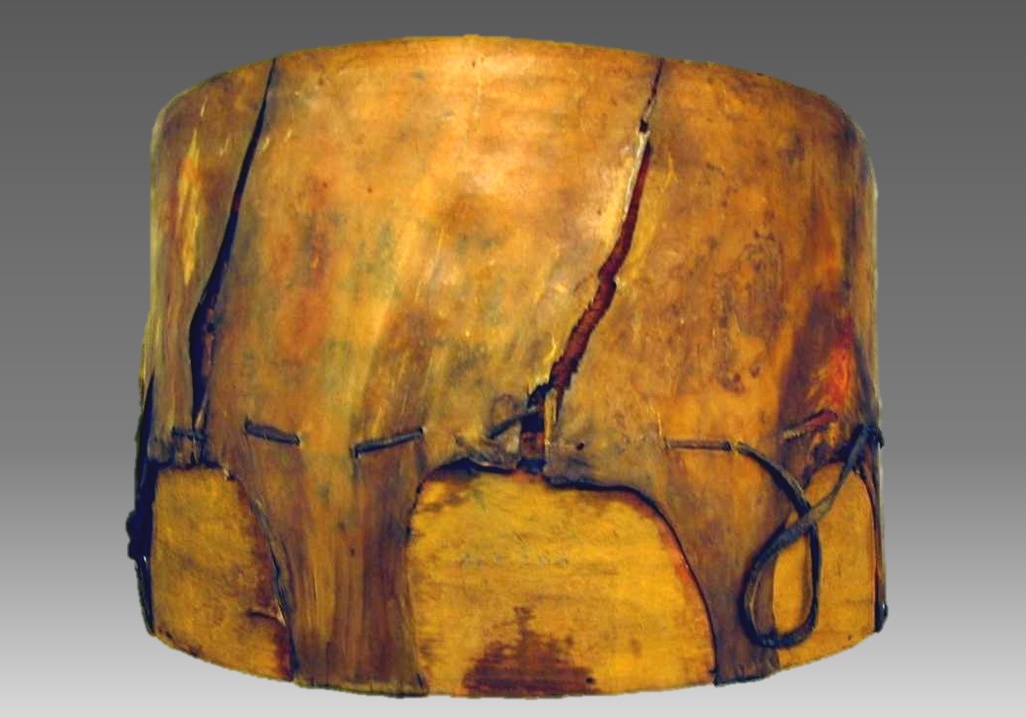
Frame Drum: A Couture Analysis of Indigenous Resonance
In the lexicon of contemporary fashion, the frame drum—particularly as manifested within the Shoshone tradition—occupies a liminal space between artifact and archetype. At Katherine Fashion Lab, our standalone study of this instrument reveals a profound sartorial intelligence: a construction logic that predates modern pattern-cutting yet anticipates its most sophisticated principles. The Shoshone frame drum, typically fashioned from ash wood and sheepskin, is not merely a musical device. It is a wearable architecture of sound, a circular garment stretched over a resonant frame, and a masterclass in material honesty. This analysis positions the drum as a couture object, examining its materiality, structural engineering, and cultural semiotics through the lens of high fashion practice.
Materiality: Ash Wood and Sheepskin as Textile Analogues
The selection of ash for the drum’s hoop demonstrates an intuitive understanding of grain orientation and tensile memory—principles that underpin every couture corset and bias-cut gown. Ash, with its open, ring-porous structure, offers a rare combination of elasticity and rigidity. When steam-bent into a circular frame, the wood retains a dynamic tension, much like a well-blocked felt hat or a hand-rolled hem. The Shoshone artisan does not merely shape the wood; they converse with it, reading its growth rings as a tailor reads the nap of velvet. In couture terms, the ash hoop functions as a structural boning—invisible yet essential, providing the silhouette upon which the skin is stretched.
Sheepskin, by contrast, introduces the tactile dimension of the garment. Rawhide or semi-tanned sheepskin possesses a variable density that mimics the drape of leather or the resilience of a double-faced wool. Its surface, when cured, reveals a subtle grain—a natural patina that no synthetic textile can replicate. The choice of sheepskin over, say, deer or elk, speaks to a specific haptic register: softer than buffalo, more forgiving than moose, it invites the hand to test its tension. In a couture atelier, this would be the equivalent of selecting a lambskin for a glove—material that must both protect and transmit sensation. The drumhead, therefore, is not a membrane but a second skin, one that vibrates with the memory of the animal and the intention of the maker.
Structural Engineering: The Circle as Couture Silhouette
The frame drum’s geometry is deceptively simple: a circle, a stretched surface, a lacing system. Yet within this economy lies a sophisticated load-bearing design. The Shoshone drum typically employs a wet-stretching technique, where the sheepskin is soaked and then lashed across the ash hoop using sinew or hide glue. As the skin dries, it contracts, creating a uniform tension across the diameter. This is analogous to the couture technique of “shrinking” a fabric onto a form—think of a bias-cut silk charmeuse gown that clings to the body through its own internal stresses rather than darts or seams.
The lacing pattern, often a zigzag or star-like configuration, serves both function and ornament. In fashion terms, this is the visible stitching—the topstitch, the pick stitch, the hand-rolled hem—that signals the maker’s hand. Each crossing of the sinew is a decision point, a place where tension is distributed and balanced. A poorly laced drum will warp; a well-laced drum will sing. Similarly, a couture garment’s integrity depends on the even distribution of stress across seams, gathers, and tucks. The Shoshone drummaker, like the couturier, is an engineer of forces invisible to the eye but felt in the hand and heard in the air.
Moreover, the drum’s depth—the width of the ash hoop—determines its pitch and projection. A shallow frame yields a bright, articulate tone; a deep frame produces a resonant, low hum. This is directly comparable to the relationship between a garment’s volume and its movement. A slim, structured jacket communicates precision; a voluminous opera coat communicates grandeur. The drummaker’s choice of hoop depth is a compositional decision, a way of tuning the object’s voice just as a designer tunes a collection’s silhouette.
Cultural Semiotics: The Drum as Wearable Cosmology
In Shoshone tradition, the frame drum is not a standalone object. It is held in the hand, rested on the knee, or suspended from the neck—always in contact with the body. This intimacy transforms the drum into a form of adornment, a ritual garment that mediates between the human and the spiritual. The circular shape evokes the sun, the moon, the cycle of seasons, and the hoop of community. To wear or hold such a drum is to don a cosmology. In couture, we speak of “wearable art,” but the Shoshone drum predates that term by centuries. It is a garment of sound, a portable altar, a second heartbeat.
The sheepskin, once stretched, becomes a canvas for both vibration and symbolism. Among some Shoshone bands, the drumhead may be painted with ochre, charcoal, or berry dyes—geometric motifs that echo beadwork or quillwork. These painted surfaces are not decorative in the Western sense; they are mnemonic devices, recording songs, lineages, or ceremonial protocols. In fashion, this corresponds to the embroidered narrative—the hand-painted silk, the beaded yoke, the printed scarf that carries a story. The drum’s surface is a textile that speaks, and its wearer becomes a curator of that speech.
Furthermore, the act of drumming—striking the sheepskin with a padded stick or the hand—introduces a performative dimension. The drum is not static; it responds to touch. This is the ultimate couture ideal: a garment that comes alive only when worn, that changes with the body’s movement. A ballgown is inert on a hanger; a frame drum is silent on a shelf. Both require a human presence to complete their purpose.
Conclusion: The Frame Drum as Couture Precedent
At Katherine Fashion Lab, we argue that the Shoshone frame drum deserves a place in the couture canon not as a curiosity but as a precedent. Its material choices—ash and sheepskin—demonstrate a sophisticated understanding of fiber, grain, and drape. Its construction—wet-stretching, lacing, tensioning—mirrors the most advanced pattern-cutting and finishing techniques. Its cultural role—wearable, resonant, narrative—anticipates the contemporary demand for fashion that is both personal and cosmological. To study the frame drum is to recognize that couture did not begin in Paris or Milan. It began wherever a human being stretched a skin over a hoop and called it a voice. The Shoshone drum is not a primitive artifact. It is a masterwork of structural textile design, and its lessons for the modern atelier are as resonant as its tone.