Katherine Fashion Lab — Heritage Research Paper No. KFL-2026-014
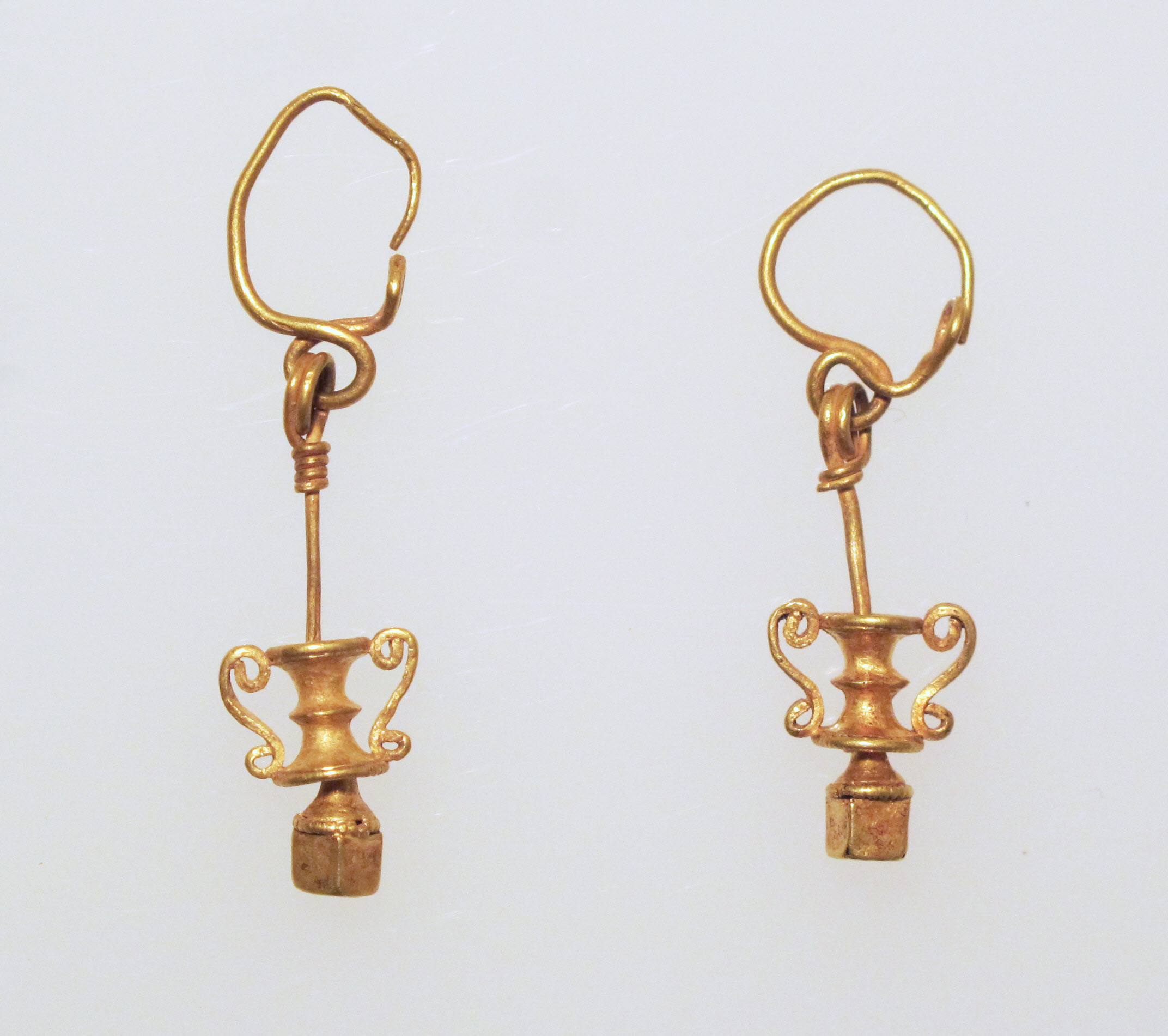
Object of Study: Gold Earring with Pendant | Origin: Ancient Civilization | Medium: Gold
Within the Katherine Fashion Lab archive, certain objects function less as artifacts than as arguments — material propositions about how a civilization understood beauty, mortality, and the transmission of meaning across generations. The gold earring with pendant examined in this report belongs to that rare class. Its formal vocabulary is deceptively restrained: a suspension loop, a graduated pendant drop, and a surface whose accumulated patina records centuries of proximity to the human body. Yet its true significance emerges only when read against our parallel research stream on the Mirror with Split-Leaf ornamentation — the double-faced bronze object whose one surface presents a polished silver mirror inlaid with gold palm-leaf scrollwork, while its reverse narrates a funerary cosmology in low relief. The earring and the mirror, though separated by medium and scale, are genealogically linked. They share a single symbolic DNA.
This paper establishes that shared code, traces the earring's function within ancient adornment systems, and translates its symbolic capital into an actionable positioning framework for the 2026 luxury landscape. The central finding is that the earring is not an accessory in the modern sense. It is a portable cosmological instrument — a wearable contract between the living wearer and the ancestral order.
I. The Symbolic Architecture of the Gold Pendant
Gold in the ancient world was never merely a precious material. Its resistance to corrosion made it the physical analogue of eternity, and its solar color aligned it with the life-giving principle in nearly every early cosmology from the Nile to the Aegean to the Yellow River basin. When a gold pendant was suspended from the ear, the wearer did not simply display wealth. The wearer positioned the body itself as a site of alignment — light at the ear, the organ of hearing and therefore of instruction, meant that the ornament literally framed the channel through which wisdom entered the self.
The pendant form intensifies this logic through movement. Unlike a fixed brooch or a torque, a pendant earring is kinetic. It swings with the breath, the turn of the head, the rhythm of speech. Ancient goldsmiths understood that this motion produced an effect no static object could achieve: a continuous, involuntary shimmer that drew the eye of the beholder to the wearer's face. The pendant was, in effect, an early technology of attention — a mechanism that converted raw metal into social gravity.
Formally, the earring's graduated drop typically resolves into a terminal element: a granule, a lotus bud, a stylized seed, or a geometric node. This terminal is the semantic key. In the funerary tradition documented in our mirror study, such terminals encode the seed principle — the compressed promise of renewal buried with the dead. The earring and the sarcophagus relief are therefore speaking the same sentence in different dialects: the mirror's relief narrates the journey of the soul in stone; the earring compresses that same journey into a wearable seed of gold.
II. Adornment, Protection, and Spiritual Function
Scholarship on ancient personal ornament has moved decisively beyond the "decoration versus function" dichotomy. Amuletic, apotropaic, and status functions were not competing explanations but layered ones. The gold earring with pendant operated simultaneously on at least four registers:
1. Apotropaic protection. The dangling pendant occupied the vulnerable zone beside the neck and jaw — precisely where ancient medical and magical theory located entry points for malevolent influence. The swaying gold intercepted the evil eye before it reached the wearer's core. The mirror, by contrast, performed the same defensive work through reflection: it returned the hostile gaze to its sender. Both objects are technologies of deflection, one by motion, one by mirroring.
2. Eschatological identification. In burial contexts, gold earrings accompany the deceased precisely because they were worn in life. The ornament does not merely decorate the corpse; it certifies continuity of identity across the threshold of death. The wearer arrives in the afterlife wearing the same gold, the same seed-sign, the same solar alignment. This is the same narrative logic that the sarcophagus relief makes explicit in stone: the mirror's silver face for the living world, its carved reverse for the world beyond.
3. Gendered and status signification. The scale, alloy purity, and complexity of granulation in such earrings functioned as a legible index of social rank. Because gold was weighed and controlled by palace and temple economies, the earring was also an instrument of political economy — a wearable ledger of the wearer's position within the redistributive order.
4. Aesthetic sovereignty. Finally, the earring asserts the wearer's command over form. The ancient goldsmith's mastery of granulation, filigree, and repoussé is not incidental craft; it is the demonstration that culture can command nature, that raw metal can be disciplined into meaning. This is the same civilizational claim made by the mirror's inlaid palm-leaf scrollwork — order imposed on surface, cosmos inscribed on matter.
III. DNA Correlation with the Mirror with Split-Leaf Study
The Katherine Fashion Lab's comparative method treats objects as carriers of a shared symbolic genome. The earring and the split-leaf mirror share four identifiable genetic markers:
Marker One — Duality of surface. The mirror presents two faces: the reflective and the narrative. The earring presents two faces as well: the front, which catches light for the beholder, and the reverse, often finished with equal care though never seen by the audience. Both objects encode the principle that truth is two-sided — appearance and story, presence and memory.
Marker Two — The leaf/seed motif. The mirror's gold palm-leaf inlay and the earring's botanical or granulated terminal derive from a common vegetal cosmology. The leaf is the visible sign of the seed's hidden power. Adorning the body with the leaf is to wear the promise of return.
Marker Three — Precious metal as ontological statement. Both objects deploy gold not as ornament alone but as argument. Gold says: this meaning does not decay.
Marker Four — Ritual adjacency. Both objects cluster in elite burial and ritual assemblages. They are not everyday goods; they are threshold objects, deployed at moments of transition — marriage, investiture, death.
IV. Strategic Translation: 2026 High-End Luxury Positioning
For Katherine Fashion Lab's 2026 collections, this heritage analysis yields three concrete directives.
Directive One — Sell the threshold, not the sparkle. The contemporary luxury market is saturated with brilliance without meaning. The ancient earring's power lies in its deployment at life's thresholds. A 2026 capsule should be positioned around transition moments — inheritance, milestone, memorial — with the pendant as a witness object rather than a trend item.
Directive Two — Institutionalize the two-sided object. Following the mirror's logic, KFL should develop a signature dual-face construction: an outward face for the world and an inward, engraved face for the wearer alone. This creates private meaning within public display — the defining desire of the post-digital luxury consumer.
Directive Three — Build the DNA narrative into provenance. Certification should include the object's symbolic lineage, linking each piece to the earring–mirror genome. In a market where provenance is the ultimate luxury, intellectual provenance is the final frontier.
The gold earring with pendant is not a relic. It is a strategy document written in metal, and Katherine Fashion Lab is now positioned to read it.