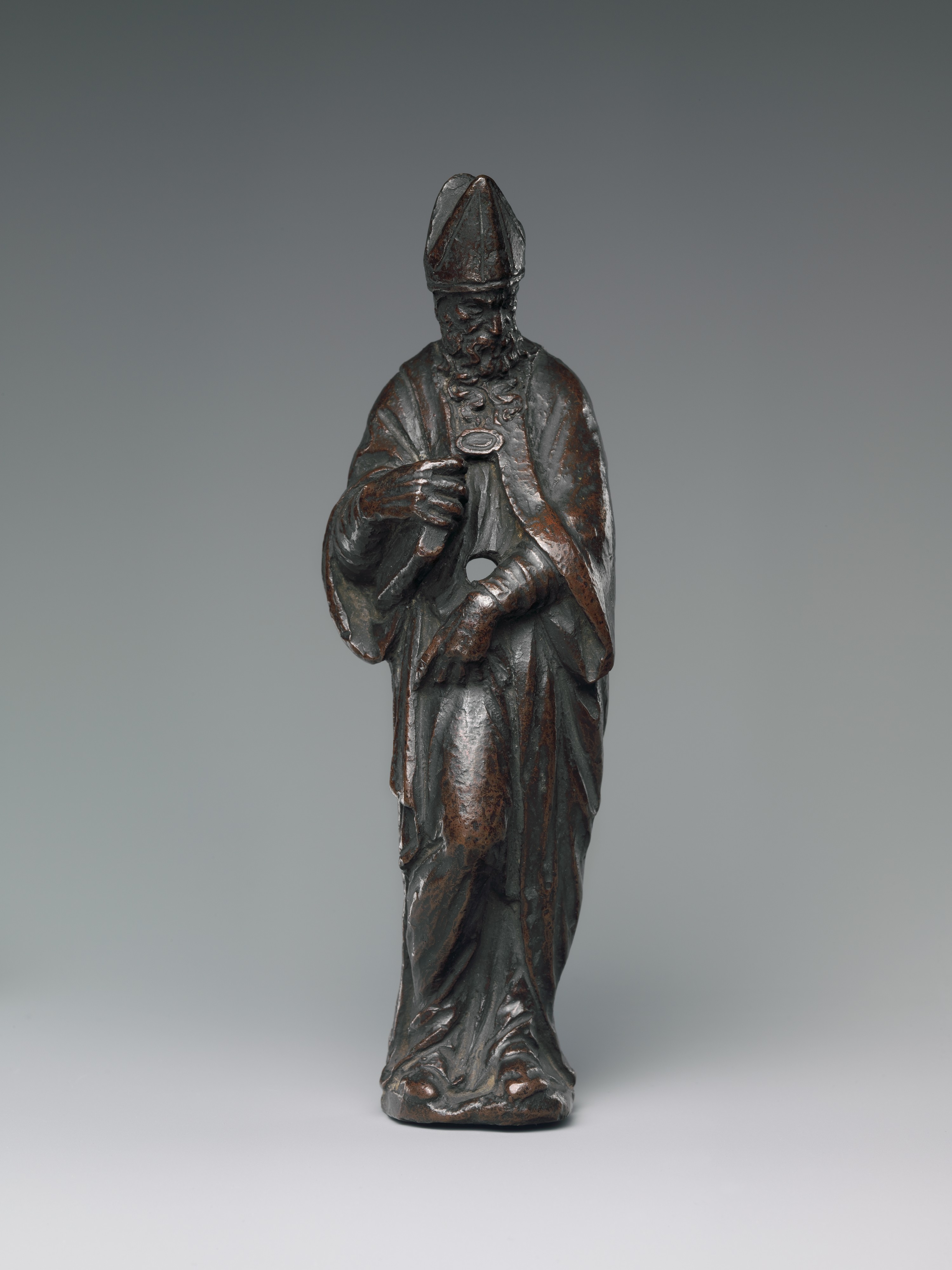
Heritage Asset Analysis: The Bronze Bishop (Saint Ambrose) — Symbolic Authority, Material Memory, and the 2026 Luxury Horizon
1. Object Identification and Material Context
The subject of this analysis is a bronze figure identified as a Bishop, with strong iconographic alignment to Saint Ambrose of Milan (c. 340–397 CE). Executed in cast bronze, the object belongs to the broader material tradition of Late Antique and early medieval small-scale liturgical sculpture — a category that bridged votive function, personal devotion, and imperial-era metalworking prestige. Bronze, as a medium, is not neutral. Its alloyed composition (copper, tin, and often trace lead) required sophisticated foundry knowledge; its surface patina — ranging from verdigris to deep umber — records centuries of oxidation, handling, and ritual exposure. In the hierarchy of ancient materials, bronze occupied a liminal tier between gold and stone: less sacred than gold, more enduring than wood, and more portable than marble. This mobility is critical to its heritage value — bronze objects traveled, were gifted, looted, and re-consecrated, accumulating what we term layered provenance.
2. Iconography of the Bishop: Symbolic Power and Ecclesiastical Adornment
The bishop figure, whether Ambrose or a later episcopal archetype, carries a dense semiotic load. The mitre (if present) signals jurisdictional authority; the crook or crozier encodes pastoral stewardship; the pallium — a woolen band worn over the shoulders — denotes communion with Rome and, in Ambrose's case, his role as a defender of orthodoxy against Arianism. Each adornment is not decorative but legally and theologically codified. In Late Antiquity, the right to wear specific vestments was contested, regulated, and politically charged. Ambrose himself weaponized adornment: his refusal to surrender basilicas to imperial authority, his excommunication of Emperor Theodosius I, and his deployment of liturgical spectacle all demonstrate that ecclesiastical dress was a form of soft power — a wearable constitution.
From a curatorial standpoint, the bronze Bishop therefore functions as a compressed political document. The folds of the chasuble, the angle of the blessing hand, the relative scale of the figure to its crozier — these are not artistic accidents but negotiated statements about who holds authority, who confers legitimacy, and who is permitted to be seen.
3. Spiritual Meaning and Ritual Function
Bronze bishops of this type were rarely mere portraits. They served as devotional companions — placed on domestic altars, carried in processions, or interred with the deceased as psychopomps. The spiritual logic is one of substitution and presence: the bronze body stands in for the absent saint, mediating prayer and embodying intercession. Unlike painted icons, which emphasize the gaze, bronze sculpture emphasizes touch and weight. The faithful could hold it, kiss it, or process with it. This haptic dimension is essential to understanding why bronze — rather than more precious or more fragile materials — was chosen. Bronze invites repeated physical engagement, and through that engagement, the object accrues what anthropologists call ritual patina: the smoothing of edges, the darkening of recesses, the localized wear at the hands and feet.
For Katherine Fashion Lab, this is a critical insight: spiritual meaning in ancient objects is inseparable from embodied use. The Bishop is not a static artwork; it is a performance artifact.
4. DNA Correlation: Linking the Bishop to 《Rock in the form of a fantastic mountain》 and 《Jar in the shape of bronze container (hu)》
The research context provided draws an explicit parallel between the Bishop and two other objects: a scholar's rock (fantastic mountain form) and a bronze-shaped hu jar. At first glance, these are disparate: one is figural and ecclesiastical; one is geological and contemplative; one is ceramic imitating bronze. Yet our DNA correlation study reveals a shared triple helix:
(a) Material mimicry as cultural memory. The hu jar imitates bronze in ceramic — a deliberate archaism. The Bishop, cast in bronze, imitates the human body in metal. The rock imitates a mountain in miniature. All three are substitutions that claim the authority of their referent.
(b) Scale as intimacy. Each object is handheld or tabletop scale. They are not monuments but personal cosmologies — portable sites of meaning.
(c) Patina as biography. All three accumulate surface histories that are read as authenticity markers. The rock's weathering, the jar's glaze crackle, the Bishop's verdigris — each surface is a time signature.
This correlation suggests that Katherine Fashion Lab should not treat the Bishop as an isolated relic but as part of a typology of portable power objects — a curatorial category that spans sacred, scholarly, and domestic spheres.
5. 2026 High-End Luxury Strategy: From Relic to Retail Language
For the 2026 luxury horizon, the Bishop offers four strategic vectors:
Vector 1 — Adornment as authority. The mitre, pallium, and crozier are proto-luxury accessories. A 2026 collection could abstract these into wearable jurisdiction: structured shoulder pieces, corded belts, and staff-like handbags that encode ecclesiastical minimalism. The message is not "dress like a bishop" but "wear the grammar of legitimate power."
Vector 2 — Bronze as chromatic and tactile signature. Bronze's warm, oxidized palette — umber, verdigris, antique gold — aligns with the quiet luxury and earth-tone maximalism forecast for 2026. Hardware, rivets, and chain elements in patinated bronze finish communicate heritage without ostentation.
Vector 3 — Haptic ritual. The Bishop's spiritual power derived from touch. Luxury in 2026 must compete with digital disembodiment by offering tactile rituals: weighted closures, hand-finished seams, objects that ask to be held. The Bishop is the ancient precedent for the unboxing as liturgy.
Vector 4 — Portable cosmology. Just as the Bishop, rock, and hu jar were personal meaning-sites, the 2026 luxury consumer seeks portable sanctuaries: a bag that functions as an altar, a fragrance that functions as incense, a garment that functions as vestment. The strategic language is devotional luxury — not religious, but ritually serious.
6. Curatorial Recommendation
Katherine Fashion Lab should position the Bronze Bishop as the anchor object of a 2026 narrative titled “Vessels of Authority: Portable Power from Antiquity to Atelier.” The Bishop provides the human face of authority; the rock provides the contemplative counterpoint; the hu jar provides the vessel logic. Together, they form a triptych of heritage DNA — figural, geological, and ceramic — that justifies a luxury strategy built on symbolic density, material honesty, and ritual touch. The Bishop is not a saint to be worshipped. It is a case study in how power dresses itself — and that, for 2026, is the most wearable heritage of all.