Chasuble: The Liturgical Vestment as a Masterwork of Textile Art
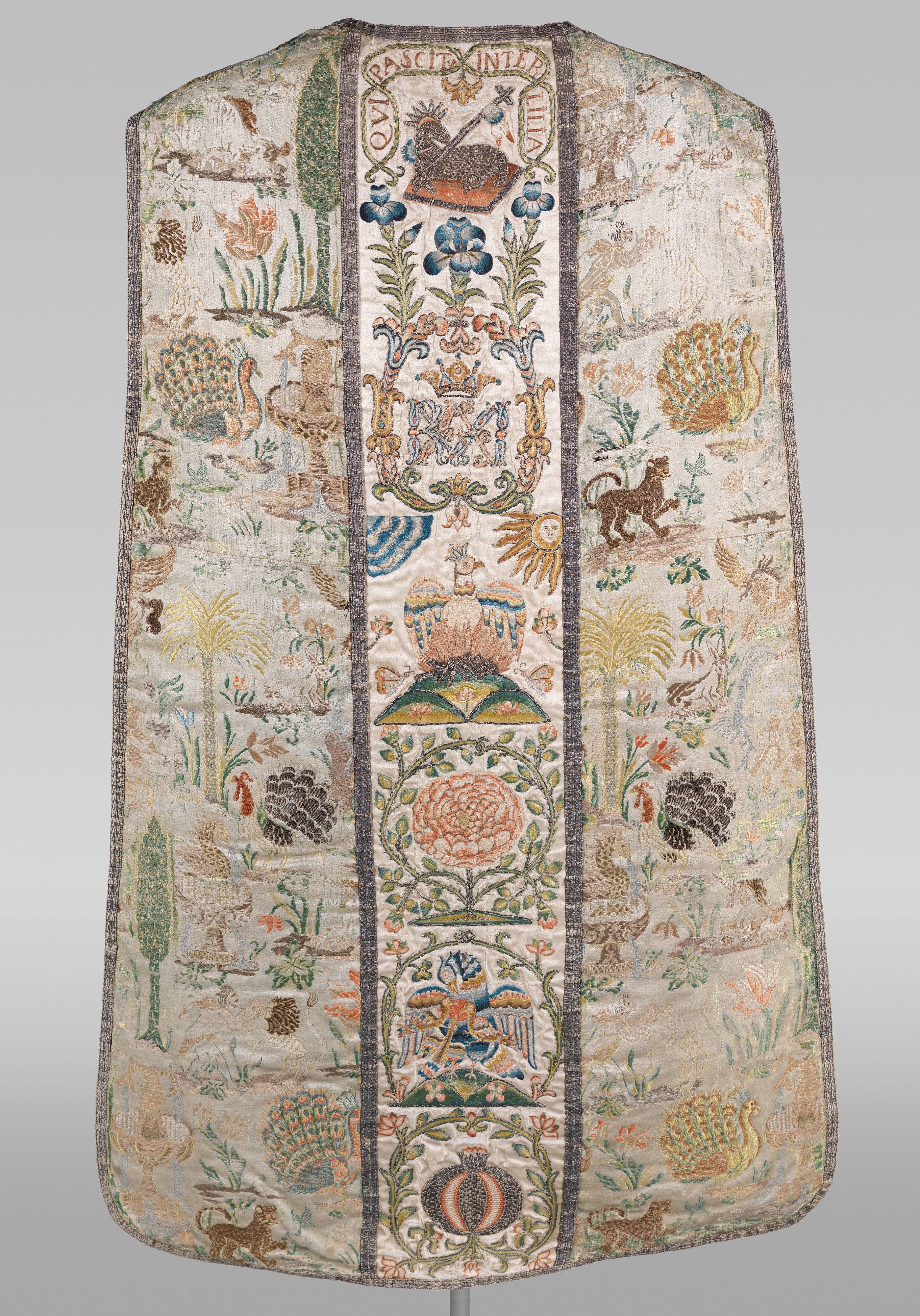
Within the rarefied domain of textile history, few garments carry the dual burden of sacred function and aesthetic ambition as convincingly as the chasuble. As the outermost vestment worn by a priest celebrating the Eucharist, the chasuble occupies a position of profound ceremonial centrality in Western Christian liturgy. Yet to appraise it solely through the lens of ecclesiastical function would be to overlook its status as one of the most technically sophisticated and materially opulent artifacts in the global heritage of dress. This standalone study examines a chasuble of exceptional distinction, whose silk satin ground is brocaded with chenille and silk, and whose orphrey—the ornamental band descending the front and back—is worked in silk satin embroidered with silk and metal-wrapped thread. The object in question is not merely a vestment; it is a convergence of weaving, embroidery, and metallurgical craft, and a document of the complex economies and devotional cultures that produced it.
Historical and Liturgical Context
The chasuble derives from the paenula, a practical Roman cloak of the late antique period, which by the early Middle Ages had been absorbed into Christian liturgical practice as the principal Eucharistic vestment. Its form evolved dramatically across centuries and geographies: the full, bell-shaped casula of the early Church gradually gave way, in the Gothic and later Baroque periods, to the heavily truncated "Roman" cut, which exposed the arms of the celebrant and permitted greater freedom of movement. This morphological shift was never merely practical. It reflected shifting theological emphases, regional synodal rulings, and the evolving relationship between the officiant's body and the ritual space. A chasuble such as the present example—richly figured and ornamented—belongs to a lineage in which the vestment functioned simultaneously as garment, icon, and offering. In many instances, such objects were donated by wealthy patrons or confraternities, their material value constituting an act of devotion in itself.
Material Analysis: Silk Satin and Brocaded Chenille
The foundational fabric of this chasuble is silk satin, a weave whose characteristic luster arises from the float of warp threads across multiple wefts, producing a smooth, reflective face. Silk, introduced to Europe through Byzantine and Islamic trade networks and later cultivated in Italy and France, was the preeminent luxury fiber of the pre-industrial world, its cost and fragility signaling both wealth and reverence. Onto this satin ground, the weaver has introduced a brocade of chenille and silk. Chenille—a yarn whose name derives from the French for "caterpillar"—is a pile yarn, typically constructed by weaving a fabric and cutting it into narrow strips that are then used as weft. Its velvety, three-dimensional texture creates a pronounced contrast against the flat sheen of the satin, lending the pattern a sculptural depth. The combination of chenille with supplementary silk wefts indicates a loom of considerable complexity, likely a drawloom or early Jacquard mechanism, and points to a production center of high repute—perhaps Lyon, Tours, or one of the Italian silk-weaving cities. The interplay of matte pile and glossy ground is not incidental; it is a calculated orchestration of light, designed to animate the vestment as the celebrant moved through the liturgy.
The Orphrey: Embroidery in Silk and Metal-Wrapped Thread
The orphrey constitutes the chasuble's conceptual and visual spine. Executed on a silk satin ground and embroidered with silk and metal-wrapped thread, it transforms the vestment from a patterned textile into a narrative and symbolic field. Metal-wrapped thread—typically a strip of silver or silver-gilt wound around a silk or linen core—was among the most costly materials available to the medieval and early modern embroiderer. Its use was governed as much by theology as by aesthetics: gold, incorruptible and luminous, was understood as the material analogue of divine light. The embroidery itself, whether executed in opus Anglicanum, or nué, or a continental equivalent, would have demanded hundreds of hours of specialized labor, often by women in convents or professional workshops. The orphrey's imagery—whether figural, floral, or aniconic—would have been read by the congregation as a catechetical text, its metal threads catching the candlelight and the filtered daylight of the sanctuary. The technical achievement lies in the tension between the rigidity of metal-wrapped thread and the fluid drape required of a garment; the embroiderer must compensate for the metal's resistance, adjusting stitch density and direction to preserve suppleness.
Global Heritage and the Circulation of Craft
To classify this chasuble under the heading of "global heritage" is to acknowledge the extraordinary geographic reach of its constituent materials and techniques. The silk may originate in China, Byzantium, or the Levant; the chenille technique has antecedents in both European and Near Eastern weaving; the metal-wrapped thread depends on mining and wire-drawing traditions that crisscrossed the medieval world; the embroidery vocabulary synthesizes Byzantine, Islamic, and Western European idioms. The chasuble is thus a node in a network of trade, conquest, and cultural exchange. It also raises pressing questions of stewardship. Many such vestments were dismantled during periods of iconoclasm or later sold into secular collections, their fabrics cut and repurposed. Those that survive intact are rare and fragile, vulnerable to light, humidity, and the very metal threads that make them magnificent—metal-wrapped threads corrode, staining the silk they adorn. Conservation must therefore balance structural stabilization with the preservation of patina and evidence of use.
Conclusion: The Chasuble as Total Work of Art
The chasuble examined here resists reduction to any single category. It is at once garment and reliquary, loom-work and needlework, theology and commerce. Its silk satin ground, brocaded with chenille and silk, and its orphrey embroidered with silk and metal-wrapped thread, represent the convergence of the era's most advanced textile technologies with its most profound devotional impulses. For the contemporary observer—whether historian, curator, or designer—the chasuble offers a lesson in integrated making: the refusal to separate structure from surface, function from meaning, material from spirit. In an age of fragmented production, it stands as a reminder that the highest achievements of dress are those in which every fiber, every stitch, and every thread of metal answers to a coherent and transcendent intention.