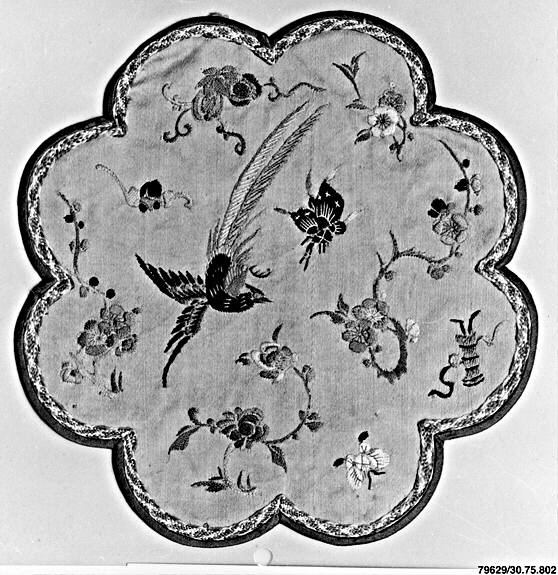
Medallion: A Standalone Study in Chinese Silk Couture
The Medallion is not an object so much as an argument—a proposition advanced in silk about how a garment can function simultaneously as structure, surface, and symbol. Originating in China and realized entirely in silk, this standalone study resists the conventional taxonomy of couture, which tends to separate the technical from the symbolic, the textile from the talisman. Here, the distinction collapses. The medallion is the garment, the garment is the medallion, and the silk that constitutes, binds, and borders it is both the medium and the message.
To analyze Medallion properly, one must begin with the material. Silk is not incidental to this work; it is the work's ontology. China's relationship with silk spans millennia, and any couture study rooted there inherits that lineage whether it wishes to or not. The fiber's peculiar brilliance—its triangular prism structure refracting light at multiple angles—gives the surface a luminosity that shifts with the wearer's movement. In Medallion, this optical property is not decorative but structural: the medallion form reads differently depending on the angle of incidence, so the garment is never quite the same object twice.
The Architecture of the Bound Edge
What distinguishes Medallion within the broader field of silk couture is its insistence on binding. The work is bound with silk—not merely lined, not simply finished, but bound in the bookbinder's sense, as though the garment were a volume requiring a spine. This binding performs several functions at once. Technically, it seals raw edges and prevents the fraying to which fine silk is prone. Aesthetically, it creates a continuous line that frames the medallion motif, converting what might otherwise be a floating ornament into an enclosed system. Conceptually, the binding asserts that the garment has boundaries—that it is a discrete entity with an inside and an outside, a recto and a verso.
The border extends this logic. Bordered with silk, Medallion establishes a perimeter that is neither purely protective nor purely ornamental. In traditional Chinese textile practice, borders often carried cosmological significance—the edge of a robe could demarcate the boundary between the ordered self and the unordered world. Medallion revives this sensibility without nostalgia. Its border is taut, precise, and modern, but it retains the older function of delimitation. The wearer is, in a sense, framed.
On Silk Upon Silk: The Layered Surface
The most technically demanding aspect of Medallion is its use of silk on silk. This is not appliqué in the ordinary sense, nor is it embroidery, though it shares properties with both. Rather, it is a form of surface articulation in which one silk structure is laid upon another, creating a relief that is at once tactile and visual. The medallion itself emerges from this layering: it is not printed, not dyed, not woven into the ground, but built up through the accumulation of silk upon silk.
This technique has precedents in Chinese textile history—the kesi or "cut silk" tradition, in which pictorial effects were achieved through silk alone, comes to mind—but Medallion does not attempt historical reconstruction. Its layering is structural rather than pictorial. The medallion does not depict anything; it is a form that generates meaning through its own construction. The silk-on-silk technique gives it a physical presence that a printed motif could never achieve. You can feel the medallion before you see it, and that haptic priority is central to the work's effect.
The Medallion as Standalone Proposition
Why a medallion? The form carries a dense freight of associations—commemoration, honor, currency, protection. In many cultures, the medallion is an object worn close to the body, often on a chain or cord, precisely at the point where Medallion places its central motif. By translating the medallion from metal to silk, the work performs a material transposition that is also a conceptual one. Metal medallions are hard, durable, and impersonal; silk medallions are soft, fragile, and intimate. The transposition asks whether commemoration can be tender, whether honor can be worn without rigidity.
As a standalone study, Medallion declines to resolve these questions. It does not present itself as a finished statement but as an inquiry—a single proposition tested in a single material. This is, in fact, its most couture-like quality. Haute couture has always been a laboratory as much as a marketplace, a place where techniques are pushed beyond utility to see what they can bear. Medallion pushes silk to its limits: it asks the fiber to be structural, symbolic, and sensuous simultaneously, and it does not apologize for the demands this places on the material.
Conclusion: The Discipline of the Single Material
What emerges from this analysis is a portrait of a work defined by discipline. Medallion uses only silk—silk as ground, silk as figure, silk as binding, silk as border—and in doing so, it achieves a coherence that mixed-media couture rarely manages. The restriction is not a limitation but a method. By refusing to introduce other materials, Medallion forces silk to carry the entire expressive load, and silk, in this case, proves equal to the task.
For Katherine Fashion Lab, Medallion represents a significant position: that couture can be rigorous without being austere, symbolic without being literal, and rooted in a specific cultural tradition without being confined by it. The work stands alone, as its designation suggests, but it also stands as an argument—that the single material, fully understood, is sufficient. In an industry that often confuses accumulation with sophistication, Medallion's discipline reads as radical. It is silk, and silk is enough.