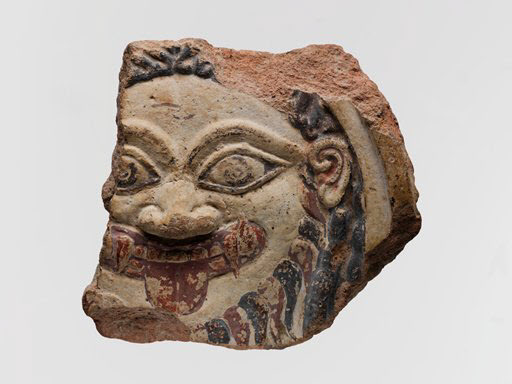
Executive Summary: The Etruscan Medusa Antefix as a Strategic Heritage Asset
In the competitive landscape of 2026 luxury, authenticity is no longer a differentiator—it is a baseline expectation. Katherine Fashion Lab's strategic interest in the Etruscan terracotta antefix bearing the head of Medusa represents a calculated move to anchor brand narrative in a pre-Roman, pre-Hellenic civilization whose aesthetic and spiritual codes remain under-leveraged in contemporary fashion. This analysis examines the object's symbolic power, historical function as adornment, spiritual meaning, and its translation into a high-end luxury strategy for the 2026–2028 cycle.
Object Provenance and Material Identity
The antefix—a vertical terracotta slab designed to terminate the final cover tile of a roof—emerges from Etruscan architectural practice between the 6th and 4th centuries BCE. Unlike the mass-produced architectural ceramics of later Roman periods, Etruscan antefixes were hand-modeled, painted with mineral pigments, and positioned at the eaves of temples and aristocratic tombs. The Medusa head, rendered in high relief with polychrome traces of red, black, and cream, served a dual purpose: structural waterproofing and apotropaic guardianship. For Katherine Fashion Lab, the object's materiality—fragile yet fired for permanence—offers a powerful metaphor for luxury that endures through controlled transformation.
Symbolic Power: The Gaze That Protects
Medusa in Etruscan iconography diverges sharply from the later Greek narrative of monstrosity and victimhood. Etruscan artisans depicted her with wings, fanged mouth, protruding tongue, and sometimes a beard—a fierce, androgynous guardian rather than a tragic figure. Her gaze was not primarily petrifying to the viewer but protective of the structure she adorned. This distinction is strategically critical. Where contemporary luxury often trades on beauty, desirability, and soft power, the Etruscan Medusa antefix offers a model of defensive luxury—adornment that wards off harm, signals boundary, and asserts institutional permanence.
Symbolically, the antefix occupies the liminal space between interior sanctuary and exterior threat. It is the architectural equivalent of a brand's intellectual property moat. For Katherine Fashion Lab, this suggests a collection narrative built not on passive ornament but on active guardianship: pieces that protect the wearer's identity, privacy, and cultural capital in an era of hyper-visibility.
Historical Adornment: From Roofline to Runway
The antefix was never purely functional. Its placement at the roofline—the most visible edge of a temple—made it a public declaration of taste, wealth, and divine alignment. The Etruscan elite commissioned these objects in series, creating rhythmic, repetitive borders that transformed architecture into wearable sculpture for the building itself. This is the earliest form of architectural branding: a signature motif repeated across a surface to claim ownership and aesthetic authority.
For 2026 luxury strategy, this history legitimizes several design directions:
1. Border and Edge Embellishment: Collars, cuffs, hemlines, and lapels as contemporary antefixes—protective edges that frame the body and declare allegiance to a heritage code.
2. Serial Craft: Limited editions of hand-finished terracotta-toned leather goods and jewelry, each piece bearing slight variations that signal artisanal origin over industrial perfection.
3. Polychrome Revival: The Etruscan palette—oxidized red, carbon black, bone white, and trace ochre—offers a chromatic identity distinct from the ubiquitous gold-and-black luxury default.
Spiritual Meaning: The Apotropaic Turn in Luxury
Etruscan spirituality was pragmatic and transactional. The antefix Medusa did not demand worship; she performed a function. She absorbed the evil eye, deflected envy, and marked the threshold between sacred and profane. In 2026, as luxury consumers increasingly seek objects with energetic or talismanic value—amulets, protection symbols, intention-setting jewelry—the Etruscan Medusa offers a pre-Christian, pre-New Age authenticity. She is not a trend; she is a 2,500-year-old technology of protection.
Katherine Fashion Lab can position this spiritual function without resorting to esoteric clichés. The narrative is one of inherited guardianship: the wearer carries a lineage of women who protected their households, cities, and selves through adornment. This aligns with the growing luxury demand for matrilineal heritage stories that avoid both victim feminism and performative empowerment.
2026 High-End Luxury Strategy: From Antefix to Asset
The strategic translation requires discipline. The antefix is not a print motif to be reproduced indiscriminately. It is a structural principle—edge, boundary, repetition, protection—that should inform silhouette, material, and communication.
Product Strategy: Launch a capsule collection titled Antefix featuring hand-painted terracotta leather, sculpted metal hardware in the form of the Medusa head (abstracted, not literal), and modular garments whose seams and closures function as protective borders. Price architecture should reflect the labor intensity of hand-firing and hand-painting, positioning the line above ready-to-wear but below haute joaillerie.
Narrative Strategy: Commission scholarly essays, museum partnerships with Etruscan collections (Villa Giulia, Tarquinia), and a digital archive documenting the specific antefix that inspired the collection. Transparency about provenance is non-negotiable in 2026; the brand must demonstrate that it is not extracting culture but stewarding it.
Experience Strategy: In-store installations that replicate the roofline rhythm—a frieze of terracotta antefixes at eye level, each one a limited-edition object available for purchase alongside the collection. This converts retail space into a temple edge, where the consumer crosses a threshold and acquires protection.
Risk Assessment and Mitigation
The primary risk is aesthetic misreading: Medusa as horror icon rather than guardian. Katherine Fashion Lab must control the visual grammar through consistent art direction—softened features, maternal severity, polychrome warmth. Secondary risk is cultural appropriation critique. Mitigation lies in rigorous attribution, collaboration with Etruscan heritage bodies, and a percentage of proceeds directed to archaeological conservation in Cerveteri and Tarquinia.
Conclusion
The Etruscan terracotta antefix with the head of Medusa is not a decorative curiosity. It is a strategic asset: a pre-Roman, pre-Greek symbol of protective adornment that speaks directly to 2026 luxury consumers' desire for authenticity, spiritual function, and matrilineal power. Katherine Fashion Lab can claim this heritage with precision—not by reproducing the object, but by adopting its logic: edge as guardian, repetition as ritual, material as memory. The brand that wears the antefix does not merely decorate the body; it fortifies it.