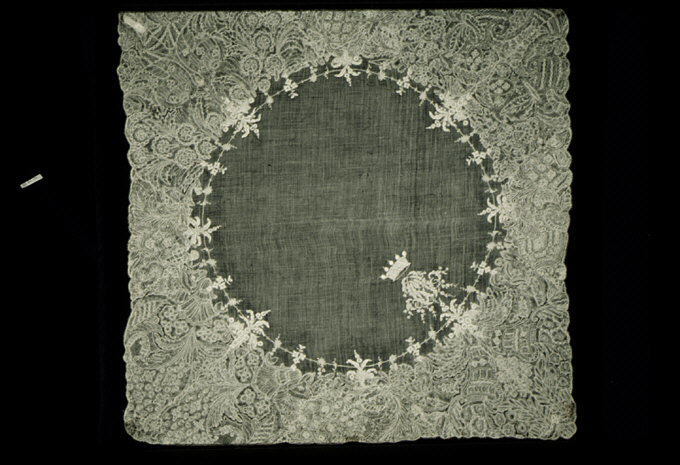
The Handkerchief as Couture Artifact: A Study in Bobbin Lace, Point d'Angleterre, and Linen
The handkerchief occupies a singular position within the architecture of dress: it is at once the most intimate and the most public of accessories, a square of cloth whose functional origins have been entirely eclipsed by its semiotic richness. Within the global heritage of textile arts, no other object so quietly encodes distinctions of class, gender, hygiene, mourning, courtship, and devotion. For the couture analyst, the handkerchief constitutes a compressed study in the entire logic of luxury — the transformation of utility into ritual through the expenditure of human labour. This standalone study examines the handkerchief through three constitutive materials: bobbin lace, point d'Angleterre, and linen, each of which carries its own historical grammar and technical vocabulary.
The Global Heritage of a Four-Square Object
The handkerchief's genealogy is genuinely transnational, which is precisely why it resists any single national attribution. Antiquity offers fragmentary precedents: Roman sudaria used to wipe the brow, Chinese and Japanese squares of silk employed in ceremonial exchange, and Islamic textile traditions in which fine linen squares accompanied prayer and pilgrimage. By the Renaissance, the object had migrated into the European aristocratic repertoire, where it functioned as a marker of refinement. In Tudor and Stuart England, the handkerchief was a gift of considerable value, often embroidered with the recipient's initials and exchanged as a token of fidelity. In France, the court of Louis XIV elevated it to a performative instrument, while in Venice and Flanders it became a vehicle for the most technically demanding lace-making in the world.
What unites these dispersed traditions is a shared principle: the handkerchief is a surface for inscription. It bears monograms, coats of arms, mottoes, lace borders, and, in the nineteenth century, the sentimental language of the Valentine. Its global heritage is therefore not a story of diffusion from a single origin but of convergent invention — cultures arriving independently at the same conclusion, that a small square of cloth could hold meaning far exceeding its dimensions.
Bobbin Lace: The Discipline of the Pillow
Bobbin lace is the technical foundation upon which the couture handkerchief's prestige rests. Unlike needle lace, which is worked with a single thread and a needle, bobbin lace is constructed by plaiting and twisting multiple threads, each wound onto a small wooden bobbin, across a parchment pattern pinned to a firm cushion. The lacemaker manipulates dozens of bobbins simultaneously, crossing and re-crossing them in sequences that must be memorized or read from the pricking. The result is a textile with no woven ground: the pattern and the ground are structurally identical, formed from the same interlaced threads.
This method demands extraordinary dexterity. A single centimetre of fine bobbin lace may require hours of work, and the great lace centres — Brussels, Bruges, Valenciennes, Alençon, and later Honiton — built economies around the skill. For the couture handkerchief, bobbin lace serves as the border, the framing device that converts a plain linen square into an object of display. The contrast is deliberate: the plain weave of the linen against the open, airy lattice of the lace produces a visual tension that has never lost its authority.
Point d'Angleterre: A Misnomer of Distinction
No term in lace history is more misunderstood than point d'Angleterre. Despite its name, this is not English lace. It is a Brussels bobbin lace of the highest grade, so called because English merchants were instrumental in its distribution, or, by another account, because it was smuggled into England concealed in bales of ordinary goods. Whatever the etymology, the technical identity is clear: point d'Angleterre is a fine Brussels lace distinguished by a particular ground — a delicate hexagonal mesh, sometimes called vrai réseau — and by the presence of a cordonnet, a thicker outline thread that gives the floral motifs their sculptural relief.
In the context of the handkerchief, point d'Angleterre represents the apex of the form. A handkerchief bordered in genuine point d'Angleterre was, in the eighteenth and nineteenth centuries, a possession of significant value, frequently listed in inventories and bequeathed in wills. Its motifs — scrolling florals, ribbon bows, small figures — were drawn by designers and executed by lacemakers working in dim light for wages that rarely reflected the rarity of the product. The couture analysis must register this asymmetry: the handkerchief's beauty is inseparable from the labour conditions that produced it.
Linen: The Ground of Everything
Linen underwrites the entire object. Woven from the bast fibres of the flax plant, linen possesses properties that no other textile fully replicates: high tensile strength when wet, rapid moisture absorption, a cool hand, and a natural lustre that increases with laundering and wear. For a handkerchief, these are not incidental virtues but functional requirements. The finest grades — batiste, linon, and the legendary toile de Cambrai — are woven from tightly spun, long-staple flax to produce a cloth of remarkable fineness and durability.
The preparation of flax is itself a heritage craft: retting, breaking, scutching, and hackling before a single thread can be spun. When a couture house specifies a linen handkerchief with a hand-worked lace border, it is therefore invoking an unbroken chain of agricultural and artisanal knowledge stretching back centuries. The material is the memory of the object.
The Handkerchief as Standalone Study
To isolate the handkerchief is to reveal how couture thinking operates at the smallest scale. The object has no structural complexity, no tailoring, no silhouette. Its entire significance resides in materials, edges, and inscriptions. Bobbin lace supplies the technique; point d'Angleterre supplies the prestige; linen supplies the ground. Together they demonstrate that luxury in dress is never merely decorative — it is an argument about time, skill, and the value we assign to the intimate and the ephemeral. The handkerchief, folded and forgotten in a pocket, remains one of fashion's most eloquent artefacts.