Object Biography: The Laconian Ivory Plaque as Ritual Instrument and Proto-Luxury Artifact
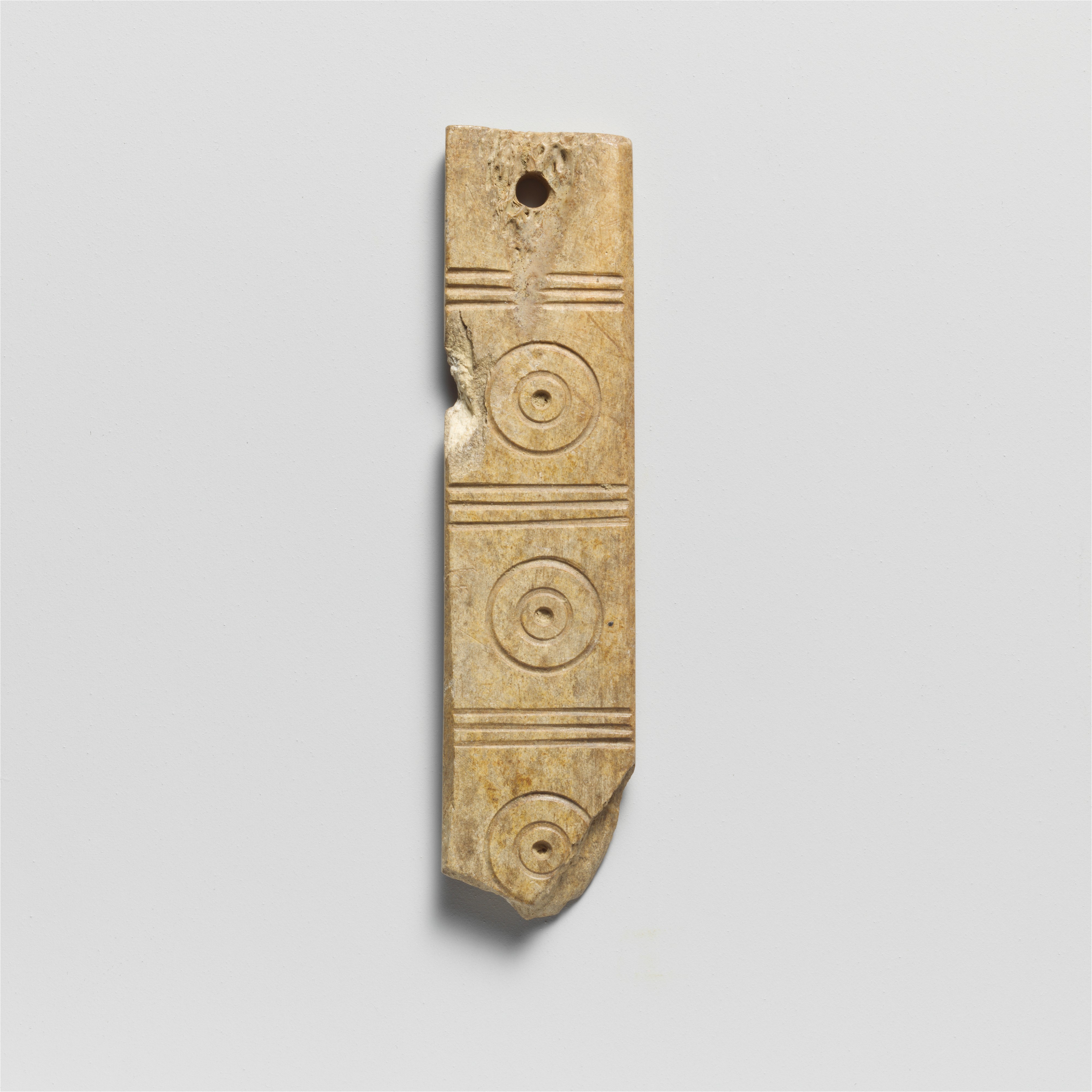
The artifact under examination—a bone plaque with a perforation at one end, executed in ivory and attributed to Greek, Laconian production—occupies a deceptively modest position within the material record of the ancient Peloponnese. Its dimensions are slight, its surface unadorned, and its function, at first inspection, ambiguous. Yet within the disciplined framework of Strategic Standalone Research, the plaque reveals itself as a convergence point of Spartan ritual practice, Mediterranean trade networks, and an early grammar of adornment that anticipates contemporary luxury's most durable mechanisms of value creation. For Katherine Fashion Lab, this object is not a curiosity but a strategic precedent.
Materiality and Provenance: Ivory in a Spartan Context
Laconia, the territory dominated by Sparta, presents an apparent paradox for ivory consumption. Spartan society was famously austere in civic display, yet archaeological evidence from sanctuaries such as the Menelaion and the Amyklaion confirms the circulation of imported ivory objects from the eighth through the sixth centuries BCE. Ivory was not indigenous to the Greek mainland; it arrived via Aegean trade routes linking the Peloponnese to the Levant, Egypt, and North Africa. The presence of ivory in Laconian hands therefore signals access to long-distance exchange—an early demonstration that rarity plus provenance equals prestige, the foundational equation of luxury economics.
The perforation at one end is the object's most diagnostically significant feature. A single drilled hole transforms a flat plaque into a suspended object: a pendant, an amulet, or a votive attachment. This small aperture is the hinge between artifact and ornament, between the utilitarian and the symbolic. It indicates that the plaque was meant to be worn, hung, or displayed—not buried inertly but activated within a visual and ritual field.
Symbolic Power: The Amuletic Logic of the Perforated Plaque
In archaic Greek practice, perforated bone and ivory plaques functioned within a broader amuletic economy. Suspension implied protection: the object mediated between the wearer and unseen forces. Laconian religion, with its emphasis on chthonic deities, hero cults, and the cult of Artemis Orthia, was particularly receptive to apotropaic devices. The plaque's material—ivory—carried its own symbolic charge. Its pale, lustrous surface evoked bone, flesh, and the enduring substance of the body after death, while its exotic origin lent it the aura of distant, semi-mythical lands.
Critically, the plaque's power derived from reduction rather than elaboration. It bears no figurative carving, no inscription, no ornamental excess. Its authority is structural: the hole, the edge, the polished plane. This restraint is not poverty but discipline—a Laconian aesthetic that locates meaning in proportion and material integrity rather than surface accumulation. The object thus embodies a paradox relevant to contemporary luxury: the most powerful symbols are often the least decorated.
Historical Adornment: From Votive to Wearable
Comparative evidence from Laconian sanctuaries suggests that such plaques were dedicated to deities, suspended in temple interiors, or worn by individuals seeking divine favor. The perforation enabled a dual life: as votive offering and as personal adornment. This duality prefigures the modern luxury object's capacity to function simultaneously as private talisman and public signal. The plaque did not merely decorate; it performed identity—marking the wearer as someone with access to imported materials, ritual knowledge, and the protection of the gods.
Adornment in this context was never merely aesthetic. It was transactional: the object negotiated relationships between human and divine, individual and community, local and foreign. The Laconian plaque thus offers a historical model of adornment as infrastructure—a system through which status, belief, and belonging were materially encoded.
Spiritual Meaning: The Hole as Threshold
The perforation deserves sustained symbolic reading. In many ancient Mediterranean traditions, the aperture is a threshold: a passage between states, a point of contact between the visible and invisible. A hole in a plaque is not an absence but a channel. It permits the passage of cord, breath, light, or spirit. For a Laconian wearer, the plaque's hole may have functioned as a conduit for divine attention—a way of ensuring that the amulet remained connected to its source of power.
This interpretation aligns with broader Greek conceptions of agalma: an object that delights the gods and thereby secures their favor. The plaque's spiritual efficacy depended on its material beauty, its correct suspension, and its ritual context. Meaning was not intrinsic but relational—activated through use, placement, and belief.
Strategic Implications for 2026 High-End Luxury
For Katherine Fashion Lab, the Laconian ivory plaque yields four strategic directives for the 2026 luxury landscape.
First, provenance as product. The plaque's value was inseparable from its origin—Laconian, imported, ritualized. Contemporary luxury must likewise treat provenance not as a marketing footnote but as the core architecture of desirability. Traceable material journeys, documented craft lineages, and verifiable cultural context are the new ivory.
Second, the aperture principle. The perforation demonstrates that a single functional intervention can transform an object's meaning. Luxury design in 2026 should pursue minimal gestures with maximal symbolic consequence—details that open the object to narrative, ritual, and personalization rather than closing it with ornament.
Third, adornment as infrastructure. The plaque was worn to do work: to protect, to signal, to connect. High-end luxury must recover this functional seriousness. Accessories should be positioned not as decoration but as instruments of identity, belief, and belonging—objects that perform within the wearer's life rather than merely accompanying it.
Fourth, disciplined restraint as luxury signal. Laconian aesthetics rejected excess in favor of proportion, material honesty, and controlled form. In a 2026 market saturated with visual noise, restraint becomes the ultimate differentiator. The plaque teaches that silence, correctly materialized, is the loudest statement.
Conclusion
The Laconian ivory plaque is a small object with a large strategic lesson. It demonstrates that symbolic power resides not in complexity but in clarity; that adornment is a technology of meaning; and that the most enduring luxury objects are those that connect the wearer to something larger—a place, a practice, a power. Katherine Fashion Lab should read this artifact not as a relic but as a brief: design objects with apertures, not surfaces; with provenance, not decoration; with the discipline to let a single hole carry the weight of the sacred.