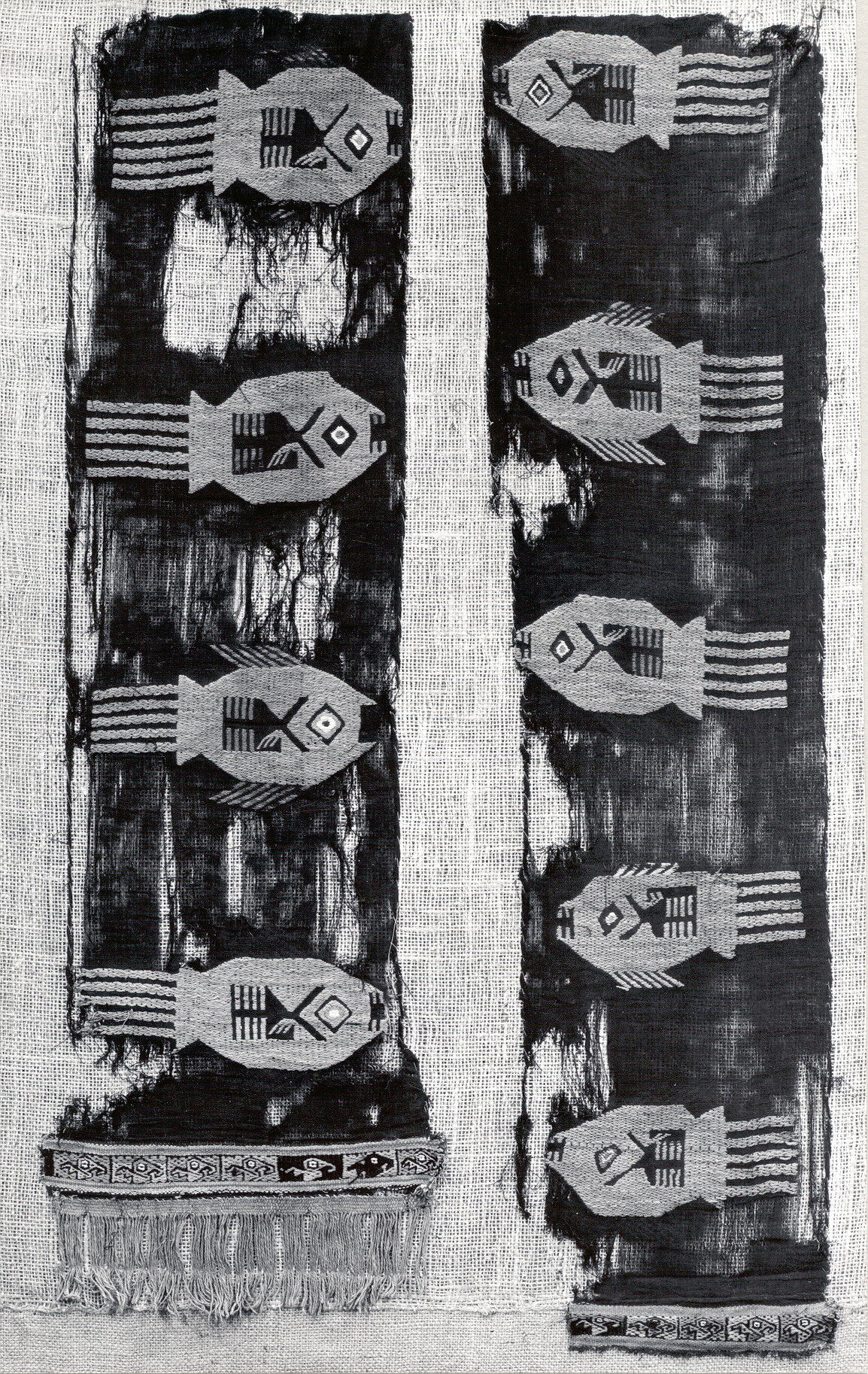
Panel Fragments: A Study in Pre-Columbian Textile Logic
The textile tradition of the central Peruvian coast constitutes one of the most sophisticated bodies of material culture in the ancient Americas. Among the surviving witnesses to this tradition, the present panel fragments—woven from cotton and camelid hair—occupy a position of considerable interpretive interest. As a standalone study, detached from any documented archaeological matrix, these fragments compel the analyst to work in a mode closer to connoisseurship than to excavation: the object must be read through its own internal evidence, its technical grammar, and the comparative corpus of related Andean textiles. What emerges is not merely a record of skilled craftsmanship but a glimpse into an epistemic system in which cloth functioned simultaneously as currency, status marker, ritual substrate, and archive.
Material Economy and the Logic of Fiber Selection
The dual-fiber composition of these fragments is itself a statement of intentionality. Cotton, cultivated extensively along the river valleys of the central coast, provided the structural warp—a robust, relatively inelastic foundation capable of sustaining tension on the loom. Camelid hair, sourced from domesticated alpacas and llamas of the highlands, supplied the weft: finer, warmer, and possessed of a natural luster that cotton lacks. This division of labor between fibers was not merely practical but hierarchical. In Andean textile practice, the finest camelid hair—particularly that of the alpaca—was reserved for garments of exceptional status, while cotton served as the utilitarian ground. The presence of camelid weft in these fragments therefore signals a context of elevated value, however fragmentary the surviving evidence may be.
The procurement of camelid fiber on the central coast involved long-distance exchange networks linking coastal settlements to highland pastoral communities. The fragments thus encode an economic geography: they are the physical residue of trade, tribute, or elite gift exchange. To handle such a textile is to touch the intersection of ecological zones—the arid coast and the Andean puna—mediated by human labor and social obligation.
Structure, Technique, and the Grammar of Weave
Analysis of the surviving structure suggests a plain-weave ground, though the fragmentary condition precludes definitive reconstruction of the original loom width or garment type. The weft-faced character of the fabric—where camelid yarns dominate the visible surface—aligns with a broader coastal preference for densely packed, visually saturated cloth. This was a tradition that would culminate, centuries later, in the famous painted and tapestry-woven textiles of the Paracas and Nazca cultures. The present fragments, however, belong to an earlier or parallel horizon, their relative simplicity of surface patterning suggesting a formative or transitional phase in coastal textile development.
Edge finishes, where preserved, reveal careful selvage treatment: the warp ends are bound or braided to prevent unraveling, a detail that speaks to the value placed on durability and completion. In a society where cloth could be burned, buried, or offered to deities, the integrity of the textile's boundaries carried symbolic weight. A frayed edge was not merely a technical failure but a ritual impropriety.
Chronology, Provenance, and the Problem of the Standalone Object
The attribution "central coast (?)" acknowledges a fundamental evidentiary gap. Without stratigraphic context, radiocarbon dating, or associated ceramics, the fragments float in a chronological limbo that could span the Early Horizon through the Early Intermediate Period—roughly 900 BCE to 200 CE. Stylistic comparison offers only probabilistic anchors. The relative absence of complex iconographic motifs, the restrained color palette, and the structural primacy of the weave itself all point toward an early date, before the florid figurative embroidery of Paracas transformed coastal textile aesthetics.
Yet the standalone status of these fragments is not solely a limitation; it is also a methodological prompt. It forces the analyst to consider what textiles meant outside the museum vitrine—in motion, in use, in the hands of people who wore, traded, and discarded them. A fragment is not a failed whole but a different kind of evidence: it reveals the interior of the cloth, the hidden architecture of warp and weft that a complete garment conceals. In this sense, the panel fragments function as a cross-section of an ancient technology, exposing the decisions—fiber choice, spin direction, sett density—that constituted the textile's DNA.
Cultural Significance and the Textile as Social Text
In Andean ontology, cloth was not inert. It was animated by the labor embedded within it and by the symbolic properties ascribed to its materials. Camelid fiber, associated with the highland herds that were themselves subjects of ritual care, carried a charge of sacredness. Cotton, tied to the agricultural cycle and the fertility of the coastal valleys, grounded the textile in the rhythms of planting and harvest. The combination of the two in a single fabric enacted a cosmological union: highland and lowland, pastoral and agrarian, wild and domesticated.
Such textiles circulated as tribute to lords, as offerings to ancestors, and as dowry in elite marriages. They were burned in rituals to release their essence into the spirit world. The panel fragments, even in their reduced state, participate in this economy of meaning. They are not merely "old cloth" but the material trace of a social system in which value was woven, not minted.
Conclusion: The Fragment as Epistemic Object
To study these panel fragments is to confront the limits and possibilities of archaeological knowledge. Deprived of context, they demand a rigorous formalism—a close reading of technique and material—that yields insights no less valuable than those derived from excavation. They attest to the centrality of textile production in pre-Columbian Peru, to the sophistication of fiber technologies, and to the deep entanglement of cloth with power, ritual, and exchange. In the absence of the complete garment, the fragment becomes the teacher: it instructs us to look closely, to reason from the part to the whole, and to recognize that in the ancient Andes, the loom was as consequential as the chisel or the kiln.