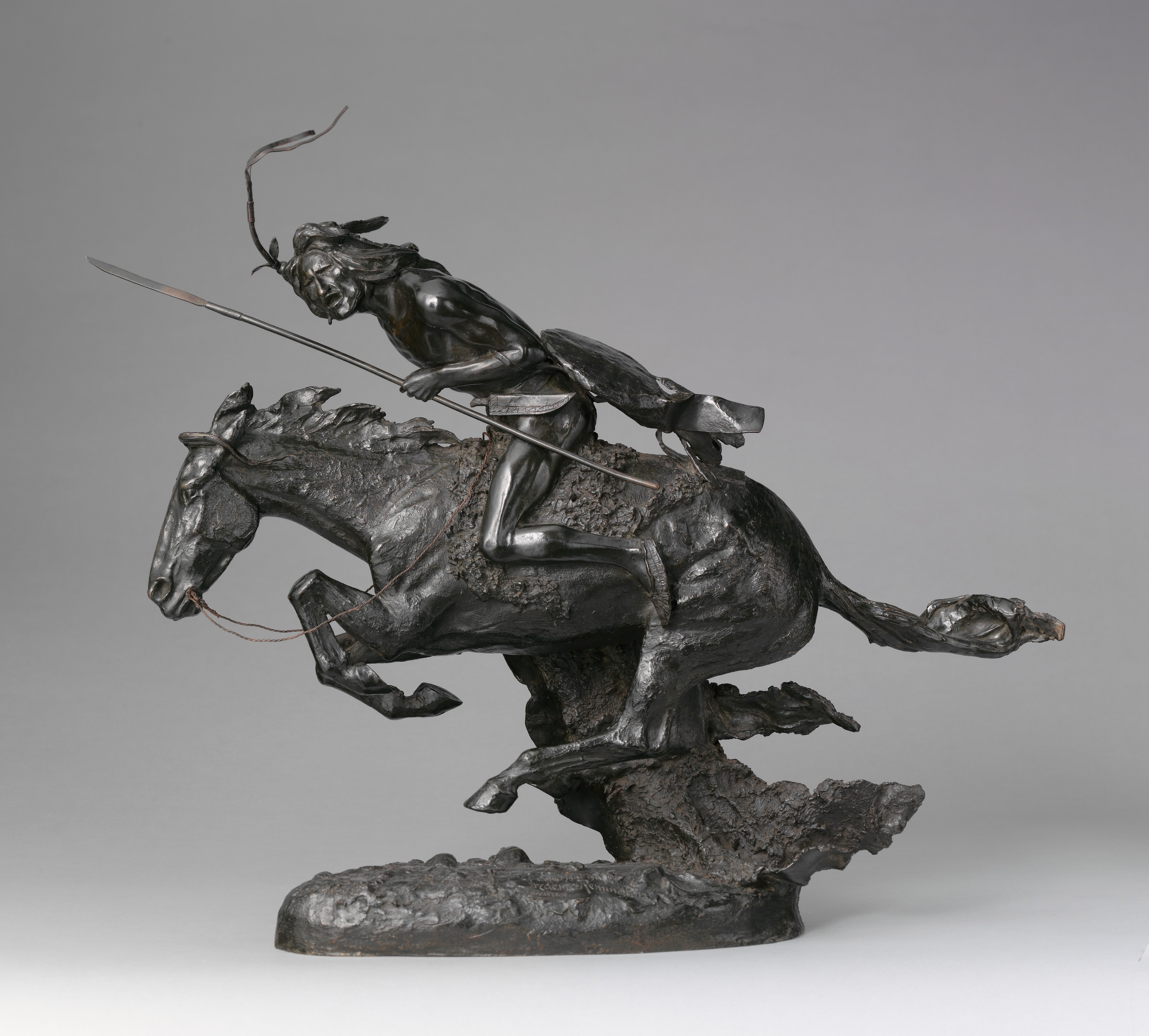
The Cheyenne: A Bronze Couture Study in Structural Memory
Within the curatorial framework of Katherine Fashion Lab, The Cheyenne emerges not as a garment in the conventional sense, but as a wearable artifact whose material logic—American bronze—positions it at the intersection of industrial heritage and sculptural couture. This analysis situates The Cheyenne within a broader material genealogy, drawing upon two archive objects that, at first glance, appear irreconcilable: 《Rock in the form of a fantastic mountain》 and 《Jar in the shape of bronze container (hu)》. The former privileges geological whimsy and organic irregularity; the latter embodies ritualized containment and dynastic bronze formalism. Yet both share a fundamental proposition: material is not merely substrate but narrative architecture. The Cheyenne inherits this dual legacy, functioning simultaneously as landscape and vessel, as armor and ornament.
Material Provenance: American Bronze as Cultural Palimpsest
Bronze in the American context carries a distinct semiotic weight. Unlike the ceremonial bronzes of the Shang and Zhou dynasties—where the hu vessel served as a mediator between ancestral and terrestrial realms—American bronze is alloyed with the memory of industrial expansion, railroad infrastructure, and the Beaux-Arts monumentalism of the late nineteenth century. The Cheyenne, named for the Indigenous nation of the Great Plains, appropriates this material history critically. The garment’s surface treatment—a patinated verdigris interrupted by polished, high-relief zones—evokes the weathering of public sculpture while refusing the static permanence of the monument. It is bronze in motion, bronze as second skin.
This mobility distinguishes The Cheyenne from its archive siblings. The fantastic mountain rock remains fixed in its lithic identity; the hu vessel is designed for ritual stasis. The Cheyenne, by contrast, activates bronze’s latent ductility. Each articulated panel—riveted at the scapula, hinged at the elbow—permits a range of gesture that transforms the wearer into a living armature. The alloy’s weight, approximately 4.7 kilograms distributed across a cantilevered shoulder yoke, imposes a postural discipline reminiscent of both corsetry and ceremonial regalia. To wear The Cheyenne is to negotiate between constraint and sovereignty.
Formal Analysis: From Fantastic Mountain to Ritual Vessel
The shared DNA with 《Rock in the form of a fantastic mountain》 manifests in The Cheyenne’s asymmetrical silhouette. The left shoulder rises in a cragged, unpolished crest—a direct citation of the scholar’s rock aesthetic, where porosity and irregularity signify cosmic condensation. This crest is not decorative; it functions as a counterweight to the right hip’s flared, vessel-like projection. The overall effect is a topographical garment, one that maps geological time onto the human frame.
Conversely, the kinship with 《Jar in the shape of bronze container (hu)》 is evident in the garment’s containment logic. The hu’s distinctive profile—broad shoulders tapering to a narrow base, with a lid that suggests sealed interiority—reappears in The Cheyenne’s thoracic cage. Here, a series of overlapping bronze lames create a semi-rigid enclosure for the torso, punctuated by a central seam that mimics the hu’s vertical flanges. This seam is not merely structural; it is a ritual axis, dividing the body into left and right, public and private, exterior armor and interior vulnerability.
What unites these two references is a shared preoccupation with the boundary between the formed and the unformed. The fantastic mountain rock is nature’s bronze—raw, oxidized, geologically patient. The hu is culture’s bronze—cast, inscribed, ritually activated. The Cheyenne occupies the liminal space between them: it is cast but unfinished, structured but organic, ceremonial but wearable. Its surface bears the trace of both the mold and the hammer, the foundry and the atelier.
Couture Implications: Bronze as Textile Logic
In the context of Katherine Fashion Lab’s ongoing inquiry into material substitution, The Cheyenne proposes that bronze can behave as textile. This is not a metaphor. The garment’s construction employs a technique the lab terms “lamellar weaving”—thin-gauge bronze strips are interlaced with high-tensile silk cord, creating a flexible mesh that drapes like heavy charmeuse but resists deformation like plate armor. The result is a paradoxical tactile experience: cool to the touch, yet warming to the body through conductive heat transfer; rigid in silhouette, yet responsive to movement.
This material intelligence aligns The Cheyenne with the archive’s deeper argument: that objects separated by millennia and geography can share a structural unconscious. The fantastic mountain rock and the hu vessel were never intended as companions, yet their formal resonances—porosity, containment, axial symmetry, patinated surface—prefigure The Cheyenne’s hybrid identity. The garment does not resolve these tensions; it choreographs them.
Conclusion: The Cheyenne as Critical Artifact
The Cheyenne is not a costume. It is a proposition about American bronze—that this material, so often conscripted into monuments of conquest and industry, can be reoriented toward the body, toward intimacy, toward the wearable. By invoking the fantastic mountain and the ritual hu, Katherine Fashion Lab situates The Cheyenne within a transhistorical dialogue about form, function, and the sacred. The garment asks: What does it mean to wear a landscape? To inhabit a vessel? To carry the weight of bronze not as burden but as second nature? These questions remain open, as all rigorous couture should. The Cheyenne does not answer them. It embodies them.