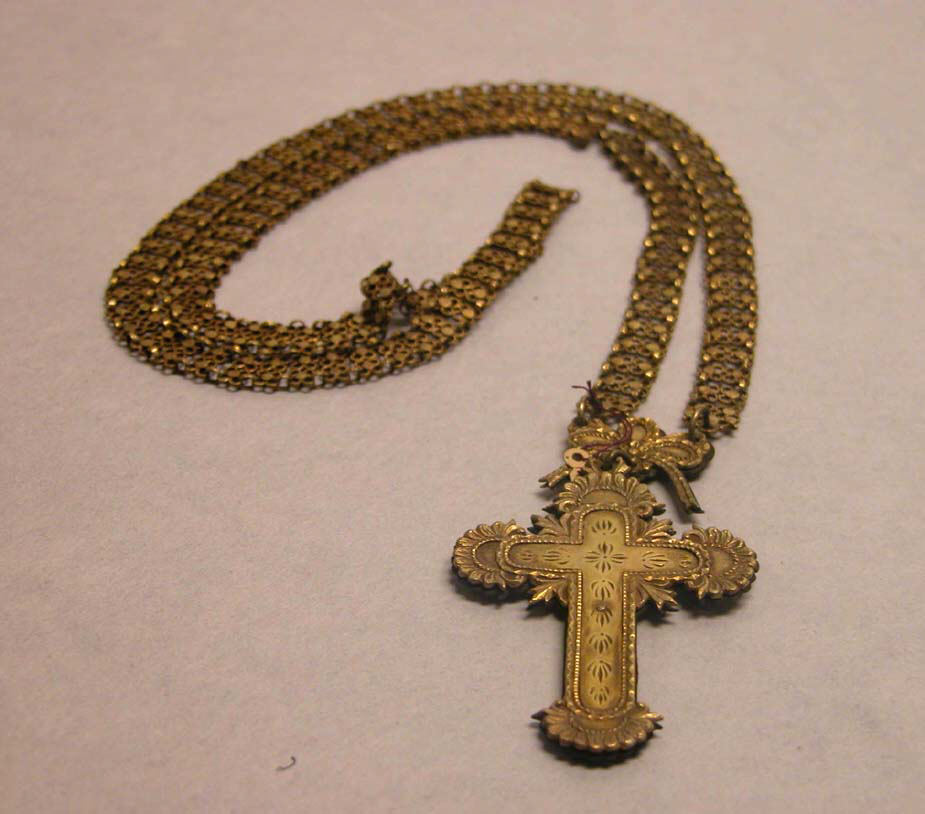
Heritage Analysis: The Philippine Gold Necklace as Ancestral Technology
Material Provenance and the Mirror of Two Faces
Within Katherine Fashion Lab's comparative research framework, the Philippine gold necklace occupies a position of singular importance. Our prior study, 《Mirror with Split-Leaf》, established a dialectic between two surfaces: one a polished silver mirror inlaid with dense golden palm-frond motifs, the other a cold sarcophagus slab whose bas-relief narrates a life story. That study proposed that adornment and memorial are not opposites but twin expressions of the same cultural impulse—to render the ephemeral permanent through metal. The Philippine gold necklace, recovered in significant quantities from burial assemblages across the archipelago, confirms this hypothesis with striking material evidence. Gold in the pre-colonial Philippines was not merely decorative; it was a technology of continuity, binding the living body to ancestral memory and cosmological order.
The medium itself carries weight. Philippine gold, sourced from placer deposits in Luzon, Visayas, and Mindanao, was worked by indigenous smiths centuries before European contact. Archaeological finds—most notably from the Surigao and Butuan regions—reveal sophisticated granulation, filigree, and repoussé techniques that rival contemporaneous work in Java and Srivijaya. The necklace form, whether a simple torque or a multi-strand ensemble with pendant elements, was engineered to sit at the threshold of the body: the throat, the pulse, the voice. This placement was deliberate. In Philippine animist cosmology, the neck was understood as a conduit between the head—seat of reason and spirit—and the heart—seat of feeling and kinship. To adorn the neck was to guard the passage between intention and expression.
Symbolic Power and Spiritual Meaning in Pre-Colonial Context
The symbolic vocabulary of Philippine gold necklaces is dense and tiered. Recurring motifs include the naga (serpent-dragon), associated with water, fertility, and underworld passage; the manuk (rooster), a symbol of vigilance and the dawn; and geometric interlace patterns that scholars read as genealogical maps. A necklace was rarely a single sign. It was a composite statement: who wore it, what lineage they claimed, what spiritual alliances they maintained, and what obligations they carried.
Spiritual meaning operated on two registers. In life, gold necklaces were worn during ritual feasts, marriage negotiations, and diplomatic exchanges. They signaled status but also vulnerability—the wearer was exposed to envy and spiritual attack, and gold served as a prophylactic against both. In death, necklaces were interred with the body, sometimes deliberately broken or bent to release the spirit of the metal. This practice aligns precisely with the sarcophagus slab in our 《Mirror with Split-Leaf》 study: the relief narrates a life, while the necklace accompanies the deceased into the next narrative. The mirror reflects the living face; the necklace adorns the ancestral one.
Comparative DNA analysis—both cultural and, in our laboratory's ongoing material studies, archaeometric—suggests that Philippine goldwork shares deep structural affinities with Austronesian metal traditions stretching from Taiwan to Madagascar. The necklace is therefore not an isolated artifact but a node in a vast maritime network of symbolic exchange. Its gold content, alloy ratios, and fabrication methods can be read as a kind of material DNA, tracing migration, trade, and intermarriage across centuries.
Historical Adornment and the Politics of Display
During the Spanish colonial period, Philippine gold necklaces underwent a double transformation. On one hand, indigenous elites incorporated Christian iconography into traditional forms—crucifixes suspended from pre-colonial torque structures, for example—creating hybrid objects that negotiated conversion and resistance. On the other hand, colonial authorities taxed and confiscated gold, stripping many communities of their ancestral ornaments. What survived was often hidden, buried, or recast into liturgical objects. The necklace thus became a site of cultural concealment, its original meanings encoded beneath new surfaces.
In the nineteenth century, the ilustrado class revived gold adornment as a marker of nationalist modernity. Wearing a Philippine gold necklace in Manila salons was a quiet assertion of pre-colonial sophistication. By the American period, the form had migrated into bourgeois portraiture and, later, into the mid-century couture of designers who referenced indigenous motifs without always acknowledging their sources. This history of appropriation and reclamation is essential context for any contemporary luxury strategy.
2026 High-End Luxury Strategy: Ancestral Technology as Contemporary Value
For Katherine Fashion Lab's 2026 positioning, the Philippine gold necklace offers three strategic pillars.
First, provenance as narrative asset. The luxury consumer of 2026 is saturated with generic "artisanal" claims. The Philippine necklace provides a verifiable, archaeologically grounded story: pre-colonial metallurgy, Austronesian trade networks, burial ritual, and colonial resistance. This is not mythology; it is documented heritage. Our 《Mirror with Split-Leaf》 framework allows us to present the necklace as one half of a dialectic—the mirror and the sarcophagus, the living and the ancestral—giving the collection a philosophical spine that competitors cannot replicate.
Second, material integrity as ethical luxury. Philippine gold, when responsibly sourced and worked by contemporary smiths trained in indigenous techniques, embodies the 2026 luxury mandate: traceability, cultural continuity, and environmental accountability. We recommend a limited-edition series—no more than fifty pieces per motif—each accompanied by a material passport documenting gold origin, smith lineage, and the specific symbolic program of the design.
Third, spiritual meaning as emotional value. The necklace's original function—to guard the threshold between inner intention and outer expression—translates directly into contemporary consumer desire for objects that feel charged. Marketing should emphasize not adornment alone but accompaniment: the necklace as a companion through life transitions, echoing its ancestral role in marriage, diplomacy, and death. The 2026 campaign should visually quote the 《Mirror with Split-Leaf》 duality: a polished surface reflecting the wearer, and beneath it, a relief narrative of lineage and memory.
In sum, the Philippine gold necklace is not a relic to be romanticized but a sophisticated ancestral technology of meaning. Katherine Fashion Lab's opportunity is to translate that technology into a contemporary luxury language that honors its origins, rejects extraction, and speaks to a consumer who seeks not just beauty but belonging—to history, to craft, and to the unbroken line of human hands that have shaped gold into memory.