Praetexta: A Standalone Study in German Couture and Textile Sovereignty
Within the rarefied discourse of contemporary couture, few garments reward sustained critical scrutiny as richly as the Praetexta, a German-origin creation whose very name invites a meditation on authority, boundary, and the semiotics of dress. This standalone study examines the Praetexta not as a component of a seasonal collection but as a self-contained thesis: a garment that argues, through its material constitution and structural logic, for a distinctly Germanic synthesis of restraint and opulence. In an industry increasingly governed by algorithmic trend cycles, the Praetexta asserts the enduring primacy of the atelier as an intellectual laboratory.
The nomenclature itself is instructive. The Latin praetexta historically denoted the purple-bordered toga worn by Roman magistrates and freeborn youths—a garment of protected status, marking the wearer as both privileged and incomplete, a figure in transition toward full civic authority. That a German couture house should resurrect this term is no accident. It signals an engagement with the classical inheritance of European dress while simultaneously repositioning that inheritance through a Northern European lens: cooler, more architectural, less inclined toward Mediterranean display. The Praetexta thus operates as a palimpsest, its classical referent overwritten by a modern German sensibility that privileges construction over ornament and proportion over spectacle.
Material Constitution: Wool, Silk, and the Metallurgy of Thread
The garment's material logic is its central argument. The foundational textile is a wool of exceptional fineness—a fabric that speaks to the German tradition of textile engineering, in which the fiber's crimp, staple length, and tensile behavior are treated as design variables rather than mere givens. This wool provides the Praetexta with its structural spine: a dense, almost architectural body that holds volume without rigidity, allowing the garment to sculpt the wearer's silhouette through tension rather than boning or interfacing. The choice is polemical. Where French couture has historically favored the fluid drape of silk crêpe or the sculptural possibilities of duchesse satin, the Praetexta's wool asserts a different value system: durability, sobriety, and a kind of moral seriousness about cloth.
Against this austere ground, silk functions as the garment's interior life. It appears in the lining, in the facings, and in strategic panels where the wool is cut away to reveal a contrasting surface. This is not decorative contrast for its own sake; it is a structural dialectic. The silk's luster and fluidity throw the wool's matte density into relief, producing an effect that is at once tactile and optical. The wearer experiences the Praetexta as a garment of two temperatures—the cool authority of wool without, the warm intimacy of silk within—a duality that mirrors the classical praetexta's own status as a garment of both inclusion and exclusion.
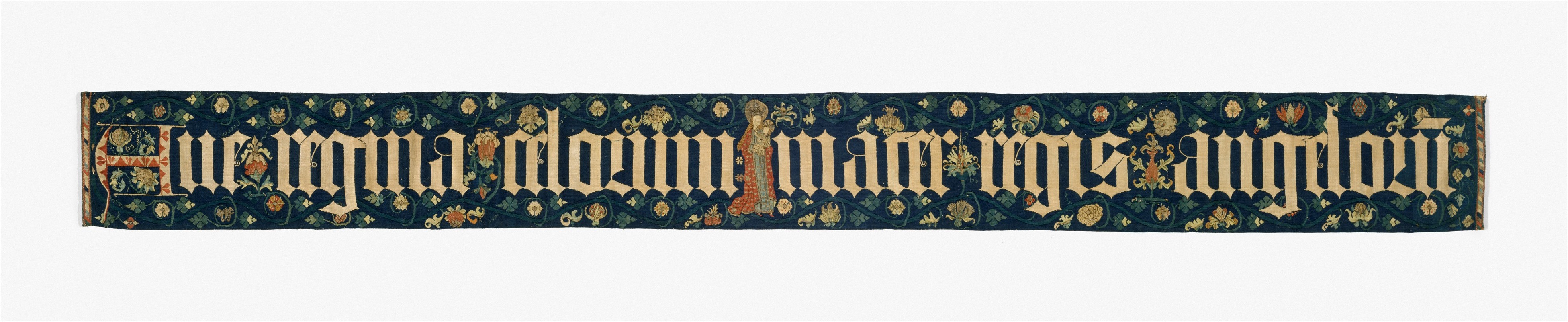
The most remarkable element, however, is the gold and silver thread embroidery. Here the Praetexta departs most decisively from the minimalist orthodoxy that has dominated German fashion since the 1990s. The metallic threads are not applied as surface embellishment but are woven into the cloth itself, producing a subtle iridescence that shifts with the wearer's movement. In certain lights, the garment appears almost monochrome; in others, the metallic weft emerges as a faint constellation across the wool's surface. This technique—reminiscent of historical Brokat and Lamé weaving but executed with contemporary precision—positions the Praetexta within a lineage of German textile artistry that stretches from the medieval weaving centers of Cologne and Aachen to the technical textiles of the present day.
Construction and Silhouette: The Architecture of Restraint
The Praetexta's silhouette is best understood as a negotiation between the body's natural architecture and the garment's imposed geometry. The cut is precise to the point of severity: a defined shoulder, a suppressed waist, and a skirt that falls in a controlled A-line rather than a fluid drape. There is no visible fastening; the garment closes through concealed closures that preserve the purity of its front plane. This is couture as engineering, and it reflects a specifically German aesthetic tradition in which the seam is not hidden as a matter of shame but elevated as a matter of principle—the structural line is the design.
The gold and silver thread is deployed with similar discipline. It traces the garment's seams, reinforces its edges, and occasionally clusters into abstract motifs at the cuffs and collar. These motifs are not narrative; they are geometric, almost cryptographic. They reward close reading but resist easy interpretation. In this, the Praetexta aligns itself with the broader trajectory of German cultural production: an insistence on form as content, on the idea that meaning resides in structure rather than in explicit statement.
Cultural Positioning: A German Couture Against the Grain
To situate the Praetexta within German fashion history is to recognize its interlocutors. It converses with the Bauhaus principle that form follows function, yet it refuses the Bauhaus's suspicion of ornament. It engages with the postwar Konfektion tradition of ready-to-wear precision, yet it insists on the hand-finished singularity of couture. And it acknowledges the global dominance of French and Italian houses while declining to imitate them. The Praetexta's achievement is to propose a third way: a couture that is luxurious without being ostentatious, intellectual without being arid, and rooted in a specifically German material culture without being provincial.
As a standalone study, the Praetexta resists the logic of the collection. It does not need a narrative arc or a seasonal theme to justify its existence. It stands as a proposition: that a garment can be both a technical artifact and a cultural argument, that wool and silk and metallic thread can be made to speak a language of authority and intimacy, and that German couture can claim a place at the table not by mimicking its neighbors but by excavating its own traditions. In an era of fashion's relentless acceleration, the Praetexta is a garment that asks to be read slowly—and rewards the reader accordingly.