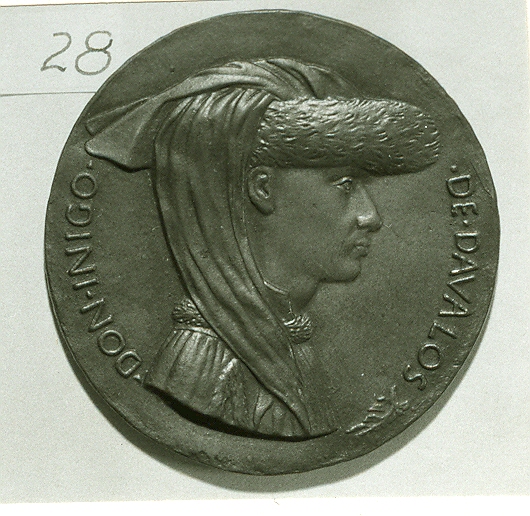
Heritage Asset Analysis: The Medal of Don Iñigo d'Avalos
Object Identification and Material Profile
The medal bearing the likeness of Don Iñigo d'Avalos represents a pivotal artifact within the tradition of Renaissance portrait medallions, a genre that fused Classical revivalism with emerging humanist ideals of individual legacy. Cast in copper alloy and finished with a deep, dark brown patina, the object exemplifies the technical sophistication of early modern European medalists, who drew directly from ancient numismatic precedents. The patina itself—a stable, lustrous oxide layer—signals both age and intentional surface treatment, suggesting the medal was valued not merely as currency or token but as a collectible object of personal and dynastic significance. For Katherine Fashion Lab, this artifact offers a strategic entry point into the symbolic economy of power dressing, where materiality and meaning converge.
Historical Context: Don Iñigo d'Avalos and the Politics of Representation
Don Iñigo d'Avalos (c. 1460–1503) was a prominent Spanish nobleman, military commander, and Grand Chamberlain to King Ferdinand II of Aragon. His lineage, the House of Avalos, was deeply embedded in the Italian campaigns of the late fifteenth century, particularly in the Kingdom of Naples. The medal—likely produced in Naples or Mantua during the height of his influence—serves as a portable monument, a strategic instrument of self-fashioning in an era when reputation was currency. The obverse typically features a profile portrait in the Classical manner, while the reverse may bear an allegorical or heraldic device. Such medals circulated among political allies, humanist scholars, and courtly networks, functioning simultaneously as diplomatic gift, commemorative badge, and talisman of authority.
Symbolic Power and Historical Adornment
In the visual language of the Renaissance, the medal was an adornment of the mind as much as the body. Worn on a chain, pinned to a hat, or displayed in a studiolo, it projected erudition, martial valor, and dynastic legitimacy. The profile format directly quoted Roman imperial coins, linking the sitter to the virtus of antiquity. For Don Iñigo, this was not mere vanity; it was a calculated assertion of his role as a bridge between Iberian kingship and Italian humanism. The copper alloy—less precious than gold or silver—nonetheless carried symbolic weight: it was the metal of durable, everyday currency, suggesting a message of steadfast service rather than ostentatious wealth. The dark brown patina, whether natural or artificially induced, added a further layer of gravitas, evoking the aged bronzes of ancient Rome and reinforcing the fiction of unbroken lineage.
Spiritual Meaning and Talismanic Function
Beyond political signaling, medals of this type often carried apotropaic and devotional dimensions. The reverse might depict a patron saint, a cross, or a motto invoking divine protection. In the context of Don Iñigo's career—marked by the brutal Italian Wars and the shifting alliances of the Borgia papacy—such objects served as personal talismans, physical anchors for prayers for victory and survival. The act of touching or gazing upon the medal was a ritual of remembrance and hope. This spiritual layer is critical for Katherine Fashion Lab: it demonstrates that adornment has never been merely decorative. It is a technology of the self, a means of aligning one's public identity with transcendent values.
Materiality and Craft: Copper Alloy as Strategic Choice
The choice of copper alloy, rather than precious metal, reflects both economic pragmatism and aesthetic intent. Copper-based medals could be produced in larger numbers, allowing broader distribution across political networks, while still taking a fine cast and a rich patina. The dark brown surface—achieved through controlled oxidation or burial—mimics the noble corrosion of antiquity, transforming a relatively modest material into a signifier of timeless value. This is a lesson in democratized luxury: the perception of worth is not solely dependent on intrinsic material cost but on narrative, craft, and context. For a 2026 luxury strategy, this principle is central to engaging a clientele that prizes authenticity, provenance, and story over mere bullion.
Strategic Implications for Katherine Fashion Lab: 2026 Luxury Landscape
As we approach 2026, the high-end market is shifting toward heritage-led, narrative-driven objects that offer emotional and intellectual resonance. The Medal of Don Iñigo d'Avalos provides a blueprint for several strategic directions:
1. Portable Power: The medal's original function—as a wearable emblem of identity—maps directly onto contemporary demand for statement jewelry and accessories that communicate personal values. Katherine Fashion Lab can reinterpret the medallion format in limited-edition pieces that combine artisanal casting with modern materials, positioning them as modern talismans for a networked, global elite.
2. Patina as Luxury Signal: The dark brown patina is not a flaw but a feature. In a market saturated with high-gloss finishes, the aesthetics of age and tactility offer differentiation. We can develop surface treatments that evoke historical depth while ensuring durability, appealing to clients who seek objects that feel lived-in and storied from day one.
3. Spiritual and Symbolic Layering: Consumers in 2026 are increasingly seeking meaning beyond logos. The medal's fusion of political, spiritual, and personal symbolism suggests a model for multi-layered design narratives. Each Katherine Fashion Lab piece could embed a discreet motto, a heraldic reference, or a talismanic element, inviting the wearer into a private dialogue with history.
4. Standalone Research as Brand Equity: This analysis itself—a strategic standalone research initiative—demonstrates the lab's commitment to deep contextualization. By publishing such heritage studies, Katherine Fashion Lab builds authority and trust, positioning itself as a custodian of cultural memory rather than a mere trend-follower. This intellectual capital is a competitive moat in the luxury sector.
Conclusion: From Ancient Alloy to Future Legacy
The Medal of Don Iñigo d'Avalos is more than a historical curiosity. It is a case study in how adornment encodes power, belief, and identity. Its copper alloy and dark patina speak to durability, humility, and the alchemy of perception. For Katherine Fashion Lab, the path forward lies in translating these principles into contemporary objects that are at once wearable, meaningful, and strategically positioned for a 2026 market that values depth over display. By anchoring our creative direction in rigorous heritage analysis, we do not merely reference the past—we reforge it for the future.