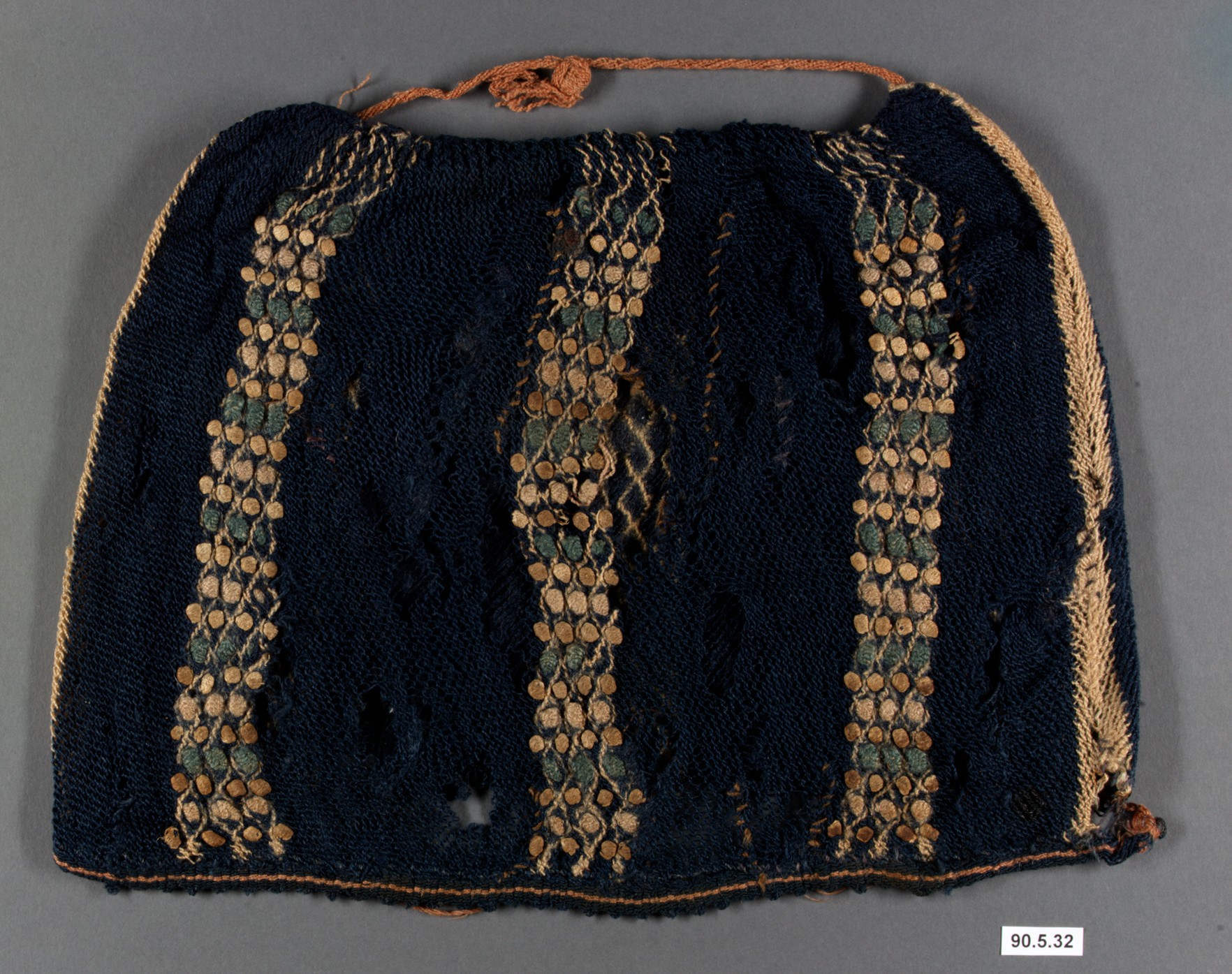
Introduction: The Hat as a Self-Contained Artifact
In the hierarchy of couture accessories, the hat occupies a singular position. Unlike garments that drape the body or jewelry that adorns it, the hat crowns—and in doing so, frames—the human form. As a standalone study, the hat transcends mere functionality to become an autonomous sculptural object, a declaration of identity, and a compressed archive of cultural memory. This analysis examines a distinctive example from global heritage: a wool hat constructed through the sprang technique and enriched with embroidery. Neither purely utilitarian nor merely decorative, this artifact invites us to reconsider the boundaries between craft, couture, and cultural transmission.
Wool, the material foundation of this study, is among humanity's oldest textile companions. Its crimp, elasticity, and natural insulation have made it indispensable across civilizations—from the highlands of the Andes to the steppes of Central Asia. Yet it is the sprang technique that elevates this hat beyond the ordinary. Sprang, a ancient method of creating openwork and interlinked structures through plaiting and twisting under tension, predates knitting and crochet. Its characteristic elasticity and reversible patterns produce a fabric that is simultaneously porous and resilient—qualities ideally suited to headwear that must breathe, conform, and endure.
The Sprang Technique: Structural Ingenuity in Wool
Historical and Technical Overview
Sprang is a braiding technique that operates on a tensioned warp, typically held between two fixed points. The maker manipulates the threads with the fingers, creating interlinking loops that can produce dense or open structures, diagonal lines, or intricate geometric motifs. Unlike knitting, sprang cannot be unraveled from the finished end; it is a locked system, which lends the resulting fabric remarkable dimensional stability. Archaeological evidence places sprang in Scandinavia, Egypt, and the Americas, suggesting independent invention or early cross-cultural exchange. In the context of a wool hat, sprang offers a dual advantage: the wool's natural crimp works in harmony with the technique's inherent stretch, while the openwork allows for ventilation without sacrificing warmth.
Material Synergy and Couture Implications
The marriage of wool and sprang is not accidental. Wool's protein structure—keratin—responds well to the tension and friction of sprang manipulation, yielding a fabric that is both lightweight and structurally robust. For the couture atelier, this technique presents a compelling alternative to conventional millinery felting or blocking. A sprang-constructed hat can be shaped through gentle steaming rather than aggressive blocking, preserving the integrity of the interlinked loops. The resulting silhouette may be soft and organic, yet it holds its form with an almost architectural certainty. In an era of mass-produced headwear, the sprang hat signals a return to slow, intentional making—a value proposition that resonates with the discerning luxury client.
Embroidery as Narrative and Ornament
Symbolic and Cultural Dimensions
If sprang provides the hat's structure, embroidery supplies its voice. Across global heritage, embroidery on headwear has served as a marker of status, belief, and belonging. In Central Asian tahya caps, in Palestinian taqiyah, in Peruvian chullo, and in Scandinavian bridal crowns, stitched motifs encode lineage, protection, and prayer. The embroidery on this wool hat—whether geometric, floral, or abstract—must be read as a deliberate intervention. Each stitch interrupts the sprang grid, introducing color, texture, and narrative. The embroidery may follow the sprang's natural lines or deliberately contradict them, creating visual tension. In couture terms, this is the difference between decoration and design: the embroidery is not applied afterthought but integrated into the object's conceptual architecture.
Technical Execution and Aesthetic Tension
From a technical standpoint, embroidering a sprang surface requires precision. The fabric's elasticity means that stitches must be tensioned carefully to avoid distortion. The embroiderer may use wool, silk, or metallic threads, each introducing different light-reflective properties. On a wool ground, silk embroidery creates a subtle sheen; metallic threads catch the light like scattered embers. The resulting surface is tactile and visually layered—an object that rewards close inspection. In the context of standalone study, this hat becomes a case study in how two distinct techniques—one structural, one ornamental—can coexist without subordination. The sprang is not merely a canvas; the embroidery is not merely a finish. They are partners in a dialogue about form and meaning.
The Hat as Standalone Study: Couture, Craft, and Cultural Continuity
Autonomy and the Collector's Gaze
Why isolate the hat as a standalone study? Because the hat, more than any other accessory, operates as a self-sufficient artifact. It can be displayed on a stand, read as a sculpture, and appreciated without reference to a wearer. In museum contexts, hats from global heritage are often exhibited as masterpieces of technique and design—their scale inviting intimate examination. For the couture collector, a sprang-and-embroidered wool hat represents an intersection of rarity, skill, and cultural depth. It is not a seasonal trend but a timeless object, capable of being passed down through generations. Its value lies not in branding but in the visible hand of the maker and the invisible lineage of the technique.
Ethical and Sustainable Dimensions
In an age of synthetic fibers and disposable fashion, the wool sprang hat offers an implicit critique. Wool is renewable, biodegradable, and, when sourced responsibly, supports pastoral economies. Sprang requires no electricity, only human hands and tension. Embroidery extends the object's life by adding layers of meaning that discourage discard. This is couture as conservation—not of a single garment but of knowledge systems. Katherine Fashion Lab's focus on such artifacts aligns with a broader movement in luxury toward provenance, transparency, and cultural respect. The hat is not a curiosity; it is a manifesto.
Conclusion: The Crowned Archive
The wool hat constructed through sprang and embellished with embroidery is a compact archive of global heritage. It carries within its interlinked loops the memory of ancient makers, and within its stitched motifs the narratives of communities across continents. As a standalone study, it challenges us to look beyond the runway and the retail floor, to see the hat as a site of technical innovation and cultural preservation. For the connoisseur, it is an object of quiet power—a crown that does not demand a throne, but instead invites contemplation. In the hands of Katherine Fashion Lab, such an artifact becomes not merely a subject of analysis but a catalyst for rethinking what couture can be: rooted, responsible, and radically beautiful.