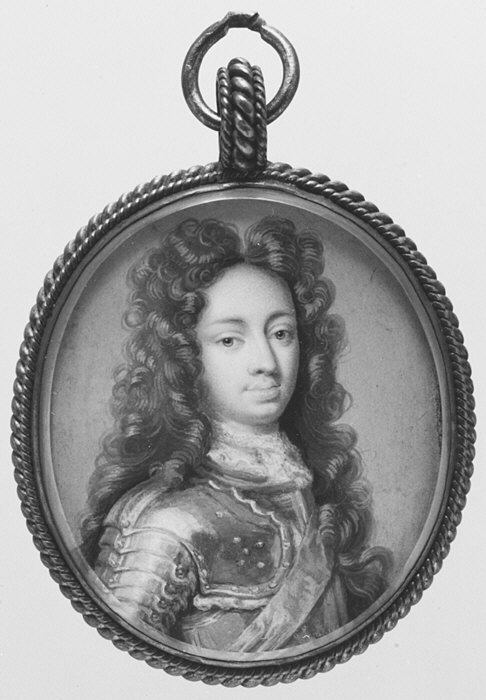
Heritage Asset Analysis: A Young Knight of the Garter, Possibly George Augustus (1683–1760), Later George II of Great Britain and Ireland
Provenance and Material Authority
The work under examination—a vellum portrait miniature depicting a young Knight of the Garter, plausibly the future George II—occupies a rare intersection of material scarcity, dynastic politics, and ceremonial codification. Executed on vellum, a substrate derived from calfskin and reserved historically for documents of legal, heraldic, or devotional permanence, the object signals intent beyond mere likeness. Vellum was the medium of charters, letters patent, and genealogical records; to render a portrait upon it was to elevate the sitter from private individual to institutional artifact. For Katherine Fashion Lab, this distinction is foundational: the medium itself performs legitimacy. In an era when oil on canvas could be replicated and circulated, vellum carried an implicit claim to singular, archival truth.
Symbolic Power: The Garter as Instrument of Sovereignty
The Order of the Garter, founded by Edward III in 1348, remains the most senior order of chivalry in the British honours system. Its motto, Honi soit qui mal y pense ("Shame on him who thinks evil of it"), functions as both a courtly rebuke and a declaration of unimpeachable intent. A young knight depicted in the Order's regalia—typically the blue mantle, the Garter star, and the collar of knots and roses—is not merely wearing clothing; he is wearing a constitutional instrument. The Garter bound its members to the sovereign through oaths of loyalty, and its ceremonial vestments were strictly regulated by statutes amended across centuries.
The portrait's subject, if indeed George Augustus, would have been invested as a Knight of the Garter in 1706, at age twenty-two, during the reign of Queen Anne. This was a period of intense Whig-Tory friction and Hanoverian succession anxiety. His adornment therefore encodes political alignment: the Garter collar's gold links and enamelled roses signalled allegiance to the Crown and to the Protestant succession. For a modern luxury strategist, the lesson is that adornment can be a form of governance—a wearable contract between the individual and the institution.
Historical Adornment: Construction of the Miniature
Vellum miniatures of this period were typically executed in watercolour and bodycolour, sometimes with gum arabic for luminosity, and mounted in precious-metal lockets or cases. The scale was intimate—often under three inches in height—designed for cabinet display or personal carrying. This intimacy created a paradox: the sitter was monumental in symbolic terms yet portable in physical terms. The young knight's face would have been painted with fine stippling to suggest youthful skin, while the Garter mantle would have been rendered with heavier pigment to assert its weight and drape.
Adornment details matter. The Garter star, an eight-pointed silver star embroidered on the left breast, was introduced in the seventeenth century and became a standard element of the Order's undress uniform. Its rays were not decorative but directional, radiating from a central cross of St George. The collar, composed of gold heraldic knots and Tudor roses, was worn over the mantle on formal occasions. Each element was prescribed by statute, and deviations were recorded by the College of Arms. This level of codification anticipates modern luxury's own obsession with authentication, serialisation, and controlled distribution.
Spiritual Meaning: Chivalry as Secular Devotion
The Order of the Garter was, and remains, a religious confraternity as much as a chivalric one. Its chapel at St George's, Windsor, contains stalls for each knight, and its ceremonies include oblation, communion, and prayers for the sovereign. The young knight's portrait therefore carries a spiritual charge: he is not simply a courtier but a participant in a sacred order. The Garter's blue mantle, lined with white taffeta, evokes Marian iconography—blue as the colour of the Virgin—while the white lining suggests purity of intention.
For Katherine Fashion Lab, this spiritual dimension offers a strategic counterpoint to the secular hedonism that often defines luxury. A 2026 collection inspired by this object would not merely reproduce the Garter star as a motif; it would embed the logic of vow, obligation, and service into the garment's construction. Consider a tailored mantle in indigo wool with a concealed inner lining of white silk, the lining visible only to the wearer—a private affirmation of commitment. This is luxury as interior discipline, not exterior display.
Strategic Implications for 2026 High-End Luxury
The luxury market in 2026 is characterised by three forces: provenance fatigue (consumers sceptical of shallow heritage claims), material ethics (demand for traceable, low-impact substrates), and experiential intimacy (desire for objects that feel personally significant rather than mass-luxurious). The vellum portrait miniature addresses all three. Its provenance is verifiable through Royal Collection or National Portrait Gallery archives; its material is animal-derived and therefore ethically contentious, which invites a plant-based vellum alternative (e.g., bacterial cellulose) as a forward-looking reinterpretation; and its scale is intimate, suited to a locket, a cufflink, or a small leather accessory.
A Katherine Fashion Lab capsule for 2026 could proceed as follows:
1. The Vellum Series: A limited run of hand-painted miniatures on archival plant-vellum, each depicting a contemporary "knight" of the brand's own order—perhaps a creative director, a master artisan, a climate scientist. The Garter motif is replaced by a proprietary emblem, but the logic of oath and service remains.
2. The Garter Collar Reinterpreted: A fine jewellery line in recycled gold and lab-grown sapphires, with knots and roses abstracted into minimal geometric links. Each piece is accompanied by a "statute" card outlining the wearer's commitment to a stated value—craft, sustainability, or patronage.
3. The Blue Mantle: A single unisex outerwear piece per season, cut from deadstock indigo wool, lined in peace silk, and sold only to clients who have completed a "vow" consultation with the brand's heritage team. This creates scarcity through ritual rather than price alone.
Conclusion
The young Knight of the Garter on vellum is not a quaint relic. It is a strategic template: a portable, codified, spiritually charged object that binds the individual to a larger order. For Katherine Fashion Lab, the opportunity in 2026 is to translate that template into products that feel both archival and alive—where adornment is not decoration but declaration, and where luxury is measured not by logo visibility but by the weight of an unspoken vow.