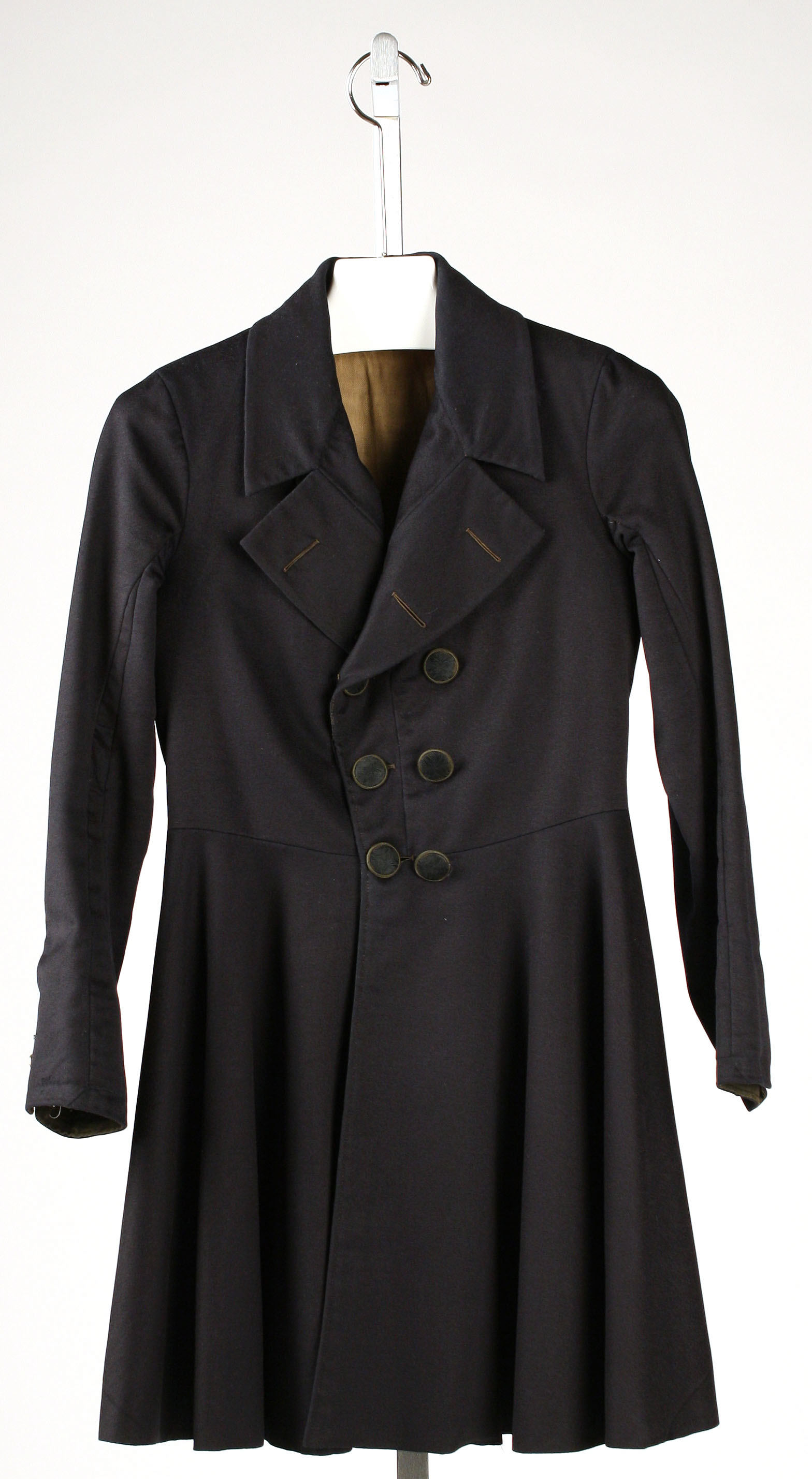
The Frock Coat: An American Study in Wool and Sartorial Authority
Within the disciplined vocabulary of menswear, few garments carry the historical weight and structural complexity of the frock coat. Often overshadowed in popular memory by its leaner descendant, the morning coat, and its informal cousin, the sack suit, the frock coat nonetheless represents a pivotal moment in the evolution of American tailoring. This standalone study examines the frock coat as a distinctly American articulation of woolen construction — a garment that negotiated the tension between European aristocratic inheritance and the democratic pragmatism of the New World.
Origins and Transatlantic Migration
The frock coat emerged in early nineteenth-century Europe as a riding garment, its name derived from the Middle English and Old French froc, denoting a loose outer tunic. By the 1820s, however, it had crossed the Atlantic and undergone a decisive transformation. American tailors, particularly in New York, Philadelphia, and Boston, adapted the silhouette to suit a republic that rejected overt courtly display yet demanded visible markers of professional standing.
What distinguished the American frock coat was not radical invention but calibrated restraint. Where English tailors often favored a pronounced waist suppression and a deeply curved front edge, their American counterparts pursued a marginally straighter line, a quieter shoulder, and a length that hovered just above the knee. This was a garment designed for the lawyer, the merchant, the physician, and the rising industrialist — men whose authority rested on competence rather than birthright.
Wool as Structural Medium
The choice of wool was neither incidental nor merely practical. Wool possessed the unique capacity to hold a tailored shape while draping with sufficient fluidity to accommodate the body's movement. American mills, particularly those in New England, developed worsted and woolen cloths that served the frock coat's dual demands: firmness in the chest and shoulder, suppleness in the skirt.
Heavier woolens — often in the twelve-to-sixteen-ounce range — were favored for winter coats, while lighter worsteds of eight to ten ounces dominated summer iterations. The fabric's natural elasticity allowed the tailor to sculpt a defined waist without the rigidity that silk or linen might impose. Moreover, wool's ability to take and hold a press meant that the frock coat's signature details — the roll of the lapel, the sharp crease of the sleeve, the controlled flare of the skirt — could be maintained through repeated wear.
Color palettes remained sober: charcoal, oxford grey, navy, and the occasional deep bottle green. Black was reserved for formal or mourning contexts. This chromatic discipline reflected the garment's function as a uniform of serious endeavor, not sartorial exhibitionism.
Construction and the American Tailoring Tradition
The frock coat's architecture reveals a sophisticated understanding of the body in three dimensions. Unlike the later sack suit, which relied on a relatively simple two-panel back, the frock coat demanded a multi-panel construction — typically a side body, a forepart, and a back, with additional darts or seams to manage the transition from chest to waist.
American tailors of the mid-nineteenth century, many trained in the English system but working within a distinct commercial environment, developed pattern-drafting methods that prioritized efficiency without sacrificing fit. The "American coat" as it appeared in trade manuals of the 1850s and 1860s featured a slightly higher armhole than its London counterpart, a concession to the greater arm mobility required by a society less bound by ceremonial stillness.
The skirt of the frock coat, cut with a gentle flare and often finished with a vent or pleat at the center back, allowed for stride and seat without distorting the upper body. This was a garment built for the courtroom, the counting house, and the street — spaces where a man might need to gesture, to turn, to sit and rise with frequency.
Decline and Legacy
By the 1890s, the frock coat was in retreat. The rise of the business suit — shorter, softer, and less encumbered by historical association — rendered it increasingly ceremonial. Yet its influence persisted. The frock coat established the template for the structured, woolen, authority-conferring garment that would define American menswear for the next century. The sack suit may have won the wardrobe, but the frock coat won the argument: that a man's clothing could be both democratic in spirit and rigorous in construction.
In the contemporary revival of interest in classic tailoring, the frock coat remains a touchstone. It reminds us that American style was never merely casual or derivative. It was, at its best, a deliberate synthesis — European technique, American context, and wool as the quiet, resilient medium that made it all possible.