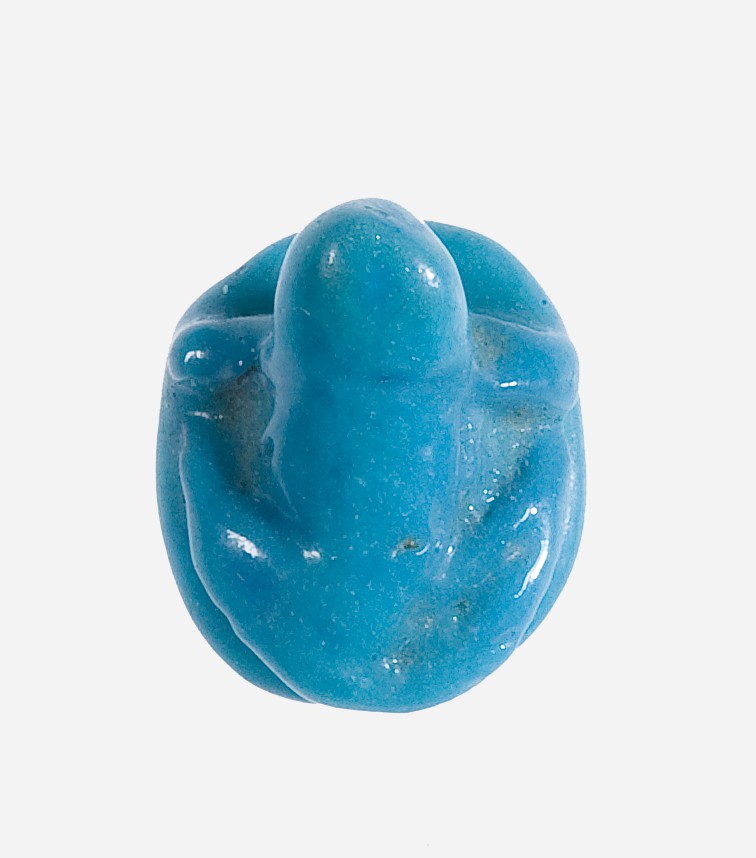
Executive Summary: The Frog Seal Amulet as a Strategic Heritage Asset
In the competitive landscape of 2026 luxury goods, authenticity and narrative depth have become the ultimate currencies. As Katherine Fashion Lab positions itself at the intersection of archaeological reverence and contemporary high-end design, the Frog Seal Amulet with a Sa Hieroglyph emerges as a singularly potent heritage asset. This small yet symbolically dense object—crafted in faience and originating from an ancient civilization—encapsulates themes of rebirth, protection, and sovereign power. For a luxury house seeking to differentiate through intellectual rigor and spiritual resonance, this amulet offers a blueprint for a collection that transcends mere adornment. This analysis examines its symbolic power, historical adornment context, spiritual meaning, and strategic application for 2026 luxury positioning.
Symbolic Power: The Frog and the Sa Hieroglyph
The frog in ancient civilizations—particularly in Egyptian and broader Near Eastern contexts—was not a creature of mere naturalism but a vessel of profound metaphysical significance. Associated with the goddess Heqet, the frog symbolized fertility, regeneration, and the annual inundation of the Nile, which brought life to the black land. Its amphibious nature represented liminality: the ability to exist between water and earth, chaos and order, death and rebirth. When rendered as a seal amulet, the frog became a portable talisman, a microcosm of cosmic renewal.
The Sa hieroglyph on the base elevates this object from a general symbol of fertility to a specific instrument of protection. The Sa sign—a stylized shepherd’s crook or folded cloth—was the ancient Egyptian hieroglyph for “protection” or “safeguard.” It was frequently carried by deities, kings, and ordinary individuals as a magical emblem. Inscribed on the underside of a frog amulet, the Sa hieroglyph creates a double-layered apotropaic device: the frog ensures regeneration, while the Sa ensures that this regeneration is shielded from harm. For Katherine Fashion Lab, this duality offers a powerful brand narrative: luxury as both renewal and defense, a talisman for the modern individual navigating a volatile world.
Historical Adornment: Faience as a Medium of Prestige
Faience—a sintered quartz paste with a vitreous, often turquoise or green glaze—was the high-tech material of the ancient world. Unlike gold or silver, which signified raw wealth, faience signified alchemical mastery and symbolic luminosity. Its blue-green hue evoked the Nile, turquoise, and the primordial waters of creation. Producing faience required precise control of temperature and chemistry, making it a luxury good accessible to elites and temple workshops. Seal amulets in faience were worn as rings, pendants, or integrated into bead nets, serving both as personal adornment and as administrative tools (seals for securing property).
This historical context is critical for Katherine Fashion Lab’s 2026 strategy. The frog seal amulet was not mass-produced trinket but a functional luxury item—simultaneously jewelry, signature, and spiritual technology. In an era where consumers demand provenance and purpose, positioning a collection around such an artifact allows the brand to claim a lineage of “intelligent adornment”—pieces that work on multiple levels: aesthetic, archival, and talismanic.
Spiritual Meaning: Protection, Rebirth, and Sovereign Identity
The spiritual ecosystem of the ancient world was transactional and material. Amulets were not metaphors; they were active agents. The frog seal with Sa hieroglyph would have been placed on the body of the deceased to ensure rebirth in the afterlife, worn by a pregnant woman for safe delivery, or carried by a traveler for protection against chaos. The Sa sign, often depicted in temple reliefs as being held by gods to shield the king, conferred a royal or divine mandate upon the wearer. Thus, the amulet democratized sovereignty: any individual could carry the same protective force as a pharaoh.
For 2026 luxury, this spiritual meaning translates into a powerful consumer proposition: wearable sanctuary. In a climate of economic uncertainty, climate anxiety, and digital fatigue, high-end consumers are seeking objects that offer grounding and agency. A Katherine Fashion Lab piece inspired by this amulet would not simply be a beautiful object; it would be a ritual tool for modern resilience. The frog’s rebirth symbolism aligns with post-pandemic and post-digital desires for renewal, while the Sa hieroglyph addresses the universal need for protection—whether from financial volatility, social fragmentation, or personal burnout.
Strategic Application for 2026 High-End Luxury
To translate this heritage analysis into a 2026 luxury strategy, Katherine Fashion Lab should adopt a three-pillar approach: material authenticity, narrative scarcity, and ritual engagement.
1. Material Authenticity: Reintroduce faience—or a modern equivalent such as recycled glass-ceramic composites with a hand-applied turquoise glaze—as a signature material. Position it against the overuse of gold and diamonds. Faience signals intellectual luxury: the wearer values craft, chemistry, and cultural memory over ostentatious bling. Collaborate with ceramic engineers to achieve the same depth of glaze as ancient workshops, and document the process in limited-edition “lab notes” for collectors.
2. Narrative Scarcity: The frog seal amulet was personal and often unique. Katherine Fashion Lab should produce numbered, seal-stamped editions of each piece, with the Sa hieroglyph hand-engraved on the reverse. Each amulet comes with a provenance card detailing the original artifact’s museum or excavation context (real or reconstructed). This creates a collectible lineage that appeals to the “quiet luxury” consumer who values story over logo.
3. Ritual Engagement: Launch a digital and physical “Protection Registry” where buyers can activate their amulet by choosing an intention—rebirth, safeguarding, or sovereignty. This transforms the purchase into a participatory ritual, bridging ancient practice with modern wellness culture. For VIP clients, host private viewings in museum-like salons, with the amulet displayed under focused light to highlight its faience glaze and hieroglyphic base.
Conclusion: From Ancient Seal to Modern Talisman
The Frog Seal Amulet with a Sa Hieroglyph is not a relic to be admired from a distance. It is a strategic template for a luxury brand that seeks to be meaningful, protective, and regenerative. By centering faience, frog symbolism, and the Sa hieroglyph, Katherine Fashion Lab can claim a unique position in the 2026 market: a house that offers not just adornment, but archaeologically grounded empowerment. In a world of noise, the quiet croak of a frog—and the silent promise of protection—may prove to be the most luxurious sound of all.