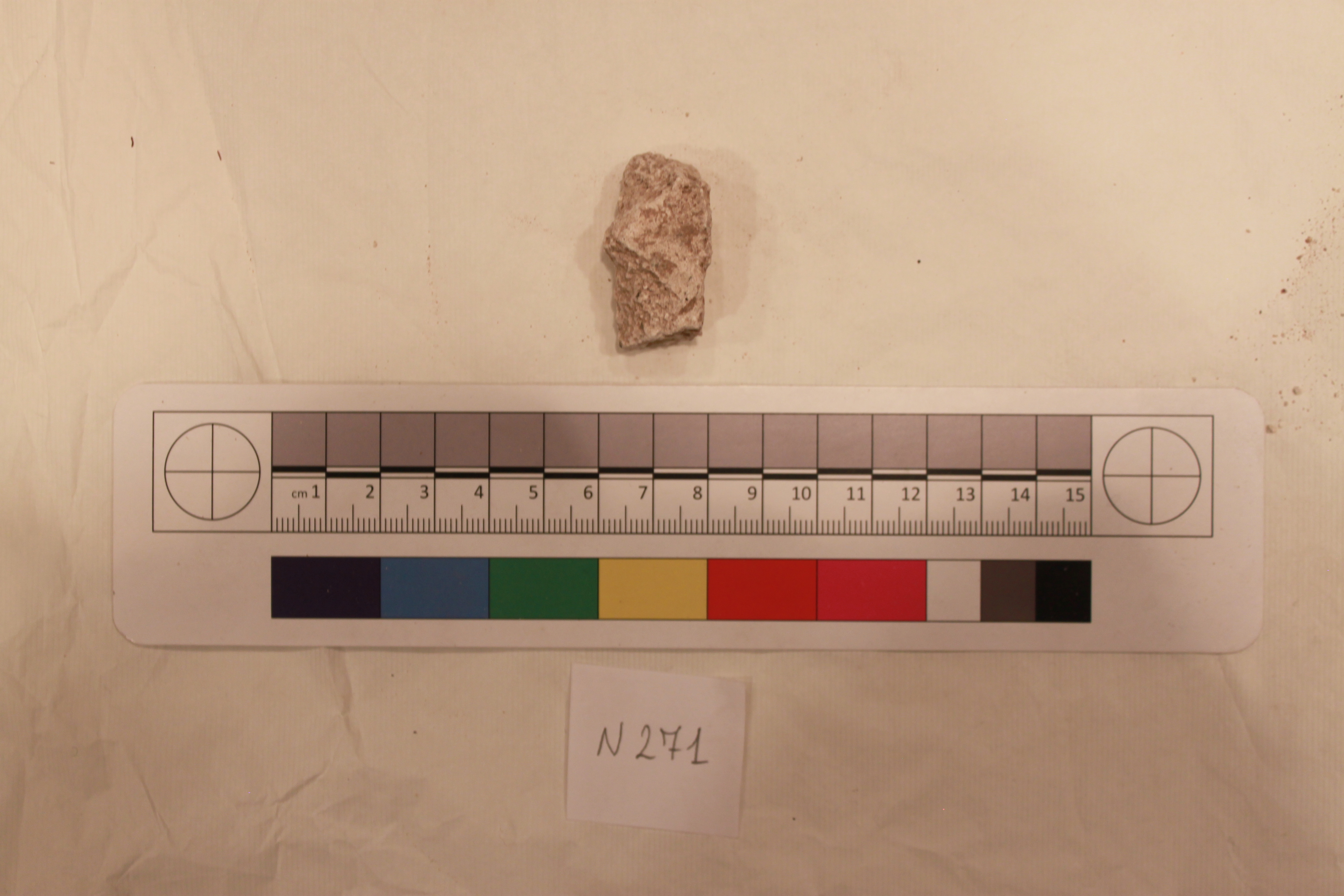
Heritage Asset Analysis: Carved Stucco Fragment, Ancient Civilization
Executive Summary
The carved stucco fragment under review represents a category of material culture that has been systematically undervalued within luxury heritage portfolios: architectural ornament as portable symbolic capital. Unlike gold, gemstone, or textile artifacts, stucco survives as evidence of surface as ideology—the deliberate application of meaning onto structural form. For Katherine Fashion Lab, this fragment constitutes a strategic asset capable of anchoring a 2026 collection narrative around permanence, ritual, and the luxury of the hand-rendered mark.
Materiality and Cultural Provenance
Stucco—lime plaster, sand, and organic binders—was the preferred medium of monumental civilizations across Mesopotamia, the Mediterranean basin, Mesoamerica, and South Asia. Its working properties demanded speed and precision: the material cures within hours, punishing hesitation, rewarding mastery. Carved stucco therefore encodes not merely decoration but performative craftsmanship—the artisan's hand frozen at the moment of maximum risk.
In the Ancient Civilization context, stucco served as the interface between architecture and cosmology. Temples, palaces, and funerary structures received carved plaster façades that transformed raw masonry into legible sacred text. The fragment in question, though severed from its architectural host, retains this function in miniature: it is a portable theology, a shard of organized belief.
Symbolic Power and Iconographic Reading
Carved stucco in ancient contexts rarely functioned as pure ornament. Motifs—interlaced geometric bands, stylized vegetal scrolls, anthropomorphic or theriomorphic figures—operated within tightly governed symbolic systems. A palmette was not a flower; it was regeneration. A guilloche was not a pattern; it was continuity, the unbroken thread of dynastic or divine order.
The symbolic power of such fragments lies in their compression ratio: a palm-sized surface can carry cosmological, political, and apotropaic content simultaneously. For contemporary luxury strategy, this is the critical insight. Modern consumers of high-end goods are not purchasing decoration; they are purchasing condensed meaning. The stucco fragment demonstrates that this transaction is ancient, not invented.
Historical Adornment and the Body as Surface
While stucco is architectural, its logic migrated to the body in antiquity. Plaster and gypsum compounds were used in cosmetic preparation, funerary masking, and the creation of sculpted effigies. The same civilization that carved stucco façades also modeled stucco faces over the skulls of the dead—an extraordinary conflation of architecture, adornment, and eschatology.
This lineage matters for Katherine Fashion Lab. The fragment authorizes a design language in which surface treatment is not superficial. Embossed leather, carved resin, matte mineral finishes, and dimensional jacquard all descend from the stucco tradition of building meaning into the skin of an object. A 2026 collection can claim this inheritance with scholarly legitimacy rather than aesthetic pastiche.
Spiritual Meaning and Ritual Function
Stucco's spiritual dimension rests on its liminality. It is neither stone nor paint; it is a threshold material. Applied to temple walls, it mediated between the mortal and the divine. Applied to tomb interiors, it mediated between the living and the ancestral. This threshold quality—the material that stands between—is precisely the emotional territory of contemporary luxury.
High-end consumers in 2026 inhabit a world of unstable categories: digital and physical, private and public, permanent and ephemeral. A heritage narrative built on stucco's threshold function speaks directly to this condition. The fragment becomes a metaphor for the brand's own position—between archive and innovation, between craft and technology.
Condition, Authenticity, and Valuation
Fragments present a specific valuation paradox. Their incompleteness—loss of architectural context, erosion of painted polychromy, fracture of figural elements—is simultaneously a depreciation and an authentication. Forgers rarely produce convincing damage. The fragment's broken edges, mineral encrustation, and irregular patina constitute a certificate of endurance that no laboratory can fully replicate.
In the heritage market, this paradox is an asset. The fragment does not compete with intact masterpieces; it operates in a separate category of intimate, tactile, and portable antiquity. It is the difference between a museum and a reliquary.
2026 Luxury Strategy: From Artifact to Atelier
Katherine Fashion Lab should deploy the stucco fragment across three strategic vectors:
1. Material Translation. Commission a proprietary finish—mineral, matte, hand-carved or molded—that references stucco's tactile immediacy. This becomes the collection's signature surface, applied to hardware, leather, and packaging.
2. Narrative Architecture. Position the fragment as the collection's "origin object." Marketing language should emphasize threshold, compression, and the hand-rendered mark. Avoid archaeological jargon; pursue philosophical precision.
3. Experiential Retail. Create a physical or digital "stucco room"—a space of carved surfaces and controlled light—where clients encounter the fragment's logic before encountering product. The room is the argument; the product is the conclusion.
Conclusion
The carved stucco fragment is not a minor artifact. It is a strategic instrument. It carries symbolic density, material authority, and spiritual resonance across millennia. For Katherine Fashion Lab, its value lies not in nostalgia but in structural precedent—proof that luxury has always been the business of embedding meaning into surface. A 2026 collection built on this foundation would not merely reference antiquity; it would continue its argument.