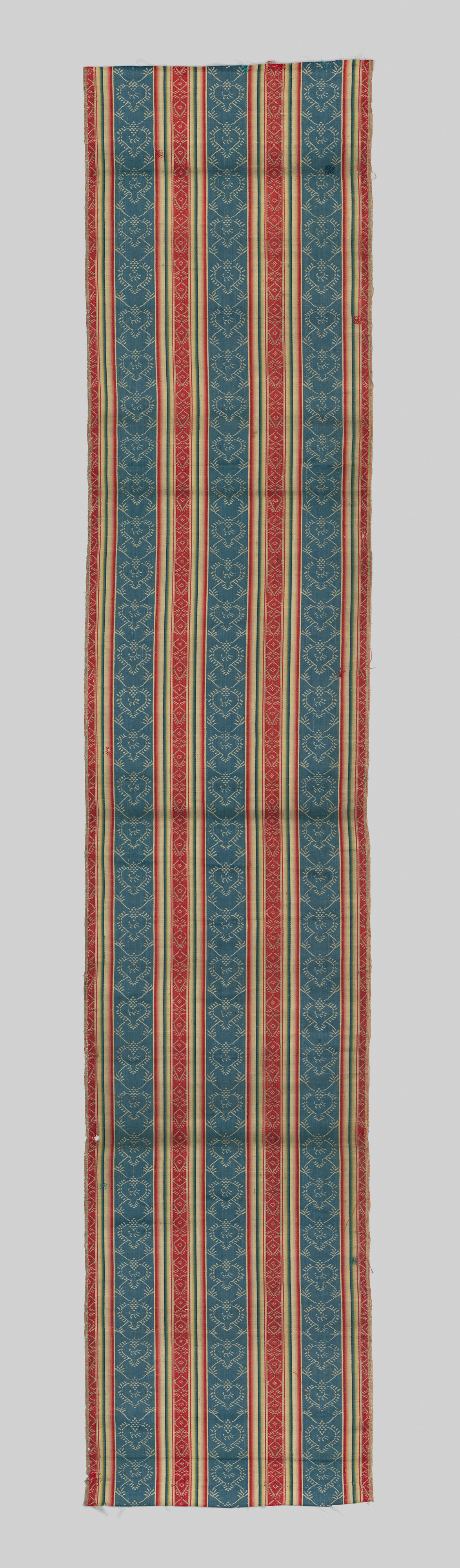
Calimanco Wool: A Study in Length, Lustre, and the Global Textile Economy
Calimanco occupies a peculiar and often misunderstood position within the history of European and Atlantic textiles. A worsted wool fabric with a distinctive glazed surface, it flourished from the late seventeenth through the early nineteenth century, circulating through the wardrobes of colonial merchants, provincial gentry, and fashionable metropolitan consumers alike. Yet the aspect of Calimanco that most repays sustained analysis is not its sheen, nor its complex weave structure, but its length—the specific dimensions in which it was woven, sold, and ultimately consumed. Length, in the Calimanco trade, was never a neutral measurement. It was a commercial instrument, a regulatory device, and a semiotic code that communicated status, function, and geographic origin.
This standalone study examines the length of wool Calimanco as a lens through which to understand the global heritage of early modern textile production. By treating length as a culturally and economically constructed category rather than a mere physical property, we can recover the complex negotiations between weavers, merchants, regulators, and consumers that shaped this remarkable fabric.
Defining Calimanco: Material and Manufacture
Calimanco—also rendered as calamanco, calamanca, or calimanco—was a worsted wool cloth characterized by a smooth, tightly woven face and a lustrous, often glazed finish. Unlike broadcloth, which was fulled and napped to produce a felted surface, Calimanco was woven from combed worsted yarns, which gave it a harder, more reflective hand. The fabric was typically woven in solid colours or with subtle stripes and checks, and its glaze was achieved through calendering—pressing the cloth between heated rollers or plates to flatten the surface and enhance its sheen.
The principal centres of Calimanco production were Norwich and Norwich-adjacent weaving districts in eastern England, though significant quantities were also produced in the Low Countries, particularly in Flanders and the Dutch Republic. By the eighteenth century, Calimanco had become a staple of the Atlantic trade, exported to North America, the Caribbean, and West Africa, where it was exchanged for enslaved people, raw materials, and colonial produce. Its durability, relative affordability, and adaptable appearance made it a fabric of extraordinary geographic reach.
Length as Commercial Instrument
The length of a piece of Calimanco was never arbitrary. In the English worsted trade, lengths were standardized according to regional custom and regulatory statute. A "piece" of Norwich Calimanco might measure anywhere from twenty to thirty yards, though surviving merchant records indicate considerable variation. This variation was not accidental; it reflected the fabric's position within a fragmented and highly competitive market.
Length functioned first as a unit of commercial calculation. Weavers were paid by the piece, merchants sold by the yard, and retailers marked up by the piece or the remnant. A shorter piece allowed greater flexibility in pricing and reduced the capital outlay required to enter the trade, while a longer piece offered economies of scale in weaving and finishing. The choice of length therefore encoded a series of economic decisions that reached from the loom to the shop counter.
Length also served as a regulatory instrument. English statutes governing the worsted trade, particularly those enacted under Elizabeth I and later refined in the seventeenth and eighteenth centuries, specified minimum and maximum lengths for various cloth types, including Calimanco. These regulations were designed to protect consumers from short measure and to maintain the reputation of English cloth abroad. A weaver who produced a piece shorter than the statutory minimum risked fines, seizure of goods, or loss of trade privileges. In this sense, length was a matter of public trust as much as private profit.
Length, Geography, and Global Heritage
The global heritage of Calimanco is inseparable from the geography of its lengths. English Calimanco tended to be woven in longer pieces, reflecting the scale of Norwich's industrial organization and the demands of long-distance export. Dutch and Flemish Calimanco, by contrast, was often produced in shorter lengths, suited to the denser, more localized markets of the Low Countries and the Rhine corridor. When these fabrics met in colonial ports—in Boston, Charleston, Kingston, or Cape Coast—their differing lengths became markers of origin and quality.
Merchants' correspondence from the eighteenth century reveals a keen awareness of these distinctions. A Boston shopkeeper might specify "Norwich calamanca, twenty-eight yards the piece" as opposed to "Dutch calamanca, eighteen yards," knowing that the former carried a premium in the American market. Length, in this context, was a proxy for provenance, and provenance was a proxy for quality. The global circulation of Calimanco thus depended on a shared vocabulary of measurement that allowed buyers and sellers across oceans to negotiate value without inspecting the cloth in person.
Consumption and the Semiotics of Length
For the consumer, the length of a Calimanco piece determined not only how much fabric was available but also what could be made from it. A full-length piece of twenty-eight yards could yield a complete woman's gown, petticoat, and matching accessories, while a shorter remnant might be reserved for a waistcoat, a pair of breeches, or a set of chair covers. The length of the fabric thus mapped onto the social and material aspirations of the purchaser.
In colonial North America, where imported textiles were both prized and expensive, the length of a Calimanco piece became a visible sign of a household's access to global markets. A long piece, carefully conserved and reused over decades, testified to the durability of the fabric and the prudence of its owner. A short piece, by contrast, might indicate a more modest purchase or a remnant acquired at auction. Length, in other words, was never merely a physical dimension; it was a social text.
Conclusion: The Measure of a Fabric
The length of wool Calimanco offers a rich and underutilized entry point into the study of early modern textiles. By attending to length as a constructed category—shaped by regulation, commerce, geography, and consumption—we can move beyond purely aesthetic or technical accounts of the fabric and recover the complex human networks that produced, traded, and wore it. Calimanco's global heritage lies not only in its lustrous surface or its worsted structure but in the measured lengths that carried it from the looms of Norwich and Flanders to the shops, homes, and bodies of the Atlantic world. To study its length is to study the fabric of global commerce itself.