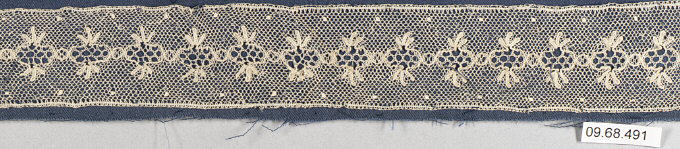
Insertion: The Architecture of Absence in Bobbin Lace
Within the taxonomy of textile construction, insertion occupies a paradoxical position: it is a technique defined not by what it adds, but by what it separates. Unlike appliqué, which layers ornament upon a ground, or embroidery, which enriches a surface from within, insertion operates at the seam—the interstitial zone where two otherwise independent planes of fabric are held apart and joined by a third, mediating structure. In the context of bobbin lace, this mediating structure becomes the principal aesthetic event. The insertion is not merely a functional bridge; it is a deliberate orchestration of void, tension, and transparency that transforms garment construction into a study of negative space.
This standalone study examines insertion as a global heritage technique, tracing its material logic through the specific demands of bobbin lace and considering its enduring relevance to couture practice. The analysis proceeds from the premise that insertion is best understood as an architectural proposition: a method of building with air.
Historical Foundations: From Utility to Ornament
The origins of insertion as a textile strategy predate the codification of lace itself. In numerous global traditions—from the filet nets of Mediterranean fishing communities to the ñandutí of Paraguay and the punto in aria of Renaissance Italy—the joining of narrow woven bands through decorative openwork served both structural and symbolic purposes. Insertion allowed garments to be shaped without cutting, to be enlarged without waste, and to be adorned without the weight of additional layers.
Bobbin lace, which emerged as a distinct craft in sixteenth-century Europe, refined insertion into a virtuosic discipline. The technique required the lacemaker to manipulate multiple pairs of bobbins—sometimes hundreds—around a parchment pricked with pin holes, weaving threads into a stable yet porous fabric. When such lace was used as an insertion, it was typically worked in narrow strips, or passements, designed to be set between two edges of linen, silk, or wool. The resulting garment possessed a dual identity: solid where the ground fabric prevailed, ethereal where the insertion intervened.
This duality was not lost on the couturiers of the nineteenth and early twentieth centuries. Charles Frederick Worth, often credited as the father of haute couture, employed bobbin lace insertions to articulate bodices and sleeves, using the technique to create the illusion of a garment held together by nothing more than shadow. His successors—Jacques Doucet, the Callot Soeurs, and later Cristóbal Balenciaga—continued to exploit insertion’s capacity to render the body simultaneously covered and revealed.
Material Logic: The Bobbin Lace Insertion
To understand insertion in bobbin lace is to understand a specific set of material constraints. Bobbin lace is constructed thread-by-thread, with each pair of bobbins acting as a discrete unit of tension. Unlike needle lace, which can be built up in any direction from a single thread, bobbin lace proceeds linearly, following the pricked pattern. This linearity makes it exceptionally well suited to insertion, which is itself a linear format: a strip, a band, a ribbon of openwork.
The structural integrity of a bobbin lace insertion depends on three factors: the ground, the motif, and the footing. The ground—whether a simple tulle, a hexagonal fond de neige, or a more complex résau—provides the transparent matrix. The motif—floral, geometric, or figurative—supplies the decorative content. The footing, or pied, is the reinforced edge that allows the lace to be sewn to the ground fabric without distortion. In insertion work, the footing is paramount: it must be stable enough to bear the weight of the adjacent fabric yet delicate enough to disappear into the seam.
This tripartite structure gives bobbin lace insertion its characteristic rhythm. The eye travels along the strip, registering the alternation of opacity and transparency, density and dissolution. The insertion becomes a kind of visual punctuation, a caesura in the continuous surface of the garment. It is, in essence, a form of textile syntax.
Global Heritage: Insertion Across Cultures
While bobbin lace insertion is most closely associated with European traditions—Belgian Bruges and Binche, French Valenciennes and Chantilly, English Honiton—the technique’s underlying logic resonates across global heritage practices. In Japanese sashiko, insertion of indigo-dyed cotton between layers of hemp creates both reinforcement and pattern. In West African adire and kente, narrow strip weaving produces bands that are subsequently joined with openwork seams, creating garments that are simultaneously modular and monumental. In Andean awa weaving, insertion of supplementary warps creates decorative bands that function as both structure and sign.
What unites these disparate traditions is a shared understanding of insertion as a form of articulation. The insertion does not merely join; it announces the join. It makes visible the otherwise invisible operation of construction. In an age of seamless digital fabrication, this visibility carries renewed significance. The insertion is a human trace, a record of the hand’s negotiation with material.
Couture Applications: Insertion as Design Strategy
For the contemporary couturier, bobbin lace insertion offers a repertoire of design possibilities that extend far beyond historical pastiche. Consider three strategic applications:
First, insertion as structural device. By placing bobbin lace strips at stress points—shoulders, waistlines, hips—the designer can create garments that appear to float, held together by lace alone. The insertion absorbs tension while distributing it across a wider area, allowing for greater freedom of movement and a more nuanced drape.
Second, insertion as chromatic intervention. Because bobbin lace is typically worked in a single thread color, insertion can introduce a subtle shift in tone without disrupting the garment’s overall palette. A white lace insertion between two panels of ivory silk creates a shimmering boundary, a line of light that defines the silhouette without hard edges.
Third, insertion as narrative element. In narrative-driven couture—collections that tell a story through material and form—insertion can function as a visual refrain. Repeated at intervals, a specific bobbin lace pattern becomes a motif, a signature that threads through the collection like a whispered refrain.
Conclusion: The Ethics of the Interstice
Insertion, particularly in bobbin lace, is more than a technique. It is an ethical proposition about the relationship between parts and wholes, between presence and absence, between the made and the unmade. In a cultural moment preoccupied with sustainability and waste reduction, insertion offers a model of construction that honors the integrity of every element. Nothing is cut away; nothing is discarded. The insertion holds the garment together by holding it apart.
For Katherine Fashion Lab, the study of insertion is not an exercise in nostalgia but an investment in a future where couture is defined by its intelligence as much as its beauty. The bobbin lace insertion—fragile, precise, and endlessly adaptable—remains one of the most eloquent arguments for the hand’s enduring place in the architecture of dress.