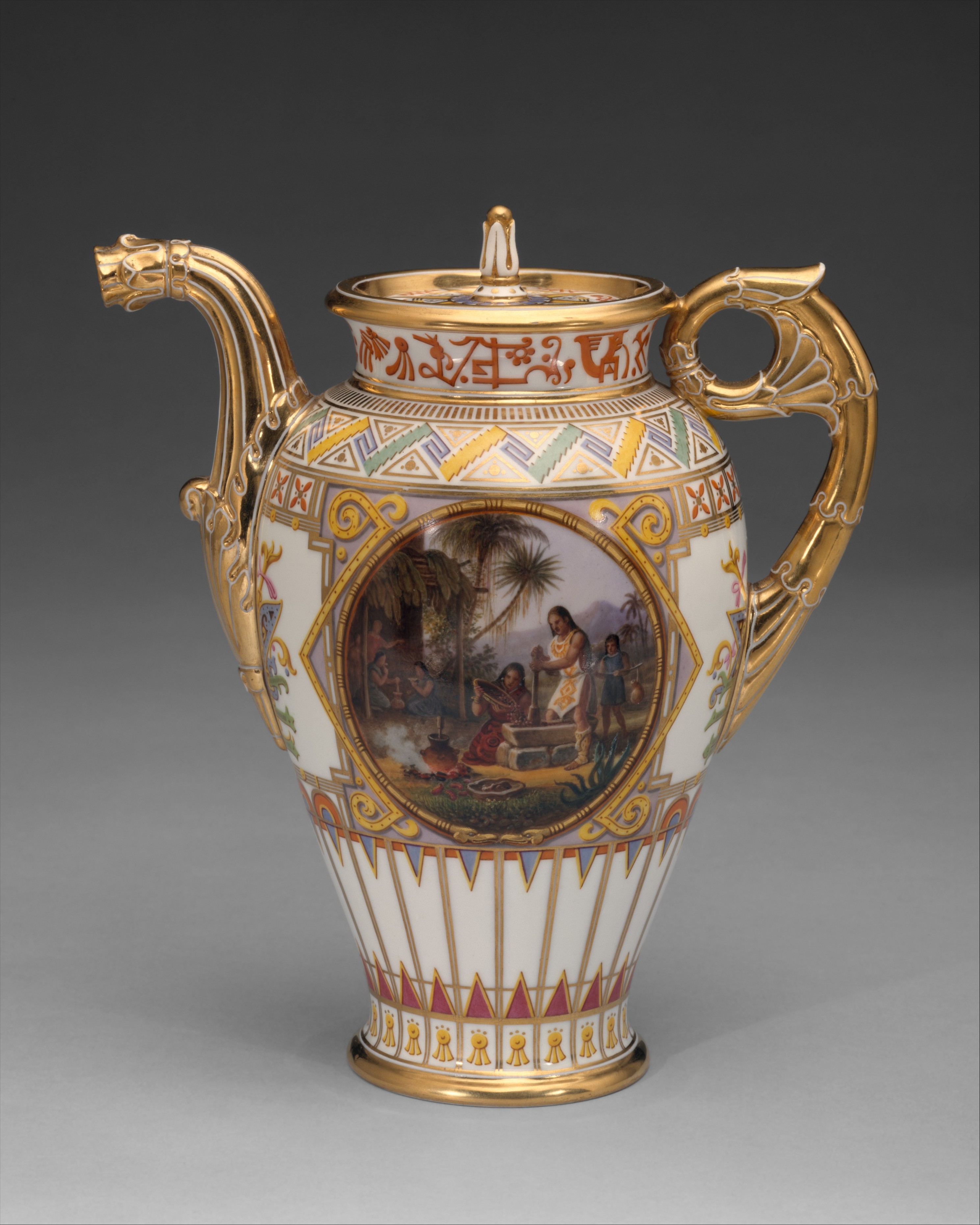
Heritage Analysis: The Campanian Cafétière as Vessel of Symbolic Power
Object Provenance and Material Distinction
The object under examination—a coffeepot, or cafétière "campanienne," belonging to a larger service—represents one of the most intellectually fertile intersections in the history of decorative arts: the deliberate archaeological revival of an ancient visual vocabulary executed in the most technologically advanced medium of its own age. Hard-paste porcelain, decorated in polychrome enamels and fired with gold, was itself a triumph of eighteenth-century European material science, a ceramic body capable of rivaling the vitreous density of Asian porcelain while accommodating the neoclassical taste that dominated the period. The designation "campanienne" references the Campanian region of southern Italy and, more precisely, the corpus of red-figure and black-glaze pottery recovered from sites such as Pompeii, Herculaneum, and the broader Vesuvian landscape. The cafétière thus performs a double act of homage: it borrows the ornamental logic of antiquity while asserting the technical supremacy of the modern atelier.
For Katherine Fashion Lab, the strategic significance of this object lies in its layered authenticity. It is not a forgery of antiquity but an interpretive translation—a luxury object that converts archaeological memory into contemporary ritual. This distinction is central to any heritage strategy that seeks to operate above the threshold of mere reproduction.
Symbolic Power and the Architecture of the Table
The coffeepot occupies a privileged position within the ceremonial architecture of the dining or salon table. Unlike the plate or the bowl, which serve individual consumption, the cafétière presides over the act of distribution. It is a vessel of mediation, standing between the host and the guest, between the prepared substance and the receiving cup. In the ancient Mediterranean world, the equivalent function was performed by the oinochoe and the krater, vessels that poured wine and mixed it according to ritual proportion. The campanienne decoration, with its scrolling palmettes, laurel bands, and mythic figures, invokes precisely this lineage of controlled outpouring. To pour from such a pot is to perform an act that antiquity would have recognized as sacred in structure, even if the beverage itself—coffee—arrived in Europe only in the seventeenth century.
The gold employed in the decoration is not ornamental indulgence but a material signifier of incorruptibility. In funerary and votive contexts across the ancient world, gold denoted the imperishable element of the human person, the spark that survives dissolution. When applied to the surface of a porcelain coffeepot, gold transfers this connotation of permanence onto the ritual of hospitality. The host who pours from a gilded campanienne vessel is, symbolically speaking, dispensing something that partakes of the eternal.
Historical Adornment and the Grammar of Ornament
The polychrome enamels of the cafétière "campanienne" follow a decorative grammar that was codified in the eighteenth century through the systematic publication of antiquarian folios—most notably the volumes of the Antichità di Ercolano and the engravings of Giovanni Battista Piranesi. These publications transformed the fragmented material record of antiquity into a reproducible design language. The pot's ornament therefore carries within it the entire apparatus of Enlightenment archaeology: the excavation, the documentation, the engraving, and finally the ceramic transcription.
This chain of transmission is itself a form of adornment. The object is decorated not only with painted motifs but with the prestige of scholarship. It signals that its owner belongs to a class capable of reading classical references and of commissioning objects that encode them. In the hierarchy of luxury goods, this intellectual patina is often more valuable than the raw materials. Katherine Fashion Lab should understand that the campanienne service is not simply a set of tableware but a portable library of taste.
Spiritual Meaning and the Ritual of the Cup
Beneath the archaeological and aesthetic layers lies a spiritual dimension that is easily overlooked in secular interpretations. The ancient Campanian vessels that inspired this coffeepot were frequently deposited in tombs, their interiors stained with the residue of funerary libations. They were understood as conduits between the living and the dead, instruments by which the living could nourish the departed and, in turn, receive their favor. When the eighteenth-century porcelain manufactory adopted this vocabulary for a coffee service, it did not necessarily intend a funerary reading—but the unconscious resonance remained.
Coffee itself, in the European imagination, was long associated with sobriety, conversation, and the life of the mind—a counterpoint to the intoxication of wine. The cafétière thus becomes a vessel of clarified consciousness, a modern counterpart to the ancient libation cup but directed toward the cultivation of reason rather than the propitiation of shadows. This duality—ancient chthonic form, Enlightenment rational content—gives the object its peculiar spiritual charge.
Strategic Implications for 2026 Luxury Positioning
As Katherine Fashion Lab develops its heritage narrative for the 2026 luxury market, the cafétière "campanienne" offers a template for strategic standalone research that transcends mere product description. Three imperatives emerge.
First, provenance as narrative architecture. The object's value is not located in any single attribute—porcelain, gold, or Campanian reference—but in the synthesis of these elements into a coherent story of cultural transmission. Luxury consumers in 2026, particularly those in the high-net-worth bracket, are increasingly resistant to generic heritage claims. They demand specificity, documented lineage, and intellectual substance. The campanienne service delivers all three.
Second, ritual as product experience. The coffeepot is a performative object. Its use requires gesture, timing, and an audience. Katherine Fashion Lab should consider how contemporary luxury rituals—the private tasting, the salon dinner, the collector's unveiling—can be structured around such objects, transforming ownership into participation in a continuous historical practice.
Third, material integrity as ethical signal. Hard-paste porcelain and gold are durable, repairable, and inherently archival. In a market increasingly skeptical of disposable luxury, the campanienne cafétière embodies intergenerational value. It is an object designed to outlive its owner and to accumulate meaning across decades. This aligns with the 2026 consumer's desire for purchases that function as cultural stewardship rather than mere consumption.
In sum, the cafétière "campanienne" is not a footnote to the history of European ceramics but a concentrated expression of how luxury objects mediate between the ancient and the modern, the sacred and the social, the material and the symbolic. For Katherine Fashion Lab, it represents a strategic asset: a heritage object whose symbolic power, historical adornment, and spiritual resonance can be activated to define a luxury proposition that is at once intellectually rigorous and commercially compelling.