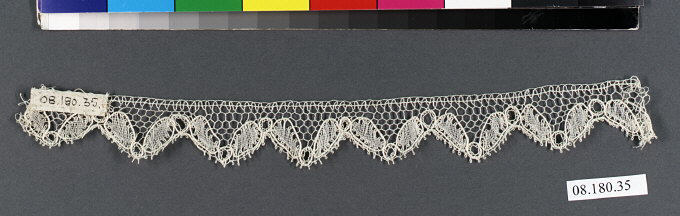
Fragment as Autonomous Object: The Curatorial Turn in Bobbin Lace
Within the contemporary couture atelier, the fragment has undergone a decisive ontological shift. No longer merely the residue of a damaged whole, the isolated section of textile now operates as a self-sufficient aesthetic proposition. Katherine Fashion Lab approaches this phenomenon through a specific lens: the bobbin lace fragment treated not as salvage, but as standalone study. This analysis examines how a single material—bobbin lace—when divorced from its original garment context and framed within a global heritage narrative, generates meaning that exceeds its functional origins. The fragment, in this reading, becomes a site of concentrated intentionality, where the hand of the maker, the memory of the pattern, and the material logic of the thread converge.
Material Specificity: Bobbin Lace as Structural Archive
Bobbin lace is not a passive surface. Unlike needle lace, which builds stitch upon stitch from a single thread, bobbin lace is woven—plaited, twisted, and crossed—using multiple pairs of bobbins wound with thread. The technique, developed independently across European centers from the sixteenth century onward, produces a textile that is simultaneously porous and architectural. Each motif is a record of tension: the weight of the bobbins, the rhythm of the lacemaker's hands, the humidity of the workshop air. When we isolate a fragment of bobbin lace, we are not extracting a decorative swatch. We are extracting a structural archive—a dense inscription of technical decisions made in real time.
The material's global heritage is irreducible. Flemish, French, Italian, and later Brazilian and Indian lace traditions each inflected the bobbin technique with local thread types, regional pattern vocabularies, and distinct finishing methods. A fragment from a Binche lace border carries different tension signatures than one from a Bedfordshire piece. Yet the fragment as standalone study allows these differences to be read comparatively, without the hierarchy imposed by complete garments. The fragment democratizes the archive: a torn section of seventeenth-century Flemish lace and a contemporary experimental bobbin sample can occupy the same analytical plane.
The Fragment as Curatorial Unit: Decontextualization and Recontextualization
To present a bobbin lace fragment as a standalone study is to perform a deliberate curatorial act. The fragment is decontextualized from its original garment—a cuff, a collar, an altar cloth—and recontextualized within a new frame. This is not loss. It is translation. The fragment loses its indexical relationship to a specific body or ritual, but it gains autonomy as a formal object. The eye is no longer distracted by the garment's silhouette or the wearer's movement. Instead, the viewer confronts the lace's internal logic: the density of the ground, the relief of the raised motifs, the negative space that the threads negotiate.
Katherine Fashion Lab's approach to this curatorial turn is neither nostalgic nor archaeological. The fragment is not presented as a relic to be mourned. It is presented as a proposition. What happens when we treat a section of bobbin lace as we would a drawing or a maquette? The answer lies in the fragment's capacity to hold multiple temporalities. The pattern may be historical, the thread may be contemporary, the tension may be the result of a maker working today from a nineteenth-century pricking. The fragment is a palimpsest, and its standalone status makes that palimpsest legible.
Global Heritage and the Ethics of Extraction
Any discussion of fragment and global heritage must confront the ethics of extraction. Bobbin lace traditions are living practices, not static inheritances. To isolate a fragment from a Brazilian renda de bilros or a Croatian paški čipka is to enter a conversation about ownership, attribution, and cultural continuity. The standalone study, if it is to be intellectually honest, must acknowledge that the fragment's beauty is inseparable from the labor and locality that produced it. Global heritage is not a flat category. It is a contested field where power, trade, and migration have always shaped which lace survives and which is forgotten.
Katherine Fashion Lab's position is that the fragment can function as a critical object only if its provenance is made visible. The standalone study does not erase origin; it reframes origin as a layer of meaning. A fragment of bobbin lace from a Portuguese workshop and a fragment from a Filipino embroidery cooperative may share technical similarities, but their heritage contexts are distinct. The fragment as curatorial unit must hold both the formal equivalence and the historical difference in tension.
Conclusion: The Fragment as Future Archive
The bobbin lace fragment, when treated as a standalone study, is not a diminished thing. It is a concentrated one. It asks the viewer to read closely, to attend to the grain of the thread and the logic of the twist. It asks the curator to resist the urge to reconstruct a phantom whole. And it asks the fashion theorist to reconsider the hierarchy that privileges the complete garment over the partial textile. In the context of global heritage, the fragment is both a witness and a prompt. It witnesses the skill of anonymous makers across centuries and geographies. It prompts us to imagine new wholes—not restorations, but recombinations. The fragment, in this sense, is not the end of a garment. It is the beginning of a method.