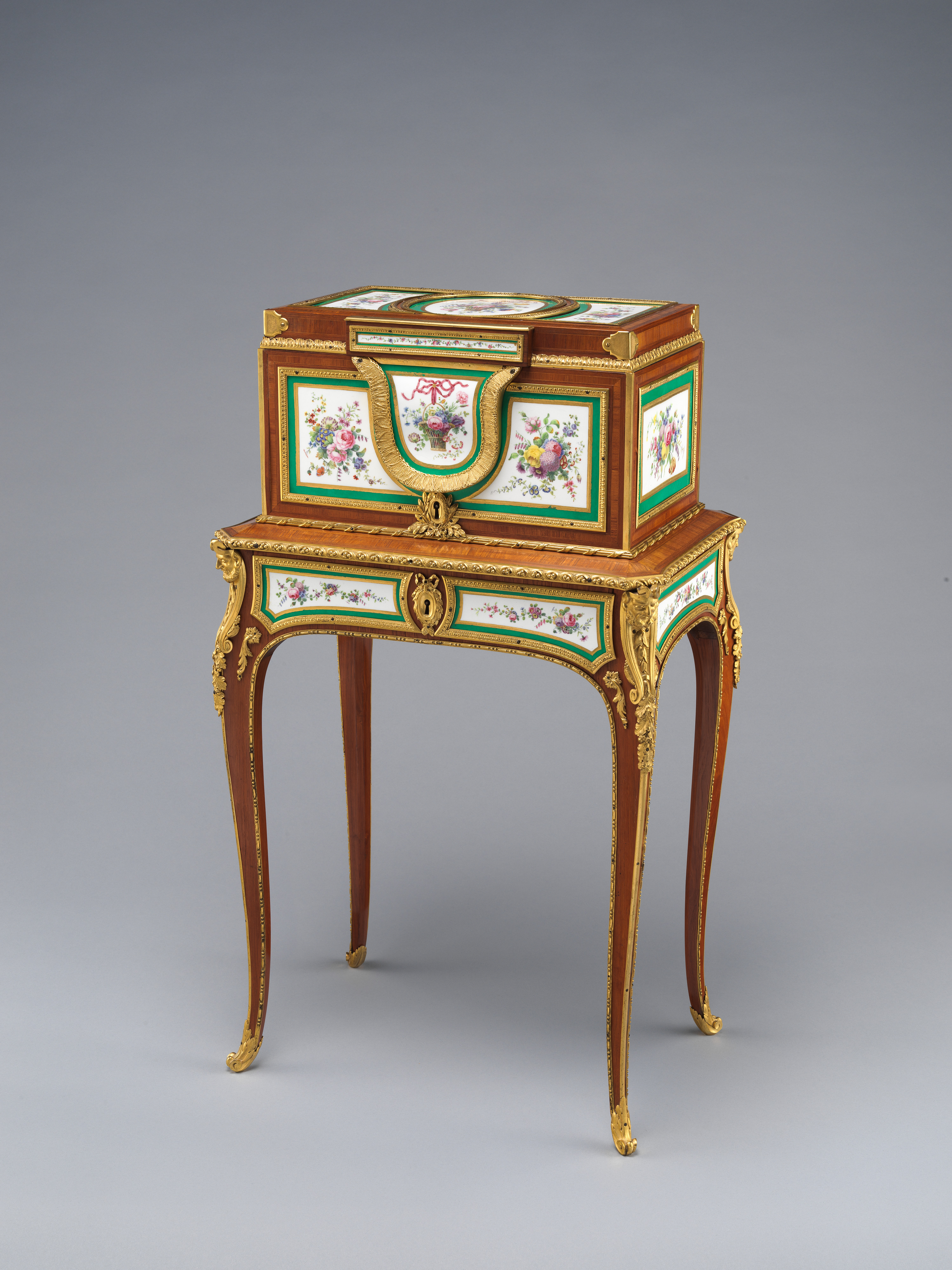
The Jewel Coffer on Stand: A Microcosm of Global Aspiration
Presented for standalone study, this exquisite petit coffre à bijoux transcends its primary function as a jewelry casket to emerge as a profound statement of 18th-century cosmopolitanism and technical virtuosity. Originating from a nexus of Global Heritage, rather than a single atelier, the piece is a material testament to a world interconnected by trade, curiosity, and the relentless pursuit of luxury. Its construction—oak veneered with tulipwood, sycamore, holly, and ebonized holly, adorned with thirteen soft-paste porcelain plaques and gilt-bronze mounts—represents a deliberate curation of the era’s most prized materials, each with its own geographic and symbolic lineage. This analysis deconstructs the coffer not merely as an object of storage, but as a wearable architecture of identity, reflecting the same principles of composition, contrast, and narrative that underpin contemporary haute couture.
Material Cartography: The Veneer as a World Map
The substrate of solid oak speaks to Northern European tradition—a robust, reliable foundation. Upon this, a meticulously assembled cartography of precious woods unfolds. Tulipwood, with its distinctive pinkish hue and fine grain, was a costly import from the Americas, cherished in French ebenisterie. Sycamore, often stained green or left pale, and the stark contrast of holly and ebonized holly, represent a mastery of European marquetry techniques. This practice of parquetry and marquetry is not simple decoration; it is a geometric language. The precise, intricate patterns—likely chevrons, cubes, or star motifs—create a rhythmic, almost architectural skin. In a couture context, this translates directly to the art of tailoring and fabric manipulation: the structured oak is the garment’s inner architecture (the canvas interlining), while the complex veneer is the exquisite, perfectly matched jacquard or intricate lace overlay, where every seam and pattern join must be flawlessly executed to create a unified, mesmerizing surface.
The Porcelain Plaques: Fragile Narratives in a Hard World
The thirteen soft-paste porcelain plaques constitute the piece’s most eloquent dialogue with Global Heritage. In the 18th century, porcelain was the ultimate alchemical luxury, its secret fervently pursued from Meissen to Sèvres. Soft-paste porcelain, a European attempt to emulate Chinese hard-paste, embodies this moment of aspirational synthesis. Each plaque is a miniature canvas, likely depicting pastoral scenes, romantic vignettes, or chinoiserie fantasies—themselves imported cultural motifs. Their integration into the wooden carcass via gilt-bronze settings is a technical marvel, acknowledging the material tension between fragile ceramic and sturdy wood. Couture finds its parallel here in the application of delicate, hand-painted embroideries, fragile glass beading, or sculptural lace appliqués onto a structured garment. Each plaque is like an emblematic brooch or a structured textile jewel, strategically placed to draw the eye and interrupt the wood’s geometry with a moment of pictorial softness. Their arrangement is a study in balance and focal points, much like the placement of embellishment on an evening gown’s bodice or skirt.
Gilt-Bronze Mounts: The Architectural Couture
The gilt-bronze mounts are the functional couture of the object—the hardware that elevates craft to art. These chased, cast, and fire-gilded elements—handles, corner guards, keyhole escutcheons, and feet—serve a protective purpose while providing rhythmic punctuation and luminous contrast. The brilliance of the gold against the muted wood and cool porcelain creates a hierarchy of light. This is analogous to the role of hardware in couture: the precise placement of a gilded zip, the sculptural curve of a hook-and-eye, the weight and sparkle of a custom-designed clasp. These are not hidden but celebrated, contributing to the aesthetic and structural integrity. The mounts frame the porcelain plaques and the veneered sections, acting as bezels for jewels and seams for fabric panels, guiding the viewer’s tactile and visual journey around the form.
The Stand and the Silhouette
The inclusion of the original stand is critical, transforming the coffer from a box into a sculptural presence, a totem. It elevates the object, literally and figuratively, demanding reverence and offering a 360-degree viewing experience. This relationship mirrors the couture garment on its stand, where the silhouette is fully revealed and the back view is accorded as much importance as the front. The stand’s design, likely featuring cabriole legs and continuations of the marquetry or mount motifs, extends the object’s language, creating a complete, holistic entity. The current velvet lining, though not original, continues a tradition of creating a sensorial, protective interior—the soft, plush counterpart to the hard, glittering exterior, much like the silk charmeuse lining of a tailored wool coat.
Context: A Standalone Study in Modern Relevance
As a standalone study, this Jewel Coffer offers the Katherine Fashion Lab a pristine case study in principles perennially relevant to couture. It demonstrates the art of synthesis—bringing disparate, globally-sourced materials into a harmonious whole. It exemplifies textural and material contrast—the warmth of wood against cool porcelain, the matte of velvet against the sheen of gilt-bronze. Most importantly, it embodies narrative. This was not a mere container; it was a proclamation of the owner’s worldliness, taste, and access to the networks of global trade. It held personal treasures within a treasure itself.
In contemporary terms, this coffer inspires a design philosophy where a garment is a portable archive of craftsmanship. It challenges designers to consider each element—the foundational fabric (the oak), the intricate surface detail (the marquetry), the applied narrative elements (the porcelain plaques), and the functional hardware (the mounts)—as contributors of equal importance to a singular, aspirational vision. It reminds us that true luxury lies in this fearless, masterful fusion, creating objects—and garments—that are not just used, but read, studied, and revered as microcosms of the world that made them.