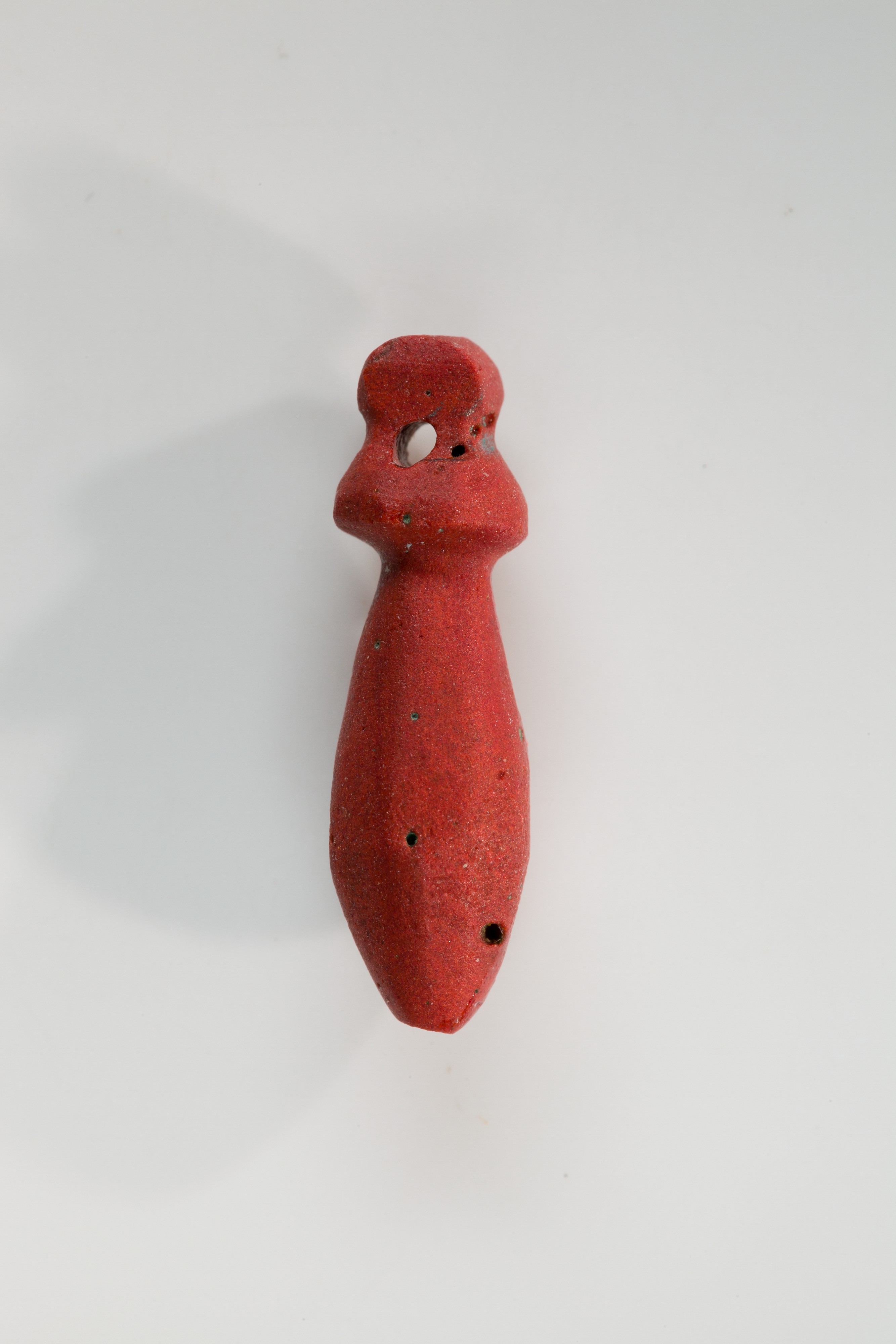
Strategic Heritage Analysis: The Papyrus Scepter (Wadj) Amulet in Red Glass
Introduction: A Material Contradiction Worth Owning
Within Katherine Fashion Lab's expanding portfolio of heritage-driven research, few artifacts present as compelling a strategic proposition as the papyrus scepter amulet—the wadj—rendered in red glass. This object occupies a rare intersection: a symbol of vegetative renewal and youthful vigor, executed in a material associated with solar fire, vitality, and the transmutation of base matter. For a luxury house positioning itself at the confluence of archaeology and contemporary adornment, the wadj amulet in red glass offers not merely a motif but a complete narrative architecture: origin, meaning, materiality, and cultural endurance across more than three millennia.
This analysis examines the wadj through four strategic lenses—symbolic power, historical adornment, spiritual meaning, and 2026 luxury positioning—to determine its viability as a standalone heritage pillar for Katherine Fashion Lab.
Symbolic Power: The Scepter That Refuses to Wither
The wadj scepter, typically depicted as a rolled papyrus scroll or a stylized stalk with a flared top, was among the most semantically dense emblems in ancient Egyptian iconography. The term itself derives from a root meaning "to be green," "to flourish," or "to be vigorous." Unlike the heka (crook) and nekhakha (flail), which signified rulership and discipline, the wadj operated on a different register entirely: it was the emblem of perpetual renewal, carried by deities, pharaohs, and the blessed dead alike to signal undiminished vitality.
In amulet form, the wadj was not merely decorative. It was a functional instrument of metaphysical insurance. Placed among the wrappings of the deceased or worn in life, it asserted that the bearer's youth, strength, and generative capacity would not decay. The papyrus plant itself reinforced this claim: it grew abundantly in the Nile Delta, its triangular stalk a symbol of Lower Egypt, and its use in the sema-tawy (union of the Two Lands) iconography tied the wadj to political cohesion as well as personal regeneration.
Strategically, this dual valence—personal vitality and collective order—gives the wadj a breadth of narrative application that narrower symbols lack. It can anchor a collection about renewal, about legacy, about the body politic of a brand as much as the body of a wearer.
Historical Adornment: From Tomb to Torso
Amulets of the wadj form appear in Egyptian archaeological contexts from at least the Middle Kingdom, with production intensifying through the New Kingdom and Late Period. They were fashioned in a remarkable range of materials: faience, carnelian, lapis lazuli, gold, and—critically for our purposes—red glass. The choice of red glass is not incidental. In Egyptian color theory, red (desher) was associated with the sun's power, with blood, with the god Set in his protective aspect, and with the fiery energy of life itself. Glass, introduced as a luxury medium in the Eighteenth Dynasty, was itself a prestige material, often reserved for royal workshops and elite burial assemblages.
A wadj in red glass therefore represents a double luxury: a symbol of vitality executed in a material of vitality, produced by a technology of vitality (vitreous transformation). Such amulets were worn in life as pendants or rings, and placed in death among the protective assemblage of the mummy. The historical wearer was not choosing between fashion and function; the object was simultaneously ornament, talisman, and theological statement.
For Katherine Fashion Lab, this historical precedent legitimizes a design philosophy in which adornment is never merely aesthetic. The wadj in red glass offers a ready-made argument that jewelry can carry meaning without sacrificing visual refinement—a position increasingly valuable in a luxury market fatigued by empty logoism.
Spiritual Meaning: The Metaphysics of Green in Red
The spiritual logic of the wadj amulet is a study in productive paradox. The papyrus is green—the color of Osiris, of resurrection, of the fertile silt. Yet the amulet under consideration is red—the color of the solar disk at dawn and dusk, of the life-force (ka) itself. This chromatic tension is not a contradiction but a deliberate metaphysical fusion: the green principle of renewal is activated and empowered by the red principle of vital heat. The bearer does not merely hope to endure; the bearer is ignited into endurance.
This layered symbolism resonates with contemporary luxury consumers who seek objects of personal significance and energetic intention. The wadj in red glass can be positioned as an amulet for the modern wearer who navigates professional reinvention, creative rebirth, or the preservation of personal vitality under pressure. Its spiritual proposition is not otherworldly but immanent: strength, youth, and flourishing are not promised in an afterlife but claimed in this one.
2026 Luxury Strategy: Positioning the Wadj Collection
As Katherine Fashion Lab plans its 2026 heritage-led collections, the wadj in red glass should be treated as a strategic standalone pillar rather than a supporting motif. Three positioning moves are recommended:
First, material authenticity as differentiator. The house should develop a proprietary red glass—hand-poured, kiln-formed, and chemically stable—that references ancient Egyptian vitreous technology without descending into costume reproduction. The material itself becomes the signature.
Second, narrative scarcity. The wadj is not a widely commercialized symbol. Unlike the ankh or the scarab, it retains a degree of scholarly obscurity that affords the house first-mover authority in the luxury segment. Educational content—short-form heritage films, collector's dossiers, museum partnerships—can build a moat around the motif.
Third, wearable metaphysics. The 2026 consumer, particularly in the high-net-worth bracket, is increasingly drawn to objects that perform both adornment and affirmation. The wadj collection should be marketed not as Egyptian-themed jewelry but as instruments of renewal, with each piece accompanied by a provenance narrative and a contemporary intention.
Conclusion: The Strategic Case for the Wadj
The papyrus scepter amulet in red glass is more than an artifact of ancient adornment. It is a compact, portable, and emotionally legible system of meaning—one that aligns with Katherine Fashion Lab's mandate to translate heritage into high-value contemporary luxury. Its symbolic power is durable, its historical pedigree is deep, its spiritual proposition is resonant, and its 2026 market positioning is, as of this writing, uncontested. The wadj does not merely represent renewal. For this house, it may well be the instrument of it.