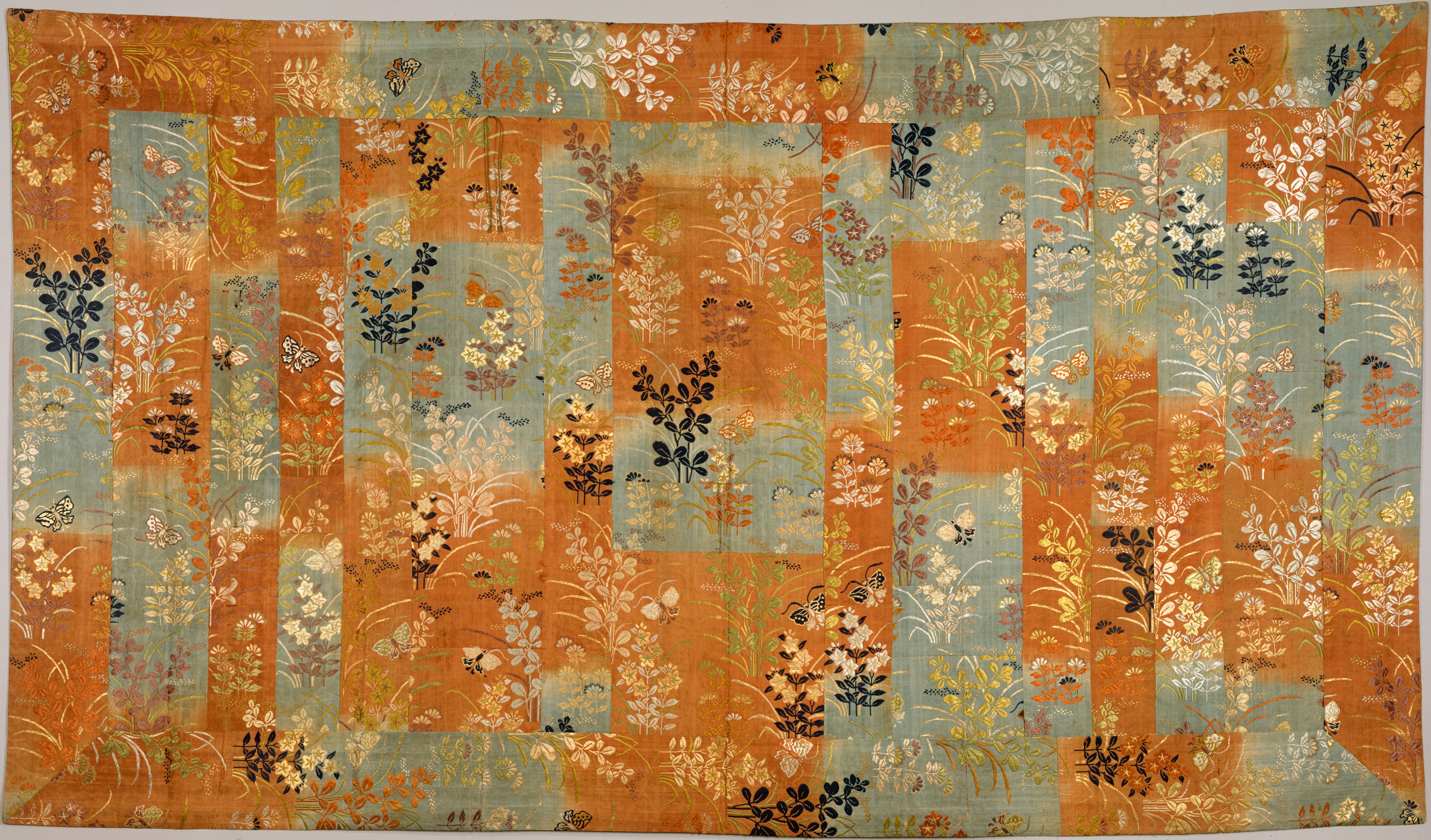
Introduction: The Kesa as a Site of Material Conversion
Within the disciplined parameters of Japanese textile practice, few objects embody the tension between renunciation and aesthetic refinement as compellingly as the kesa—the patched robe worn by ordained Buddhist monks and nuns. The example under examination here is a singular case: a kesa whose constituent fabric was originally a Noh costume of the karaori type, woven in twill-weave silk and brocaded with both silk and metallic thread, patterned with autumn grasses and butterflies. This object is not merely a garment; it is a palimpsest of Japanese cultural history, wherein the theatrical aesthetics of the Edo period were ritually dismantled and reassembled into a vehicle for monastic discipline. As a standalone study, it invites us to consider how material transformation can function as both a theological statement and an art-historical document.
The Kesa: Function, Form, and Symbolic Economy
The kesa (Sanskrit: kaṣāya) is the quintessential Buddhist vestment, traditionally sewn from discarded rags in a patchwork configuration known as funzō-e. Its form encodes the Buddha's instruction to monks to wear robes made from refuse—a practice that inculcated detachment from material desire. Yet by the medieval and early modern periods in Japan, elite patrons commissioned kesa from luxurious silks, often donated as votive offerings. The garment thus became a paradox: a symbol of renunciation executed in the most costly materials available. This particular kesa, fashioned from a karaori Noh robe, intensifies that paradox by explicitly repurposing a garment associated with theatrical spectacle and aristocratic display.
Karaori: The Noh Costume as Woven Surface
Karaori (literally "Chinese weave") is a type of Noh costume worn primarily in female roles. It is characterized by a twill-weave silk ground densely brocaded with silk and metallic threads, producing a surface of extraordinary tactile and optical complexity. The example in question features autumn grasses and butterflies—a motif that in Japanese visual culture signals the transient beauty of the natural world. Autumn grasses (akikusa) evoke the season of decay and melancholy, while butterflies (chō) carry associations of metamorphosis, fragility, and the fleeting nature of existence. In the context of Noh, such motifs are not merely decorative; they are semiotic devices that situate the drama within a specific emotional and seasonal register.
From Stage to Altar: The Mechanics of Conversion
The transformation of a karaori Noh costume into a kesa required the systematic dismantling of the original garment. The fabric would have been unpicked, cut into rectangular panels, and reassembled according to the prescribed patchwork format of the kesa. This process is itself a ritual act: the theatrical costume, designed to be seen and admired, is fragmented and reordered into a garment whose primary function is to be worn in meditation and ritual. The original motifs—autumn grasses and butterflies—do not disappear; they persist, but their meaning is altered. What was once a sign of aesthetic refinement on the Noh stage becomes, in the kesa, a reminder of impermanence. The butterfly, which in Noh might symbolize a spirit or a lover, now gestures toward the Buddhist doctrine of anicca (impermanence). The autumn grasses, once evocative of seasonal poignancy, now underscore the inevitability of decay and the futility of attachment.
Materiality and Meaning: Silk, Metal, and the Aesthetics of Renunciation
The material composition of this kesa—twill-weave silk brocaded with silk and metallic thread—demands close attention. Silk itself is a protein fiber produced by the silkworm, a creature whose life cycle (larva, cocoon, moth) is itself a metaphor for transformation. The metallic thread, likely comprising gold or silver leaf wrapped around a silk core, introduces a quality of luminosity that would have been visible in candlelit temple interiors. The kesa, when worn, would have caught the light, its gold threads shimmering against the matte twill ground. This is not the aesthetic of poverty; it is the aesthetic of conspicuous renunciation—a phenomenon familiar in the anthropology of religion, where the rejection of worldly goods is performed through the very materials that signify worldly wealth.
The Butterfly and the Autumn Grasses: Iconographic Tension
The iconography of the original karaori is worth unpacking in detail. Autumn grasses in Japanese art typically include susuki (pampas grass), kikyō (bellflower), hagi (bush clover), and ominaeashi (patrinia). These plants are codified in classical poetry and painting as markers of the seventh, eighth, and ninth lunar months. Butterflies, meanwhile, appear in the Genji monogatari and in Noh plays such as Kochō (The Butterfly), where they symbolize the soul or the transient nature of love. When these motifs are transferred to a kesa, they undergo a semantic shift. The butterfly, no longer a theatrical emblem of erotic longing, becomes a memento mori. The autumn grasses, no longer a poetic evocation of a specific season, become a generalized meditation on the passing of all phenomena. This is not a loss of meaning but a recontextualization—a process by which the same visual signs are made to serve a radically different ideological purpose.
Provenance, Patronage, and the Politics of Donation
Kesa made from Noh costumes were typically produced through donation. A wealthy patron—perhaps a daimyo, a merchant, or a member of the imperial court—would offer a valuable karaori to a temple, where it would be converted into a kesa for a senior monk. This act of donation served multiple functions: it earned religious merit for the donor, it demonstrated the donor's refined taste and cultural capital, and it reinforced the symbiotic relationship between elite secular culture and institutional Buddhism. The resulting kesa was therefore a social document as much as a religious object. It recorded the donor's wealth, the temple's prestige, and the aesthetic sensibilities of a particular historical moment. In the case of this kesa, the choice of a karaori with autumn grasses and butterflies suggests a donor with a sophisticated understanding of Noh and its symbolic vocabulary—someone who recognized that the themes of transience and metamorphosis in the original costume would resonate with Buddhist doctrine.
Standalone Study: Methodological Implications
Treating this kesa as a standalone study allows us to focus on the object itself—its material, its construction, its iconography—without subordinating it to a larger narrative of Noh costume history or Buddhist vestment typology. This approach reveals the kesa as a hybrid object that resists easy categorization. It is neither purely a Noh costume nor purely a Buddhist vestment; it is a third thing, produced by the collision of two cultural systems. The twill weave and metallic brocade belong to the world of theatrical display; the patchwork format and ritual function belong to the world of monastic discipline. The autumn grasses and butterflies belong to both, but with different meanings in each context. By attending to these details, we can begin to understand how Japanese artisans and patrons thought about materiality, meaning, and the transformative power of religious practice.
Conclusion: The Kesa as Palimpsest
This kesa, made from a karaori Noh costume with autumn grasses and butterflies, is a remarkable artifact of Japanese cultural history. It demonstrates that the boundaries between the sacred and the secular, the theatrical and the devotional, were not fixed but permeable. The transformation of a Noh costume into a Buddhist vestment was not a simple act of recycling; it was a deliberate theological and aesthetic statement. The silk and metallic threads that once shimmered on the Noh stage now shimmer in the temple, but their meaning has been inverted. The butterfly that once symbolized love now symbolizes impermanence. The autumn grasses that once evoked a season now evoke the passing of all things. In this inversion, the kesa becomes a meditation on the relationship between beauty and detachment, between the world of appearances and the world of ultimate truth. It is, in the end, a garment that wears its own history—a palimpsest of Japanese religion, theater, and material culture.