Toward a Taxonomy of the Towel End: Textile Hierarchy and the Semiotics of the Domestic Edge
The towel end occupies a curious position within the broader discourse of textile arts: it is at once a functional terminus and a site of concentrated aesthetic expenditure. Within the collections of major decorative arts museums, these narrow, embroidered bands—often detached from their original woven support—have been catalogued variously as fragments, borders, or standalone studies. Yet to approach the towel end as a mere trimming is to misread the object's semiotic density. In the context of global heritage, the towel end functions as a liminal artifact: it marks the boundary between the utilitarian and the ceremonial, the domestic and the liturgical, the everyday hand and the ritualized body.
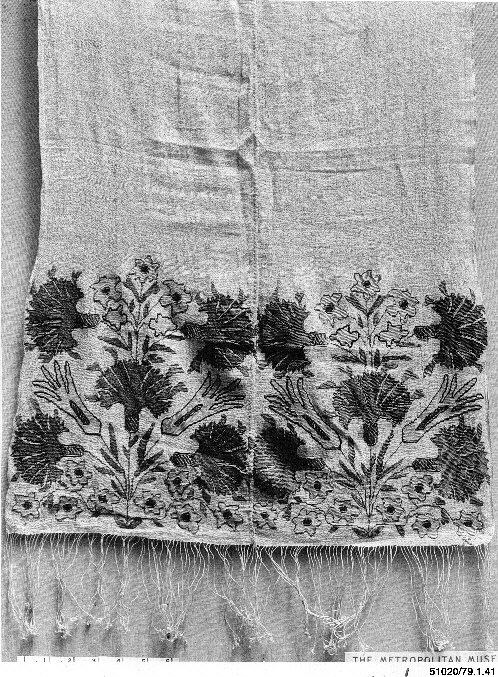
This analysis examines a standalone towel end executed in linen and silk with metal-wrapped thread, worked in plain weave with supplementary embroidery. The object's material composition alone signals a deliberate hierarchy of value: the linen ground provides a durable, absorbent substrate—itself a marker of domestic utility—while the silk and metallic embroidery introduces a register of luxury and permanence that exceeds the functional requirements of drying hands or covering bread. The coexistence of these materials within a single artifact constitutes a deliberate aesthetic argument about the relationship between use and ornament.
Materiality and the Logic of the Ground
The choice of linen as the foundational weave is neither incidental nor neutral. Linen, derived from the flax plant, has historically been associated with ritual purity across Mediterranean and Northern European cultures. Its natural luster, tensile strength, and resistance to microbial degradation made it the preferred substrate for ecclesiastical linens, table napery, and domestic toweling alike. In plain weave, the linen ground achieves a balanced, stable structure—an ideal canvas for embroidery that requires precise registration of stitch and tension.
The introduction of silk into this matrix complicates the object's material narrative. Silk, with its protein-based fibroin structure, possesses a refractive quality that linen lacks; it catches light rather than absorbing it. When silk floss is used for embroidery, the resulting surface becomes dynamic, shifting in appearance according to the angle of illumination. This optical variability is further intensified by the inclusion of metal-wrapped thread—typically a silk or linen core wound with flattened silver or silver-gilt strip. Such thread is historically associated with ecclesiastical vestments, court dress, and ceremonial textiles, where its reflective properties were understood to signify divine radiance or temporal authority.
The technical decision to embroider rather than weave the decorative elements is significant. Embroidery operates additively; it builds meaning layer by layer, stitch by stitch. In the case of this towel end, the embroidery likely follows a predetermined pattern—perhaps a geometric repeat, a floral scroll, or a heraldic motif—executed in satin, stem, or couching stitches. Couching, in particular, is the preferred technique for metal-wrapped thread, as it minimizes the stress on the fragile metallic strip while allowing the embroiderer to create broad, reflective surfaces. The result is a surface that is simultaneously tactile and visual, inviting both touch and gaze.
Function, Ritual, and the Domestic Edge
To understand the towel end's cultural significance, one must consider the broader category of "towel" in pre-industrial and early modern contexts. The towel was not merely a utilitarian object for drying; it was a marker of hospitality, hygiene, and social distinction. In Islamic, Byzantine, and Western European traditions, elaborately decorated towels were used in ritual contexts: to cover the chalice during the liturgy, to wrap the newborn during baptism, to present gifts during diplomatic exchange, or to adorn the hands of honored guests during feasts.
The towel end, as the most visible and handled portion of the textile, became the primary site for decorative elaboration. It was the edge that would be seen, touched, and remembered. In this sense, the towel end functions as a form of semiotic capital: it communicates the owner's access to skilled labor, costly materials, and cosmopolitan taste. The presence of metal-wrapped thread, in particular, would have been legible to contemporary viewers as a sign of significant economic investment. Gold and silver threads were not merely decorative; they were stores of value, subject to sumptuary laws and often recycled from older textiles.
Cross-culturally, the towel end reveals striking parallels. In Ottoman Turkey, peşkir towels with embroidered ends were produced in court workshops and presented as gifts to foreign envoys. In Safavid Persia, similar textiles were woven in silk and metal thread, often featuring poetic inscriptions or figural scenes. In Renaissance Italy, asciugamani with lace or embroidered borders were included in dowry inventories and displayed on sideboards as markers of familial prestige. The towel end thus emerges as a global form—a shared solution to the problem of how to make the utilitarian edge speak.
Standalone Study: The Fragment as Epistemological Object
The fact that this towel end exists as a standalone study—detached from its original linen body—raises important methodological questions for the textile historian. Fragmentation is not merely loss; it is also revelation. When a textile is separated from its functional context, its material and technical properties become more legible. The embroidery can be examined without the distraction of the larger ground; the metal-wrapped thread can be analyzed for alloy composition; the silk can be tested for dye provenance.
At the same time, the standalone fragment resists complete interpretation. Without the original towel, we cannot know its dimensions, its pattern repeat, or its precise use context. We cannot determine whether the embroidery ran along a single edge or bordered the entire textile. The fragment is thus a site of both evidence and absence—a material trace that demands a form of speculative reconstruction.
For Katherine Fashion Lab, the towel end serves as a productive case study in the relationship between material hierarchy and cultural meaning. It demonstrates that even the most ostensibly marginal textile—a band at the end of a towel—can function as a sophisticated vehicle for aesthetic expression, technical innovation, and social signaling. The object invites us to reconsider the boundaries between art and craft, luxury and utility, fragment and whole. In its interweaving of linen, silk, and metal, the towel end becomes a miniature cosmology of value: the humble ground and the radiant figure, the durable and the precious, held together in a single, embroidered edge.
Conclusion: The towel end is not an afterthought but an argument. It argues that the edge matters, that the domestic can be ceremonial, and that the fragment can carry the weight of an entire cultural logic. In the global heritage of textile arts, it stands as a quiet but insistent testimony to the human impulse to ornament the boundary—to make the place where the hand meets the cloth a place of meaning.