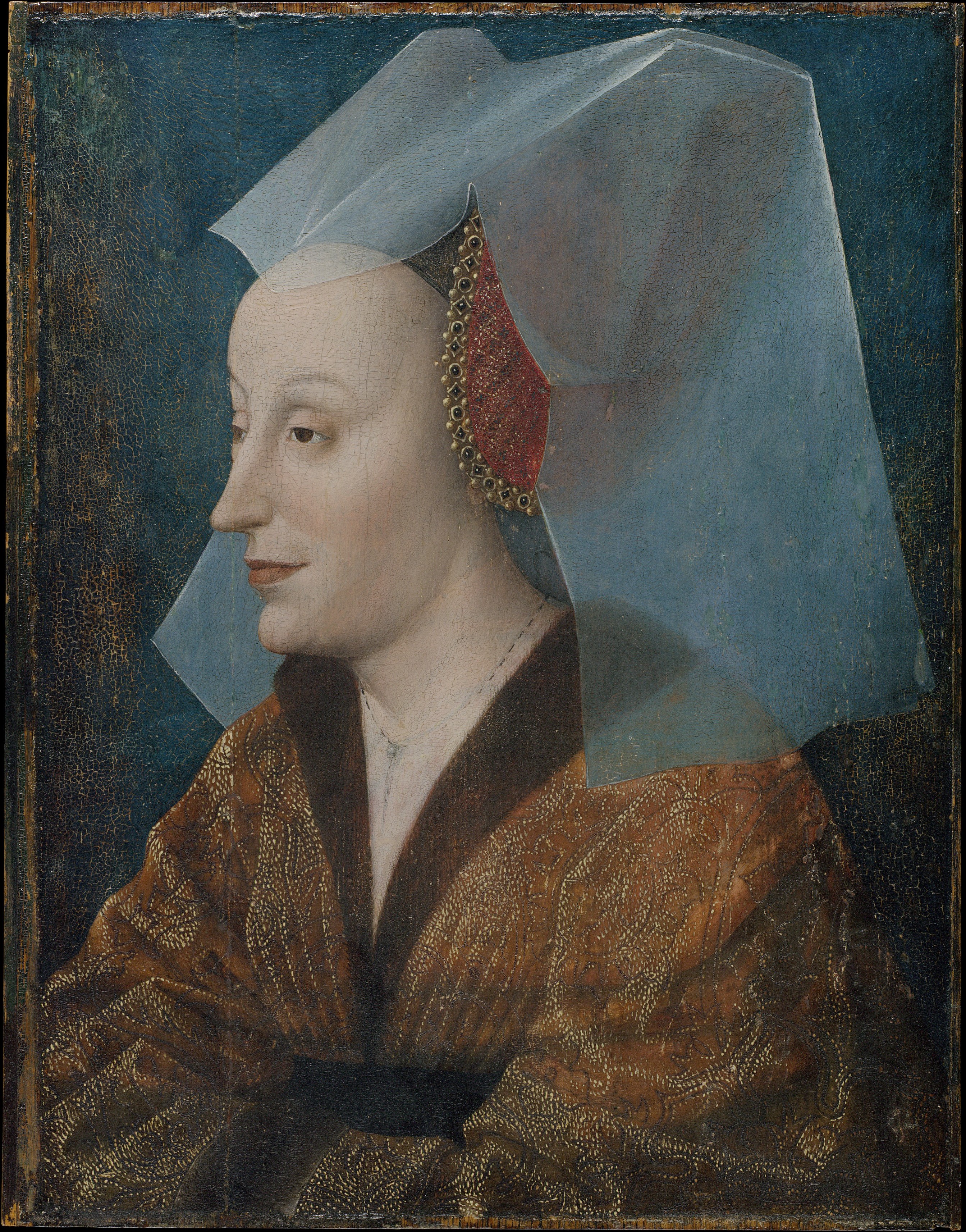
Portrait of a Noblewoman, Probably Isabella of Portugal (1397–1472): A Heritage Analysis for Katherine Fashion Lab
Introduction: The Portrait as a Strategic Artifact
The Portrait of a Noblewoman, Probably Isabella of Portugal (1397–1472) occupies a critical position in the visual economy of early Netherlandish and Iberian court culture. Attributed to the circle of Rogier van der Weyden and executed in oil on wood, the panel depicts a woman whose identity—while debated—has been persuasively linked to Isabella of Portugal, Duchess of Burgundy. For Katherine Fashion Lab, this artifact is not merely a historical curiosity. It is a case study in how adornment functions as a compressed language of power, piety, and dynastic ambition—a language that luxury brands in 2026 must learn to speak fluently.
Symbolic Power: Dress as Diplomatic Infrastructure
Isabella of Portugal entered the Burgundian court in 1430 as the third wife of Philip the Good. Her portrait, whether a life study or a posthumous idealization, encodes a visual diplomacy that modern luxury houses would recognize as brand architecture. The black gown—likely velvet or fine wool—is not simply mourning attire. In the Burgundian context, black was the color of imperial gravitas, a deliberate rejection of the chromatic exuberance of lesser courts. It signaled restraint, fiscal prudence, and moral seriousness.
The headdress—a truncated henin or a closely fitted cap of reticulated goldwork—frames the face with architectural precision. Its function is twofold: to expose the forehead (a marker of noble lineage and unimpeded intellect) and to display metalwork of controlled opulence. The jewels are not scattered; they are strategically positioned at the neckline and along the headdress edge, creating a vertical axis of authority. This is adornment as governance: every gem, every fold of fabric, every controlled exposure of skin participates in a system of legibility for the courtly viewer.
Historical Adornment: The Material Grammar of the Burgundian Court
The Burgundian court of the 15th century was the most sophisticated fashion laboratory in Europe. It set the template for what would later become French and Habsburg luxury codes. Isabella’s portrait reflects three material innovations that Katherine Fashion Lab should study:
First, the consolidation of silhouette. The gown’s high, squared neckline and long, fitted sleeves create a monolithic form that subordinates the body to the dress. This is not the naturalism of the Italian Renaissance; it is the heraldic abstraction of Northern Europe. The woman becomes a living coat of arms.
Second, the semiotics of the girdle. A long, thin belt—often of leather or metal links—hangs low on the hips. It is a mnemonic device for chastity and marital fidelity, but also a display of imported materials (Spanish leather, German silver). Luxury in this period is traceable to trade routes.
Third, the veil as spiritual technology. The transparent or semi-transparent veil over the headdress is not modesty alone. It is a filter for the gaze, a way of making the face both present and remote. This aesthetics of partial concealment would later inform the portraits of Spanish Habsburg queens and, centuries later, the branding of houses like Loewe and Delvaux.
Spiritual Meaning: The Portrait as Devotional Instrument
Isabella of Portugal was a devout Catholic whose piety was legendary. The portrait’s stillness—the downcast eyes, the clasped or resting hands, the absence of gesture—is not a failure of naturalism. It is a devotional posture. The noblewoman is depicted in a state of recollected interiority, as if in private prayer. The jewels and fine fabrics are not vanities; they are offerings, material evidence of the wealth she holds in trust for God and dynasty.
For Katherine Fashion Lab, this spiritual dimension is a strategic differentiator. In 2026, the luxury market is saturated with secular hedonism—logo maximalism, ironic nostalgia, performative excess. The Isabella portrait offers an alternative: adornment as spiritual discipline. The woman who wears a gemstone as an act of stewardship rather than self-indulgence is a powerful archetype for a generation of consumers seeking meaning alongside material quality.
2026 High-End Luxury Strategy: From Heritage to Heirloom
How should Katherine Fashion Lab translate this 15th-century portrait into a 2026 luxury strategy? Three directives emerge:
1. Design for the vertical axis. The portrait’s power lies in its vertical integration—headdress to neckline to girdle to hem. Contemporary luxury often fragments the body through crop tops, cutouts, and asymmetric hems. A 2026 collection inspired by Isabella would reclaim the column silhouette, using structured wool, silk velvet, and recycled metallic thread to create garments that read as single, coherent statements of authority.
2. Codify restraint as luxury. The Burgundian court understood that black is not absence; it is concentration. Katherine Fashion Lab should develop a signature palette of deep blacks, bone whites, and oxidized golds, avoiding the seasonal color churn that erodes brand equity. The message: we do not chase trends; we set the terms of permanence.
3. Reintroduce the heirloom logic. The jewels in the portrait are portable wealth—they can be removed, inherited, re-set. In 2026, luxury consumers are increasingly skeptical of disposable fashion. Katherine Fashion Lab should position its high-end line as heirloom infrastructure: garments and adornments designed to be passed down, not worn out. This means traceable materials, modular construction, and archival documentation for each piece.
Conclusion: The Noblewoman as Brand Archetype
The Portrait of a Noblewoman, Probably Isabella of Portugal is not a relic. It is a strategic blueprint. It demonstrates that symbolic power, historical adornment, and spiritual meaning can coexist within a single visual field—and that this coexistence is precisely what distinguishes luxury from mere expense. For Katherine Fashion Lab, the task in 2026 is not to imitate the 15th century, but to reactivate its codes: vertical authority, restrained opulence, devotional stillness, and heirloom intent. The noblewoman looks down from her panel not as a passive subject, but as a silent advisor to any house bold enough to listen.