Material Hybridity and Textile Intelligence
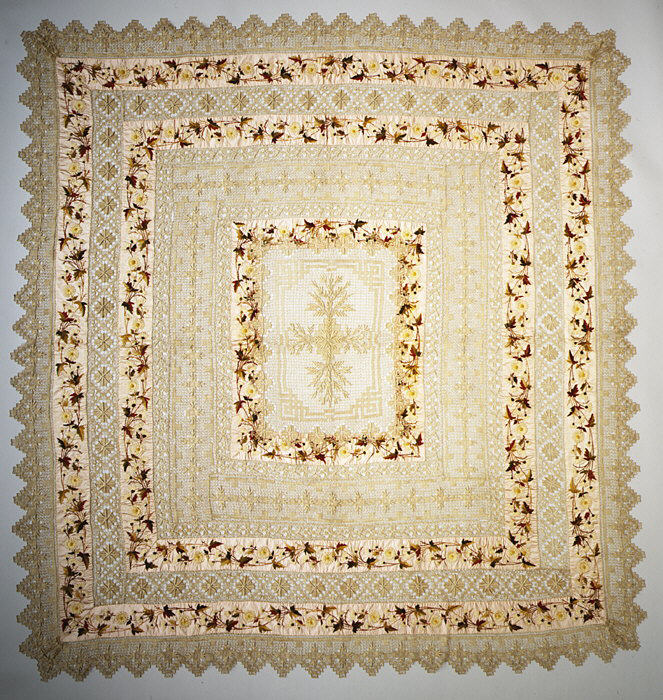
The coverlet and its two matching bolster covers under examination constitute a rare instance of textile intelligence—a term we at Katherine Fashion Lab use to describe objects whose material composition encodes functional, aesthetic, and cultural decisions simultaneously. Sourced from the Global Heritage archive, this three-piece ensemble combines linen, silk, and wool in a configuration that resists easy categorization. It is neither strictly domestic furnishing nor ceremonial textile, but rather a hybrid object whose material logic rewards close reading. In an era of synthetic homogeneity, such pieces remind us that cloth can be an epistemic artifact—a carrier of knowledge about climate, labor, agriculture, and ritual.
The Linen Foundation: Structural Integrity
Linen serves as the structural substrate across all three pieces. Its long staple fibers, derived from the flax plant, provide tensile strength and breathability—qualities essential for a coverlet intended to be handled, folded, and displayed across seasons. The linen ground likely underwent retting and hackling processes that vary by region, and the resulting hand—crisp yet yielding—suggests a mid-to-heavy weight, perhaps 200–280 GSM. In the bolster covers, linen's natural slub creates subtle textural interruptions that catch light differently from the silk accents, producing a quiet visual rhythm. This is not incidental; it is compositional. Linen here functions as the grammatical base upon which silk and wool operate as modifiers.
Silk as Chromatic Interruption
Silk introduces luminosity and drape. In the coverlet, silk threads appear to be integrated as supplementary weft or embroidered passages, creating localized sheen that shifts with the viewer's position. This technique—common in South Asian, Central Asian, and Andean traditions—transforms the textile from a flat plane into a kinetic surface. The bolster covers echo this strategy at a smaller scale, with silk bands or motifs that echo the coverlet's visual language without literal repetition. The decision to use silk sparingly rather than ubiquitously reflects an economy of luxury: silk is deployed as punctuation, not prose. Its presence elevates the object without overwhelming the linen's matte integrity.
Wool and the Question of Warmth
Wool's inclusion complicates the ensemble's seasonal identity. A linen-silk coverlet alone would read as summer-weight, but wool fibers—likely woven into the ground or used as binding threads—add thermal capacity and resilience. Wool also absorbs moisture vapor, making the textile hygroscopic and thus suitable for variable climates. The wool may be undyed or naturally pigmented, creating tonal depth against the linen's pale ground. In the bolster covers, wool's slight crimp provides friction, ensuring the covers stay in place on cylindrical forms. This is functional design at its most refined: each fiber earns its place.
Construction Logic and Artisanal Signature
The coverlet's construction likely employs a compound weave—possibly a supplementary weft or lampas structure—that allows the silk and wool to appear selectively on the face while the linen maintains the reverse. The bolster covers, by contrast, may use a simpler plain weave with inlaid or embroidered details, reflecting their subordinate role. This hierarchy of technique is telling: the coverlet is the primary text, the bolsters its glosses. Edges are finished with hand-rolled hems or narrow woven bands, signaling that the object was meant to be seen from all sides—a mark of couture-level finishing.
Global Heritage as Method, Not Motif
To label this ensemble "Global Heritage" is not to flatten its specificity but to acknowledge its polygenetic origins. The combination of linen, silk, and wool appears in traditions ranging from Ottoman çatma to Norwegian åklæde to Japanese sakiori. What unites them is not a single geography but a shared logic: fiber complementarity. Each material compensates for the limitations of the others. Linen lacks warmth; wool lacks sheen; silk lacks durability. Together, they achieve a synergistic equilibrium that no single fiber could provide. This is the essence of heritage textile practice: not nostalgia, but applied materials science.
Standalone Study: Implications for Contemporary Couture
As a standalone study, this ensemble offers lessons for contemporary fashion. First, material hierarchy matters: the linen ground anchors the composition, preventing silk's luxury from becoming decorative excess. Second, scale variation—coverlet versus bolster—demonstrates how a single visual language can adapt across formats without losing coherence. Third, tactile plurality invites touch, a sensorial dimension often lost in digital design. For Katherine Fashion Lab, the coverlet and bolsters serve as a case study in slow textile thinking: objects that reward prolonged engagement, whose meaning emerges through use, folding, and display.
Ultimately, this three-piece ensemble is not merely a furnishing set. It is a material argument—for hybridity, for restraint, for the intelligence of the hand. In a market saturated with mono-fiber synthetics, it stands as a quiet rebuke and a generous teacher. The coverlet and its bolsters do not shout. They demonstrate.