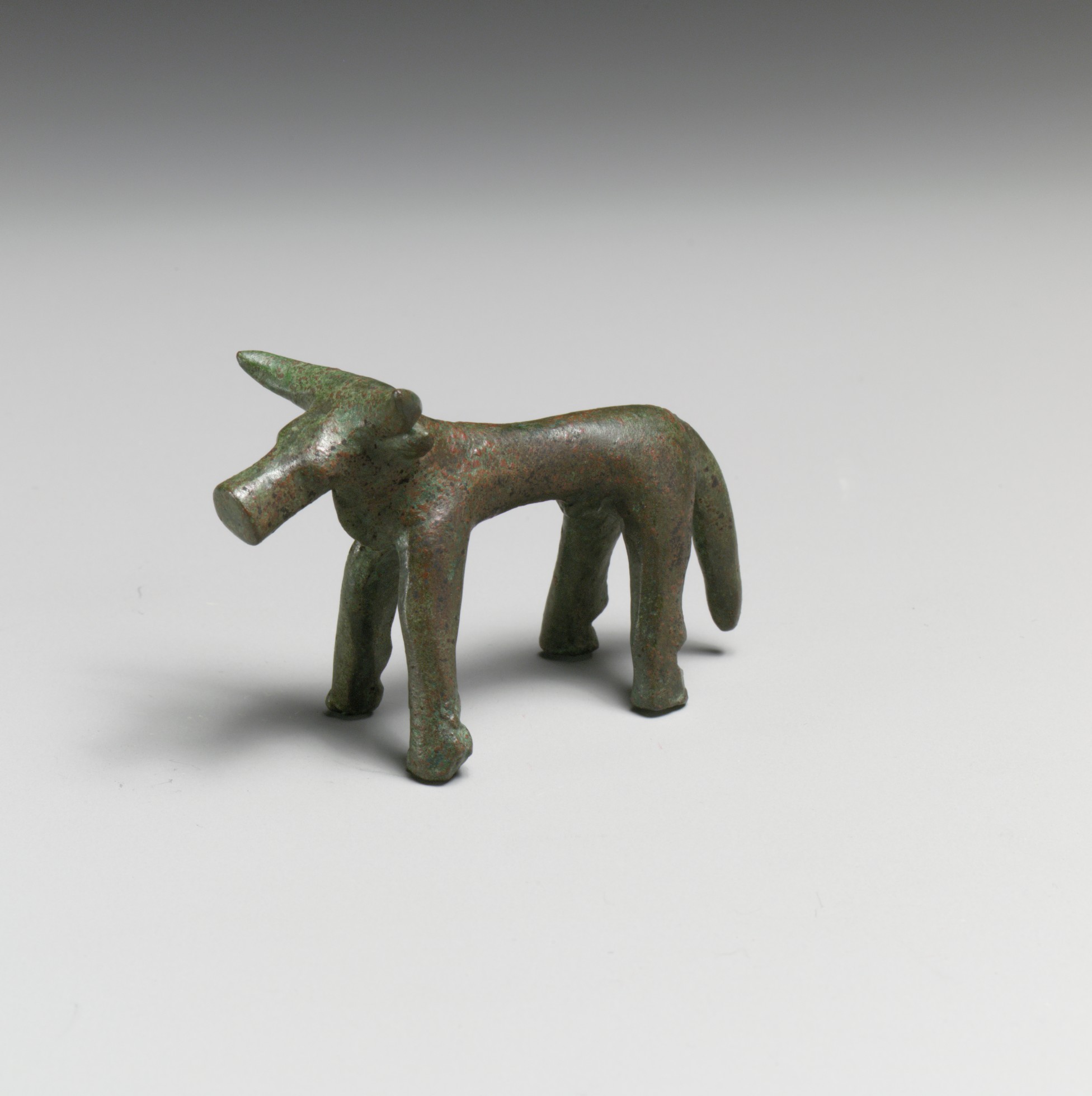
Heritage Asset Analysis: Greek Bronze Bull Statuette
Object Overview and Material Authority
The bronze bull statuette under examination represents one of the most persistent and symbolically dense forms in the ancient Greek artistic corpus. Cast in bronze—an alloy of copper and tin that demanded sophisticated metallurgical knowledge and significant capital investment—this object belongs to a class of votive and decorative figurines produced across the Greek world from the Geometric period through the Hellenistic era. The bull's compact mass, muscular tension, and forward-leaning posture are rendered with an economy of form that speaks to both the technical proficiency of Greek bronzesmiths and the animal's enduring status as a signifier of potency, fertility, and sacral authority. For Katherine Fashion Lab, this statuette is not merely an archaeological artifact; it is a compressed archive of symbolic capital, a material witness to how pre-modern societies encoded value into portable, wearable-adjacent forms.
Symbolic Power: The Bull in Greek Sacred and Civic Life
In Greek antiquity, the bull occupied a liminal position between the domesticated and the wild, the economic and the divine. As a draft animal and source of wealth, it anchored agrarian life. As a sacrificial victim—most notably in the hecatomb—it mediated between human communities and the Olympian gods. The bull's association with Zeus, who assumed bovine form in the myth of Europa, and with Dionysus, whose mysteries often invoked bull-shaped divinities, elevated the animal to a polyvalent symbol of sovereign power, generative force, and initiatory transformation. Bronze statuettes of bulls were frequently deposited in sanctuaries such as Olympia, Delphi, and the Heraion of Argos, functioning as votive offerings that materialized a donor's petition or gratitude. The choice of bronze was deliberate: its reflective surface and resistance to corrosion suggested permanence, while its casting required the collaborative labor of miners, traders, and artisans—a supply chain that prefigured modern luxury production networks.
Historical Adornment and the Logic of Miniaturization
The impulse to miniaturize the bull into a hand-held bronze reveals a deeper logic of adornment that resonates with contemporary high-end strategy. In the ancient world, small-scale figures served as personal talismans, grave goods, and decorative accents in domestic and sacred spaces. They were objects of touch and display, designed to be handled, rotated, and admired from multiple angles. This tactile dimension aligns with the modern luxury consumer's desire for intimate, sensuous engagement with objects—a phenomenon Katherine Fashion Lab has tracked in its research on wearable heritage. The bull statuette's patina, a variegated surface of green and brown oxidation, further anticipates the contemporary valuation of "living finishes" in luxury goods, where time and use are not defects but markers of authenticity and narrative depth.
Spiritual Meaning and the Metaphysics of Casting
The process of lost-wax casting, by which most Greek bronze bulls were produced, carries its own metaphysical charge. The original wax model is destroyed to create the final metal object—a transformation that mirrors sacrificial logic. The bull, already a sacrificial animal, is thus doubly sacrificed: first in ritual, then in the foundry. This layered symbolism suggests that the statuette was never merely representational. It participated in a network of meanings that linked metallurgy, animal sacrifice, and divine communication. For a luxury brand attuned to spiritual and ritual dimensions of adornment, the bronze bull offers a template for objects that embody transformation, loss, and rebirth—narratives that resonate with contemporary consumers seeking meaning beyond mere ornament.
DNA Correlation with Cross-Cultural Research
Our comparative study of 《Rock in the form of a fantastic mountain》 and 《Jar in the shape of bronze container (hu)》 reveals a shared "DNA" of material transformation and symbolic condensation. The rock—likely a scholar's stone or miniature landscape—compresses cosmic order into a portable form. The hu jar, shaped like a bronze ritual vessel but often executed in ceramic or lacquer, translates elite bronze prototypes into alternative media. The Greek bronze bull operates according to the same logic: it condenses the power of the sacred herd, the authority of Zeus, and the prestige of bronze metallurgy into a single, hand-sized object. Across cultures, such objects function as "portable altars"—sites where material, form, and meaning converge. This cross-cultural pattern is not coincidental; it reflects a universal human strategy for managing the sacred and the social through miniaturization and material substitution.
2026 Luxury Strategy: From Artifact to Adornment
For Katherine Fashion Lab's 2026 high-end strategy, the bronze bull statuette provides three actionable insights. First, symbolic density: luxury consumers increasingly seek objects with layered narratives. A contemporary jewelry or accessory line inspired by the bull could integrate references to Zeus, sacrifice, and metallurgical transformation, creating a story that rewards deeper engagement. Second, material honesty: the Greek use of bronze—not gold, not silver—signals that value resides in craft and meaning, not merely in intrinsic material worth. This aligns with the shift toward "quiet luxury" and artisanal provenance. Third, tactile ritual: the statuette's hand-held scale invites touch, rotation, and display. A 2026 collection could translate this into modular adornments—pendants, cufflinks, or bag hardware—that encourage physical interaction and personal ritual. By treating the bronze bull not as a static relic but as a strategic template, Katherine Fashion Lab can position itself at the intersection of heritage scholarship and forward-looking luxury innovation, transforming ancient symbolic power into contemporary desirability.