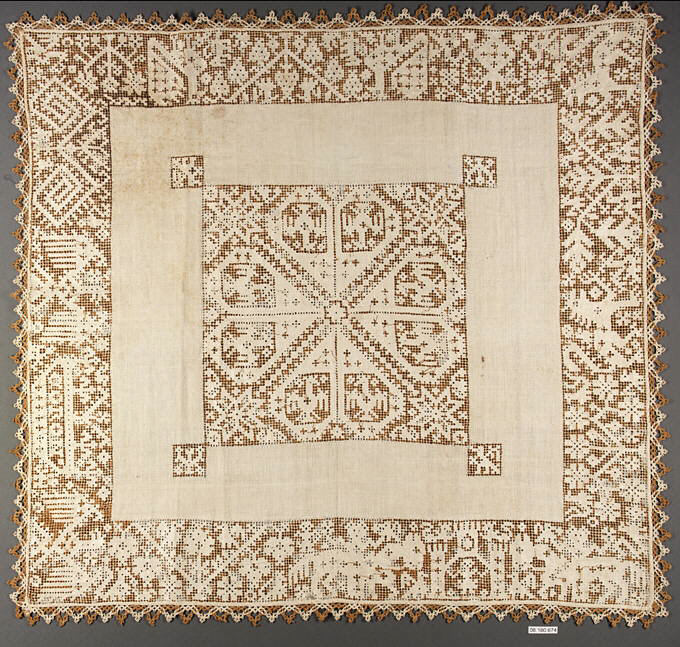
Cover: Drawnwork as a Global Heritage Idiom
In the vocabulary of haute couture, few techniques carry the quiet authority of drawnwork. It is a discipline of absence — a practice in which the artisan removes threads rather than adds them, constructing ornament through subtraction. For Katherine Fashion Lab, drawnwork is not a regional curiosity but a global heritage language, one that has surfaced across cultures from the needle-lace traditions of sixteenth-century Italy to the calado embroideries of the Philippines, the drawn-thread work of Elizabethan England, and the openwork linens of Scandinavia and Eastern Europe. This standalone study examines drawnwork as a couture proposition: how a technique of removal becomes a statement of presence.
Defining the Technique
Drawnwork, or drawn-thread work, begins with a woven ground — typically linen, sometimes silk or fine cotton — from which selected warp or weft threads are carefully withdrawn. What remains is a skeletal grid, a lattice of tension held by the threads left in place. The artisan then works into this void: bundling, weaving, looping, or needle-lacing the remaining filaments to stabilize and embellish the open structure. The result is a fabric that is simultaneously transparent and structural, fragile in appearance yet engineered in fact.
The distinction between drawnwork and its cousins matters. It is not cutwork, which excises entire sections of cloth and fills them with needle lace. It is not pulled work, which distorts threads without removing them. Drawnwork occupies its own category: it is subtractive embroidery, a negotiation between what the cloth is and what it is permitted to become. This is why it appeals to couture ateliers, where the manipulation of material is the central act of authorship.
Global Heritage, Local Hands
The global heritage of drawnwork resists a single origin story. Italian punto tirato and reticella emerged from the Renaissance lace workshops of Venice and Genoa, where drawn threads were combined with geometric needle lace to produce elaborate borders for ecclesiastical and aristocratic linens. In the Philippines, Spanish colonial influence fused with indigenous weaving to produce calado, a drawnwork tradition of extraordinary refinement in which floral and geometric motifs float within the open ground. In Portugal, crivo developed into a national craft, while in Ukraine and the Baltic states, drawn-thread work became a marker of bridal and ritual textiles.
What unites these traditions is not a shared design language but a shared philosophy: the cloth is treated as a field of potential, and the artisan's authority lies in knowing precisely what to remove. For Katherine Fashion Lab, this global spread is the point. Drawnwork is not a heritage to be borrowed from a single source but a distributed inheritance — a technique that belongs to many hands and, therefore, to none exclusively.
Material Logic and Couture Application
The material logic of drawnwork is inseparable from its couture value. Because the technique depends on the integrity of the woven ground, the choice of substrate is a creative decision, not a technical afterthought. A tightly woven linen yields crisp, architectural apertures; a silk organza permits a more fluid, almost atmospheric openness. The density of the withdrawal — how many threads are removed and in what pattern — determines whether the resulting fabric reads as delicate veil or as structural mesh.
In a couture context, drawnwork functions on three levels. First, as surface: it provides texture and shadow without weight, ideal for overlays, yokes, and sleeves. Second, as structure: carefully planned withdrawals can create zones of differential transparency, allowing a designer to sculpt the body through opacity and exposure rather than through cut. Third, as narrative: drawnwork carries the visible trace of time — the hours of patient withdrawal and re-weaving — and this trace is legible to the wearer and the viewer alike. It is a technique that refuses to be rushed, and in an era of accelerated production, that refusal is itself a luxury statement.
The Aesthetics of Absence
Drawnwork's aesthetic power lies in its paradox. It is an art of emptiness that produces fullness; a practice of removal that generates ornament. Where embroidery adds, drawnwork subtracts, and in that subtraction it exposes the architecture of cloth — the grid, the tension, the interdependence of warp and weft. This exposure is not decorative but philosophical. It asks the viewer to consider what a garment is made of, and what it is made by.
For Katherine Fashion Lab, the standalone study of drawnwork is an argument for slowness and for global literacy. A couture piece built on drawnwork cannot be understood through a single cultural lens. It is Italian and Filipino and Portuguese and Ukrainian at once — a palimpsest of traditions that have each, independently, arrived at the same insight: that beauty can be woven from what is taken away.
Conclusion: Cover as Statement
To cover a body in drawnwork is to cover it with absence made deliberate. The garment does not conceal; it reveals through structure, offering glimpses rather than surfaces. This is the couture proposition of drawnwork: that the most sophisticated form of covering is not the addition of fabric but the intelligent removal of it. In a global heritage context, that proposition is not merely formal but ethical — a reminder that technique, like cloth, is shared inheritance, and that the atelier's task is to honor the hands that came before while cutting a new pattern for what comes next.