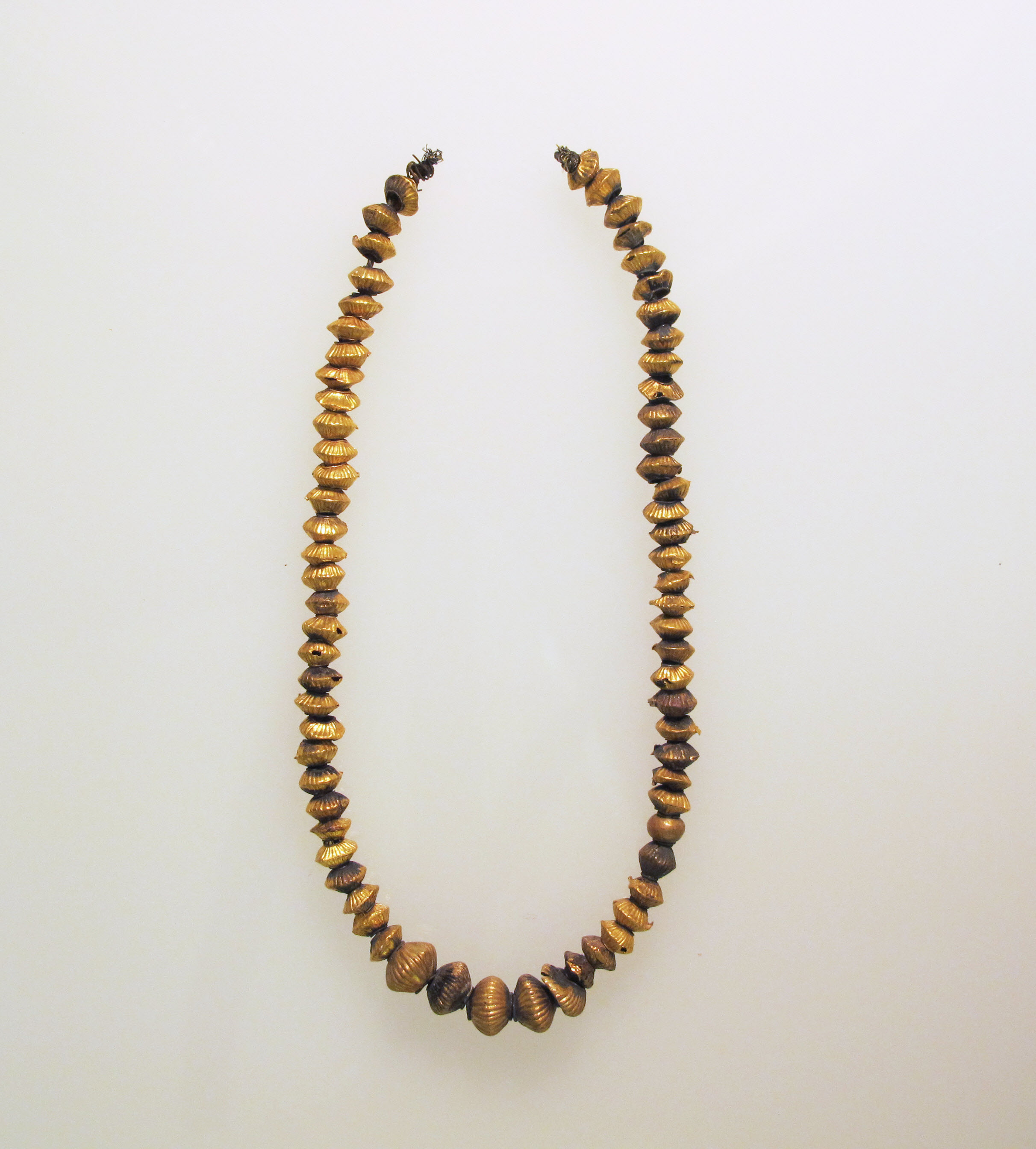
From Necropolis to Atelier: The Gold Necklace as Civilizational Archive and 2026 Luxury Mandate
Introduction: The Necklace as Primary Document
In the material record of ancient civilizations, few objects carry the evidentiary weight of the gold necklace. Unlike monumental architecture, which asserts power publicly, or coinage, which circulates instrumentally, the necklace occupies the most intimate register of adornment: it is worn against the pulse, suspended over the heart, and buried with the deceased as a permanent attribute of identity. For Katherine Fashion Lab, the gold necklace is not merely a category of jewelry but a primary document of symbolic power, ritual function, and aesthetic intent. This analysis situates the ancient gold necklace within the same interpretive framework as our ongoing study of the Mirror with Split-Leaf — a silver mirror bearing gold-inlaid palm frond motifs on one face and a cold stone sarcophagus relief narrating life on the other. Both objects share a constitutive duality: the luminous surface and the funerary substrate, ornament and mortality, the visible and the inscribed. The necklace, like the mirror, is a technology of meaning.
Symbolic Power: Gold as Ontological Substance
Across ancient civilizations — from Sumerian royal tombs at Ur to Egyptian Theban necropolises, from Scythian kurgan burials to the elite interments of the Chinese Bronze Age — gold was never merely a material. Its resistance to corrosion, its solar luminosity, and its rarity converged to produce an ontological claim: gold was the substance of permanence in a world of decay. A gold necklace therefore enacted a proposition about its wearer. It asserted that the individual belonged to the category of the enduring — the divine, the ancestral, the sovereign.
This is where the DNA correlation with our Mirror with Split-Leaf study becomes methodologically productive. The mirror's gold-inlaid palm fronds on a silver surface represent the grafting of permanence onto reflection — the fleeting image of the self anchored by incorruptible metal. The necklace performs the identical operation on the body: the mortal neck encircled by the incorruptible. In both cases, gold functions as an argument against transience. The symbolic power of the necklace is thus not decorative but propositional. It makes a claim about the wearer's relationship to time, lineage, and the sacred.
Historical Adornment: The Necklace as Social Technology
Historically, the gold necklace operated as a sophisticated social technology. In Egyptian contexts, the usekh collar and the shebyu were instruments of royal favor, awarded to officials as encoded grants of status — wearable patents of nobility. In Mesopotamian and later Persian practice, necklaces of gold and semi-precious stones signaled proximity to the sovereign. In Scythian and Celtic contexts, torcs and gold chains functioned as insignia of rank and, in some readings, as ritual instruments associated with oath-taking and divine mediation.
The critical insight for contemporary luxury strategy is that these objects were never passive. They were active instruments within systems of obligation, patronage, and spiritual contract. The necklace bound the wearer to a network of meaning. This is the historical precedent that distinguishes heritage-driven luxury from mere ornamentation: the necklace as a binding instrument, not a decorative accessory.
Spiritual Meaning: The Necklace at the Threshold
The funerary dimension is decisive. In the same way that the stone sarcophagus relief in our Mirror with Split-Leaf study narrates life on the cold face of death, the gold necklace frequently served as a threshold object — placed upon the deceased to accompany the soul, to identify the body for ancestral recognition, and to assert continuity beyond mortality. Egyptian broad collars on mummies, Scythian gold torcs in kurgan burials, and the gold neck ornaments of Chinese elite tombs all participate in this logic. The necklace is worn in life and retained in death; it is the one adornment that crosses the threshold intact.
This spiritual function generates the necklace's enduring emotional authority. It is the object closest to the voice, the heart, and the breath. It is the adornment most associated with blessing, protection, and remembrance. For a luxury house, this is not sentimentality but strategic capital: the necklace carries the highest symbolic load of any jewelry category.
2026 Luxury Strategy: Heritage as Proposition, Not Decoration
For Katherine Fashion Lab in 2026, the strategic mandate is clear. The high-end luxury market is saturated with aesthetic references but starved of propositional meaning. Consumers at the pinnacle of the market are not purchasing gold; they are purchasing an argument about permanence, lineage, and identity. The ancient gold necklace provides exactly this argument, and it does so with documented historical authority.
Three strategic directions follow. First, design must foreground the necklace's threshold function — pieces conceived as objects of continuity, suitable for transmission across generations, with narrative documentation of their symbolic lineage. Second, the DNA correlation with the Mirror with Split-Leaf study should be made explicit in brand storytelling: the duality of luminous surface and funerary inscription, ornament and narrative, is the house's intellectual signature. Third, the necklace should be positioned not as an accessory to an outfit but as a proposition about the wearer's relationship to time — the same proposition the ancient gold necklace made in the necropolis.
Conclusion
The ancient gold necklace is a civilizational archive worn on the body. Its symbolic power lies in its propositional claim about permanence; its historical function lies in its role as a social and spiritual technology; its spiritual meaning lies in its unique capacity to cross the threshold between life and death. For Katherine Fashion Lab, the strategic opportunity in 2026 is to recover this propositional authority and translate it into contemporary luxury — not by reproducing ancient forms, but by restoring the ancient argument. The necklace is not decoration. It is a claim about time, and the houses that understand this will define the next decade of high jewelry.