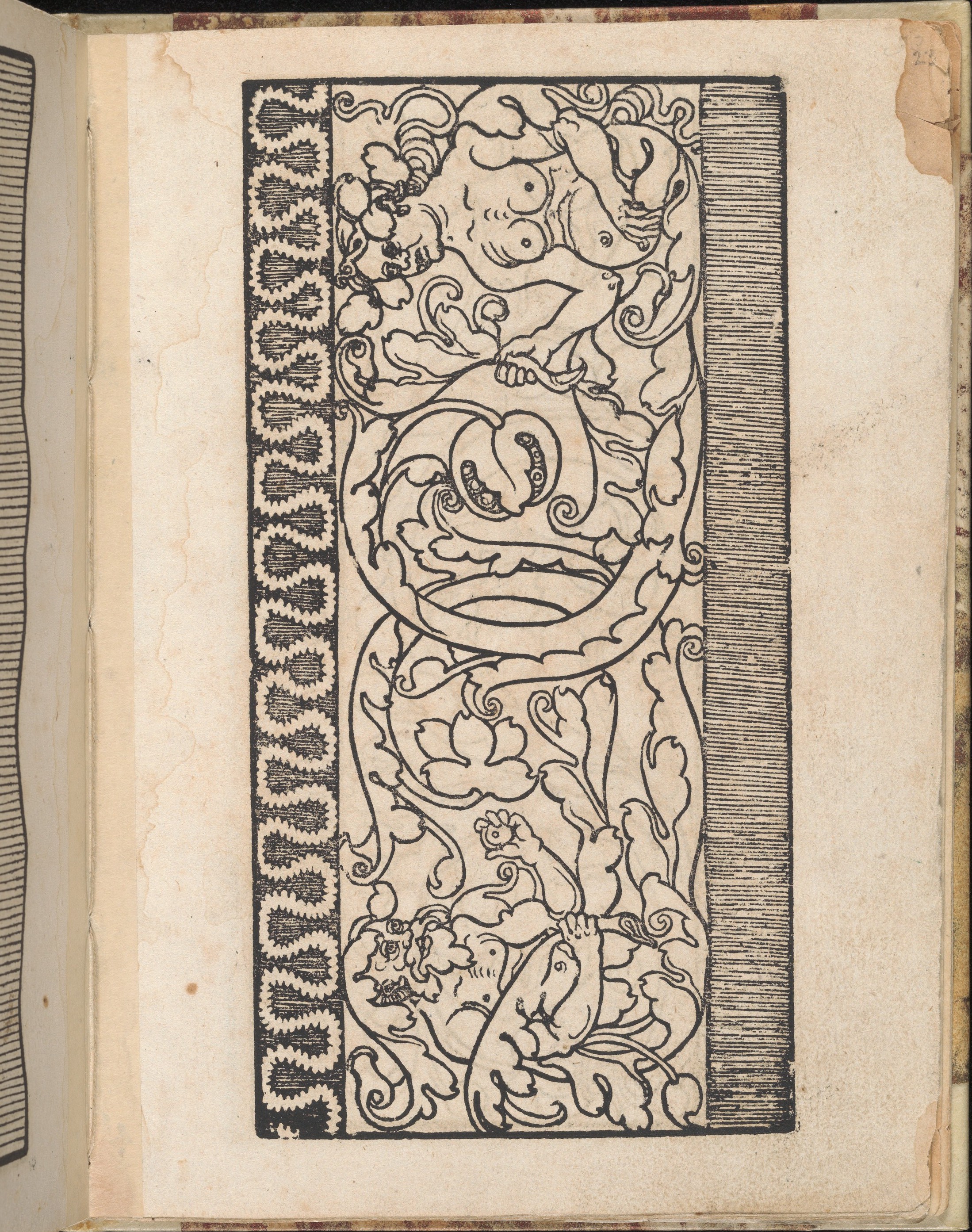
Ein new getruckt model Büchli: Page 23, Recto — A Woodcut Study in Proto-Couture
Page 23, recto, of Ein new getruckt model Büchli is a document that resists easy categorization. It is not a finished garment, nor a portrait, nor a religious illustration. It is a woodcut pattern sheet — a printed template for cutting and constructing clothing — and it belongs to a genre that historians of dress have long treated as marginal: the instructional model book. Yet this single leaf, examined closely, reveals the earliest mechanics of what we would now call couture: the codification of cut, the standardization of proportion, and the transmission of sartorial knowledge through reproducible media. As a standalone study, the page functions less as an artifact of fashion history than as a prototype for the fashion system itself.
The Woodcut as Technical Medium
The choice of woodcut is not incidental. By the early sixteenth century, the woodblock had become the dominant vehicle for technical illustration in Northern Europe, prized for its ability to render crisp linear contours — precisely the quality required for a cutting pattern. Unlike engraving, which encouraged tonal depth and pictorial illusion, the woodcut privileges the outline. A pattern printed from a woodblock is, in effect, a diagram: it instructs the eye to follow a seam, a fold, or a gusset rather than to admire a scene. Page 23, recto, exploits this bias toward the linear. The garment forms are presented as flattened schematics, their curves reduced to legible arcs, their construction exposed rather than concealed. In this, the woodcut anticipates the fashion plate, the technical flat, and the modern sewing pattern — all of which depend on the same principle: that a garment can be communicated as a set of lines before it is ever realized as cloth.
What distinguishes this page from a mere craft manual is its ambition. The Büchli — a diminutive of Buch, suggesting a small, portable book — was designed for circulation. It presumed a reader who might be a tailor, a merchant, or a curious amateur, and it addressed that reader in the vernacular. This democratization of technical knowledge is the precondition for couture: before a garment can be elevated to an art, its construction must first be systematized and taught. The woodcut is the medium of that systematization.
Cut, Proportion, and the Proto-Couture Logic
Examining the recto composition, one notices that the patterns are not drawn to a single scale. Different pieces are sized independently, implying that the user was expected to adapt them — to grade them, in modern terms — according to the wearer's measurements. This is a crucial point. The page does not present a finished design; it presents a method. The tailor is invited to participate, to interpret, to adjust. Couture, at its most rigorous, operates on the same principle: the toile is not the dress, but the dress is unimaginable without it. The woodcut pattern is a proto-toile, a two-dimensional argument for a three-dimensional form.
Moreover, the arrangement of the pieces on the page suggests an early awareness of what we would now call nesting — the efficient layout of pattern pieces on a length of fabric to minimize waste. While the page does not depict a full marker, the grouping of curved and straight-edged components hints at a spatial intelligence that would later become central to industrial pattern-cutting. In this sense, Page 23, recto, is not merely a historical curiosity; it is a document of design economy. It demonstrates that the aesthetic and the pragmatic were never separate in the history of dress. The most beautiful garment is also the most efficiently cut.
The Standalone Study and Its Interpretive Value
To treat this page as a standalone study is to isolate it from its original binding, its companion pages, and its textual instructions. This is an artificial act, but a productive one. Removed from its context, the woodcut becomes an object of pure form — a composition of lines that can be read as abstract geometry, as calligraphy, or as the ghost of a body. The standalone study forces the viewer to confront the page as a visual argument rather than a practical tool. What emerges is a tension between the utilitarian and the aesthetic that is, in fact, the defining tension of couture itself.
Consider the negative space. The gaps between pattern pieces are not empty; they are the fabric that will be discarded, the seam allowance that will be folded inward, the air that will separate cloth from skin. A couture garment is defined as much by what is removed as by what is retained. The woodcut, with its stark black lines on white paper, literalizes this principle. Every line is a cut. Every cut is a decision. The page is, in effect, a score for a performance that has not yet occurred — and may never occur, if the reader chooses not to sew. This potentiality is the essence of the pattern as a medium.
Global Heritage and the Circulation of Technique
The designation "Global Heritage" is not merely a curatorial label; it is an argument about the movement of knowledge. Pattern books of this type circulated along trade routes that connected German-speaking print centers to workshops in Italy, France, and the Low Countries. The woodcut was lightweight, inexpensive, and easily copied — qualities that made it an ideal vector for the spread of sartorial technique. Page 23, recto, is therefore a node in a network. It is local in its manufacture and global in its implications. The same lines that guided a tailor in Augsburg might have informed a cutter in Lyon or a draper in London. Couture, long before it was codified in Paris, was already an international language written in woodcut.
This page also reminds us that the history of fashion is not only a history of finished objects. It is a history of instructions — of the diagrams, notations, and templates that made objects possible. Museums tend to preserve the gown; they rarely preserve the pattern. Yet the pattern is where the intelligence of the gown resides. To study Page 23, recto, is to study the mind of the maker before the hand touched the cloth. It is to witness couture in its most abstract and most essential form: as a set of lines waiting to become a body.
Conclusion: The Page as Prototype
What, finally, does this woodcut teach us about couture? It teaches that couture begins not with fabric but with notation. It teaches that the most sophisticated garment is the one whose construction can be communicated, reproduced, and varied. And it teaches that the printed page — humble, portable, ephemeral — is as central to the history of dress as the atelier or the runway. Page 23, recto, of Ein new getruckt model Büchli is not a masterpiece. It is something more useful: a prototype for the entire system of fashion. In its lines, we see the future of the seam.