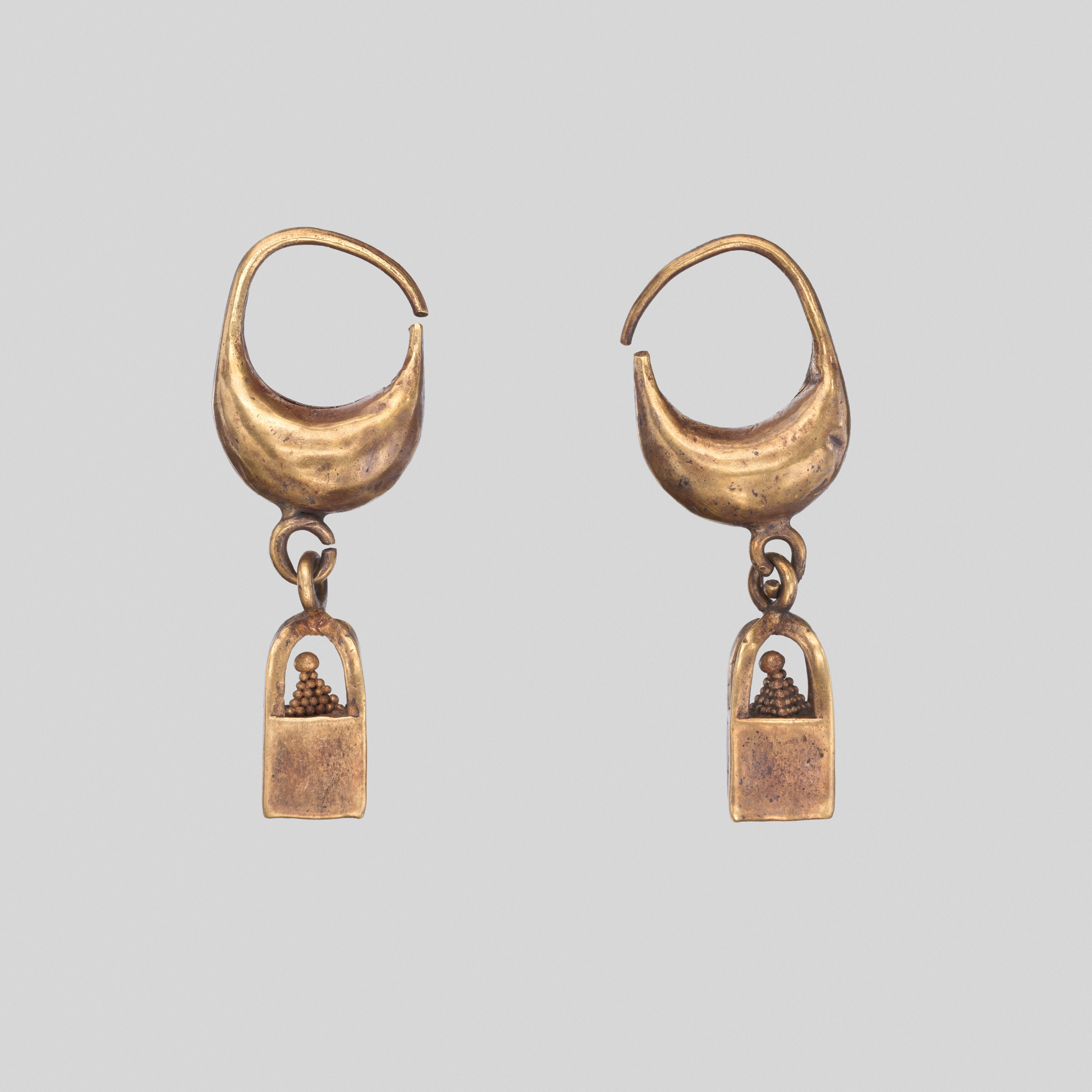
Heritage Asset Analysis: Cypro-Phoenician Gold Pendant
Object Identification and Material Context
The subject of this analysis is a Cypro-Phoenician gold pendant, a portable artifact of exceptional historical density originating from the Eastern Mediterranean trading corridor between approximately the 8th and 6th centuries BCE. The medium is high-karat gold, likely hammered and cut from sheet before being embossed, pierced, or granulated according to Levantine and Cypriot workshop conventions. The pendant form is characteristically composite: a central field of repoussé ornamentation framed by suspension loops or biconical beads that allowed the object to hang close to the wearer's throat or chest. Its material value and its ritual function were never separable. Gold in the ancient Near East was understood as incorruptible flesh of the gods, a substance that resisted decay and therefore carried the wearer into symbolic proximity with permanence, divinity, and dynastic continuity.
Symbolic Power and Iconographic Program
Cypro-Phoenician goldwork occupies a distinctive position in the archaeology of adornment because it synthesizes Egyptian, Mesopotamian, Aegean, and indigenous Cypriot motifs within a single portable format. The pendant's iconographic program typically includes stylized palmettes, lotus blossoms, winged solar discs, or the baetyl — a conical or pillar-like stone marker associated with Astarte and Aphrodite. These are not decorative accidents. Each element operates as a compressed theological statement. The palmette signals regeneration and the cyclical return of life; the lotus, borrowed from Egyptian cosmology, evokes the primordial marsh from which creation emerged; the winged disc asserts solar sovereignty and protective surveillance. When worn against the body, the pendant transformed the human torso into a living altar, converting private anatomy into public testimony of allegiance to a tutelary deity.
The pendant's power was therefore apotropaic, votive, and social simultaneously. It deflected malign forces, advertised the wearer's access to imported luxury networks, and functioned as a portable relic of temple economies. In a world where literacy was restricted and monumental architecture was controlled by elites, gold jewelry was one of the few media through which ordinary and aristocratic women alike could participate in high theology. The pendant gave the body a voice.
Historical Adornment and the Grammar of the Body
In Cypro-Phoenician burial contexts, gold pendants are frequently recovered from the neck and chest regions of female inhumations, often in association with scarabs, faience amulets, and bronze mirrors. This distribution is not random. It reveals a coherent adornment grammar in which the upper body was organized as a vertical axis of spiritual protection: the throat guarded by suspension cords, the sternum occupied by the pendant's central motif, the hands holding mirrors or cosmetic implements. The pendant was the keystone of this ensemble, the point at which material wealth, gendered ritual authority, and metaphysical insurance converged.
This grammar finds a direct methodological parallel in Katherine Fashion Lab's ongoing study, Mirror with Split-Leaf, which examines the dialectic between a polished silver mirror face inlaid with gold palmette ornamentation and the cold relief narrative of a sarcophagus panel. Both objects — the Cypro-Phoenician pendant and the split-leaf mirror — stage the same fundamental tension: the reflective, luminous surface of the living body against the carved, commemorative surface of the dead. The pendant belongs to the side of light. It is worn while the heart beats. It is the ornament of presence, not memory. Yet its iconography is drawn from funerary theology, meaning the wearer carried the wisdom of the tomb on her chest while walking through the marketplace.
DNA-level continuity between Cypro-Phoenician coastal populations and later Mediterranean communities has been documented in recent archaeogenetic literature, and this biological persistence mirrors the persistence of ornamental forms. The pendant's descendants appear in Punic Carthage, in Etruscan aurei, and eventually in Roman bulla traditions. The object type survived because the human need it addressed — protection, status, and spiritual legibility — did not change.
Spiritual Meaning and the Economics of Blessing
The spiritual economy of the Cypro-Phoenician pendant rested on a simple contract: gold, the most durable available substance, was offered to the deity in miniature and then returned to the wearer as a portable blessing. The pendant was therefore both sacrifice and receipt. It participated in temple wealth while remaining in private circulation, a tension that prefigures modern luxury's negotiation between institutional heritage and personal possession. To own such a pendant in antiquity was to hold a fragment of the divine economy in one's hand.
Strategic Application: 2026 High-End Luxury Positioning
For Katherine Fashion Lab's 2026 collections, the Cypro-Phoenician pendant offers a rare strategic asset: an authentic historical prototype for the convergence of ornament, narrative, and bodily ritual. The following positioning pillars are recommended.
Pillar One — Portable Theology. Position the pendant not as a charm but as a wearable thesis. Each piece should carry a documented iconographic program, with the palmette, lotus, or baetyl explained in client-facing materials as a coherent spiritual argument rather than a decorative motif. This differentiates the house from competitors who use "ancient inspiration" as surface quotation.
Pillar Two — The Mirror/Pendant Dialectic. Extend the Mirror with Split-Leaf research into a dual-object collection: the mirrored surface for the living face, the gold pendant for the living chest. The two objects should be presented as a single ritual ensemble, restoring the original Cypro-Phoenician grammar of the adorned upper body. This creates a proprietary narrative architecture that cannot be replicated without the house's research archive.
Pillar Three — Material Integrity and Provenance Transparency. The 2026 luxury consumer, particularly in the Middle East and East Asia, rewards verifiable historical grounding. Katherine Fashion Lab should publish short provenance notes with each pendant, linking the design to specific Cypro-Phoenician typologies and archaeogenetic research. Transparency becomes a luxury signal.
Pillar Four — Ritual Reintroduction. The pendant's original power derived from wearing, not display. The house should design client experiences — private fittings, consecration ceremonies, heirloom registration — that restore the act of putting on the object as a meaningful transition. In a market saturated with acquisition, ritual is the scarcest luxury.
Conclusion
The Cypro-Phoenician gold pendant is not a historical curiosity. It is a compact technology of protection, status, and spiritual legibility that has survived three millennia because it addressed permanent human needs. For Katherine Fashion Lab, its value lies in the precision of its symbolic program and the rigor of its bodily grammar. The 2026 strategy should treat the pendant as a heritage asset with active strategic force: a small gold object that still knows how to speak to the chest, the mirror, and the tomb.