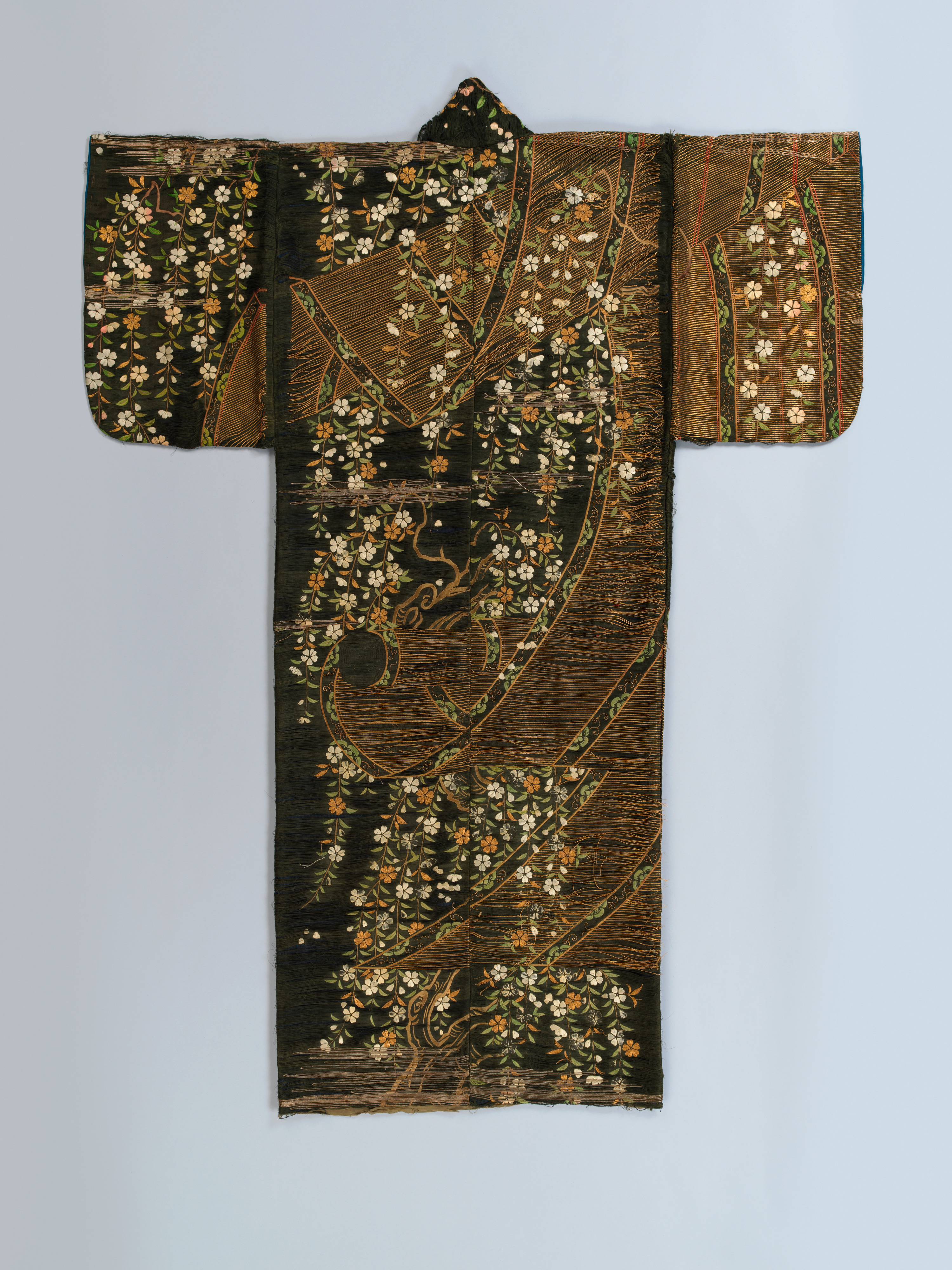
Robe: The Japanese Silk Robe as a Study in Restrained Opulence
Within the vocabulary of global couture, few garments carry the historical density and formal discipline of the Japanese silk robe. It is a garment that resists the Western impulse toward structural tailoring, preferring instead to articulate the body through drape, proportion, and the calculated interplay of surface and void. As a standalone object of study, the robe offers a rare lens through which to examine how material, silhouette, and cultural philosophy converge into a single, coherent statement of luxury. At Katherine Fashion Lab, we treat the Japanese silk robe not as a costume or a relic, but as a living architecture of cloth—one whose logic remains relevant to contemporary couture practice.
Materiality: Silk as Structural and Symbolic Medium
The primacy of silk in the Japanese robe is not incidental. Silk is a protein fiber whose triangular cross-section produces a distinctive luster—soft, directional, and dependent on the angle of light. This optical behavior is critical to the robe’s aesthetic: the garment is designed to shift in appearance as the wearer moves, creating a kinetic surface that is never static. Unlike wool or cotton, which absorb and diffuse light, silk reflects it with a cool precision, lending the robe an air of quiet authority.
Beyond its visual properties, silk’s tensile strength and elasticity allow for the extreme fineness of weave required in high-grade kimono textiles. A single thread may be degummed and twisted to a diameter measured in microns, enabling the dense, flat weaves that characterize rinzu (figured silk) and chirimen (crepe). These fabrics do not merely cover the body; they hold a shape. The robe’s rectangular panels are cut with geometric exactness, and the silk’s memory—its ability to recover from folding—preserves the crisp lines of the garment across decades of storage and wear. In this sense, silk is not a passive medium but an active collaborator in the robe’s formal integrity.
Silhouette: The Logic of the Rectangle
Western couture has historically prioritized the articulation of the body through darts, seams, and shaped panels. The Japanese robe inverts this logic. It is constructed from four primary rectangles—two body panels, two sleeves—plus narrower strips for the collar and hem. The resulting silhouette is not anatomical but architectural. It creates a column of fabric that falls from the shoulders without interruption, allowing the wearer’s movement to generate the only curves the garment will ever possess.
This rectangular approach has profound implications for proportion. The sleeve, or sode, is attached not at the shoulder but along the back panel, creating a deep armhole that allows the fabric to drape in a single continuous line from nape to wrist. The collar, or eri, is a long, stiffened strip that crosses the chest and defines the neckline through layering rather than cutting. The effect is one of containment without constriction: the robe encloses the body in a controlled volume, but it never grips or reshapes it. For the couturier, this offers a lesson in restraint—how to achieve presence through proportion rather than through aggressive tailoring.
Surface and Restraint: The Discipline of Ornament
The Japanese silk robe is often misread in the West as a canvas for maximalist decoration. In fact, its ornamentation is governed by a strict economy. Patterns are typically confined to the lower hem or the sleeves, leaving the upper body largely undecorated. This distribution is not arbitrary; it directs the eye downward, grounding the garment and emphasizing the wearer’s movement. The technique of yuzen (resist-dyeing) allows for painterly gradients and fine line work, but even the most elaborate yuzen robe respects the underlying structure of the cloth. The pattern does not obscure the weave; it interacts with it.
Color follows a similar discipline. Traditional palettes are drawn from seasonal references—indigo for winter, pale green for spring—and are applied in flat, unmodulated fields. The absence of shading or trompe-l’œil effects reinforces the robe’s two-dimensional logic. When a modern couture house attempts to translate this aesthetic, the failure mode is almost always excess: too much embroidery, too many colors, too little respect for the rectangle. The Japanese robe succeeds because it treats ornament as a form of punctuation, not as the sentence itself.
Cultural Context and Contemporary Relevance
The robe’s origins lie in the Heian period, when layers of silk were used to signal rank and season. Over centuries, it evolved into the kosode, the direct ancestor of the modern kimono, and later into the formal furisode and tomesode. Each iteration refined the relationship between silk, silhouette, and social meaning. What remains constant is the garment’s refusal to separate beauty from utility. A robe is worn, folded, stored, and worn again; its silk is chosen for durability as much as for sheen.
For contemporary couture, the Japanese silk robe offers a counter-model to the spectacle of the runway. It demonstrates that luxury need not be loud, that a garment can be both simple and profound, and that the body can be dressed without being disciplined. At Katherine Fashion Lab, we regard this robe not as a closed tradition but as an open proposition: a study in how material intelligence, geometric clarity, and cultural memory can produce a garment that outlasts the season of its making.