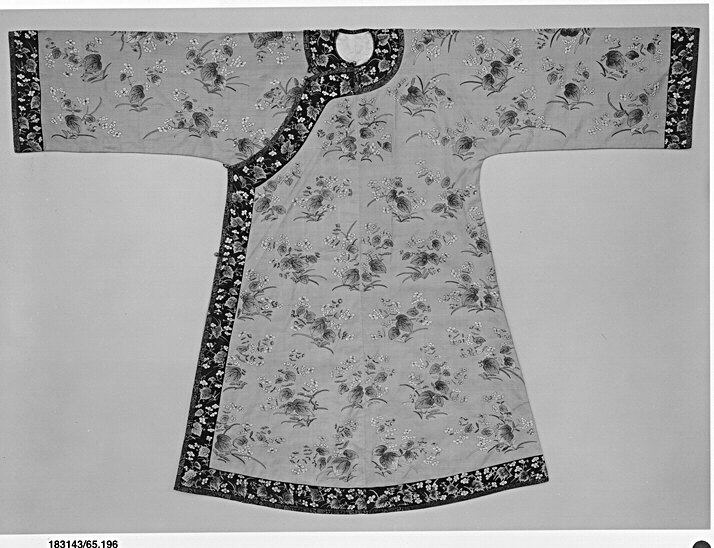
An Exegesis of Elegance: The Begonia Robe as a Study in Kesi Mastery
Within the rarefied realm of historical costume, certain garments transcend their functional purpose to become autonomous canvases of cultural and technical articulation. This Woman's Informal Robe, originating from China and crafted from silk tapestry (kesi), adorned with a begonia motif, presents such a case. As a standalone study, divorced from specific dynastic attribution or provenancial narrative, it invites a focused analysis on the intersection of material intelligence, symbolic botany, and the philosophy of informal elegance. This examination positions the robe not merely as apparel, but as a consummate artifact of design thinking, where every thread contributes to a holistic statement of cultivated leisure.
The Structural Poetry of Kesi: Beyond Woven Fabric
To understand this robe is to first deconstruct its foundational medium: kesi, often translated as "cut silk," is a superlative form of tapestry weaving. Unlike continuous weft brocades, kesi employs a discontinuous weft technique, where colored weft threads are woven only within the boundaries of a specific design area. This method, akin to painting with a loom, allows for unparalleled pictorial sharpness, color gradation, and a reversible fabric where the pattern appears identical on both sides. The technical implication is profound—it prioritizes aesthetic integrity over production speed, resulting in a textile that is inherently non-functional for mass consumption.
The standalone study of this robe’s kesi reveals a strategic material choice. The robe’s informality is thus a calculated informality, a display of luxury that is quiet yet unequivocal. The slight stiffness and substantial hand of the tapestry fabric grant the garment an architectural drape, allowing it to fall in clean, sculptural lines rather than cling to the form. This creates a silhouette of dignified ease, where the body moves within a defined, beautiful space. The analysis must note that the durability of kesi, a result of its dense structure, paradoxically preserves a garment meant for private, intimate moments, elevating the ephemeral to the eternal.
The Begonia: A Floral Lexicon of Nuanced Meaning
The pattern of begonias is not a casual decorative selection but a deliberate engagement with a rich symbolic lexicon in Chinese art and literature. The begonia (haitang) carries a complex bouquet of associations. Aesthetically, it symbolizes delicate beauty, spring, and the bittersweet passage of time, its often-lopsided leaves and vibrant yet fragile blooms representing a beauty that is captivating precisely because it is imperfect and transient. In the context of an informal robe for a woman, this symbolism operates on multiple levels.
It may reference the idealized beauty and cultivated sensibility of the wearer, aligning her with a natural, poetic elegance. Furthermore, the begonia has literary connections to moments of private reflection, scholarly retreat, and romantic longing. By adorning an informal garment with this motif, the wearer subtly communicates a state of mind—one of leisure, introspection, and aesthetic appreciation. The standalone study allows us to focus on the pattern's execution: the kesi technique would capture the begonia's subtle color shifts, from the deep pinks at the petal's heart to the paler edges, and the intricate veining of its leaves. This is not a stamped pattern but a botanical portrait rendered in silk, inviting contemplation up close, making it perfectly suited for the intimate context of its use.
Informality as the Highest Form of Sartorial Rhetoric
The designation "informal robe" (bianfu or changfu, depending on era) is critical to its analysis. In the highly codified sartorial landscape of historical China, where court dress and official rank were meticulously prescribed, informal wear represented a realm of personal expression and comfort. However, this was not a descent into simplicity, but a migration of artistry into a more personal sphere. This robe exemplifies that principle. Its informality is a statement of context, not of quality.
The cut, likely a cross-collar, wide-sleeved, and flowing form, prioritizes ease of movement and physical comfort for activities such as reading, receiving close friends in a garden pavilion, or engaging in artistic pursuits. Yet, the extravagance of its material and the sophistication of its pattern reclaim that ease as a privilege. It speaks of a wearer so secure in her status that she can embody refined taste away from the public, performative gaze. The standalone study compels us to consider the haptic experience—the cool, smooth texture of the silk against the skin, the weight of the tapestry, the sound of its rustle—all contributing to a multisensory performance of private luxury.
Synthesis: The Autonomous Artifact in the Katherine Fashion Lab
As a curated object of study, this Begonia Robe stands as a complete thesis on pre-modern luxury design. It demonstrates a tripartite harmony of medium, motif, and milieu. The kesi technique (medium) provides the flawless, painterly execution necessary to realize the nuanced symbolism of the begonia (motif), which in turn perfectly complements the philosophical and social posture of cultivated informality (milieu). Each element reinforces the others, creating a closed loop of meaning and effect.
In conclusion, this analysis reveals that the robe’s greatest significance lies in its embodiment of a specific aesthetic intelligence. It is a garment that understands luxury as an experience rooted in material truth, symbolic depth, and contextual appropriateness. The kesi is not just a fabric but a statement of technical ambition; the begonias are not just decoration but a wearable poem; the informality is not an absence of ceremony but a different, more personal kind of ceremony. For the Katherine Fashion Lab, this piece serves as a paramount example of how fashion objects can function as autonomous cultural texts, offering boundless insight into technology, botany, semiotics, and social practice, all woven together in a single, exquisite testament to silk and symbolism.