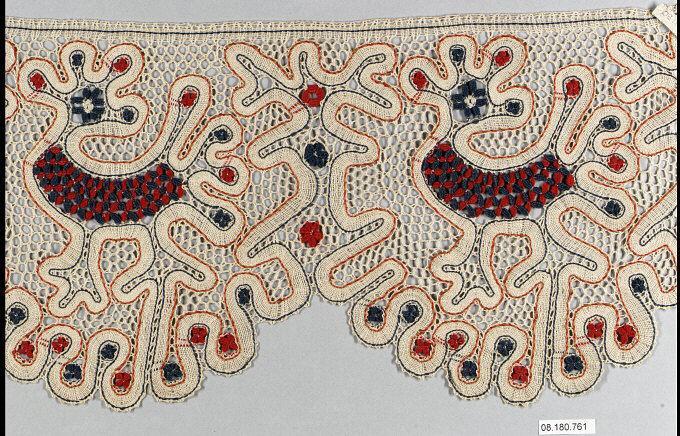
Fragment as Method: Bobbin Lace and the Architecture of Couture Memory
In the contemporary couture landscape, the fragment occupies a paradoxical position. It is simultaneously an artifact of loss and a vessel of concentrated meaning—a partial object that, precisely because of its incompleteness, generates interpretive density. Within the Katherine Fashion Lab's standalone study of bobbin lace fragments, this paradox becomes the organizing principle of inquiry. The fragment is not treated as a diminished whole but as an autonomous aesthetic proposition, one whose authority derives from its material specificity rather than its completeness.
The bobbin lace fragment, in particular, resists the teleological logic of the finished garment. Unlike a bodice or a sleeve, which announces its function through form, a lace fragment presents itself as pure structure—a lattice of threads whose purpose is suspended between ornament and architecture. This suspension is not a deficiency. It is, rather, the condition of the fragment's couture potential.
Material Intelligence: The Bobbin Lace Proposition
Bobbin lace is among the most labour-intensive textile structures in the global heritage canon. Its production involves the interlacing of multiple thread pairs, each wound on a bobbin, manipulated over a pricked parchment pattern. The technique appears across disparate geographies—Flemish, Venetian, Honiton, Chantilly, and Bedfordshire traditions each developed distinct vocabularies of ground, motif, and picot. What unites them is a shared commitment to structural transparency: the lace does not conceal its method of making. Every crossing, twist, and plait remains legible to the trained eye.
This legibility is critical to the fragment's curatorial value. When a bobbin lace fragment is isolated from its original garment—whether a 17th-century Flemish collar or a 19th-century Chantilly shawl—it does not lose information. It gains it. The fragment foregrounds the technical decision-making that the completed garment often obscures: the tension of the thread, the density of the ground, the rhythmic spacing of motifs. These are not decorative details. They are the grammar of a material intelligence that has been transmitted across generations and geographies.
Katherine Fashion Lab's study positions the bobbin lace fragment as a site of material epistemology—a place where knowledge is stored not in documents but in the physical structure of the textile itself. The fragment becomes a primary source, not a secondary relic.
Global Heritage and the Problem of Origin
To speak of bobbin lace as "global heritage" is to confront the uneven geographies of its production and circulation. Lace was never a neutral commodity. In the early modern period, it functioned as a marker of aristocratic distinction in Europe, a luxury import in colonial markets, and a site of female labour whose value was systematically undervalued in economic accounts. The fragment, when read critically, exposes these contradictions.
A fragment of Honiton lace, for instance, carries within its structure the history of Devonshire lacemakers who worked in poor light for subsistence wages. A fragment of Venetian needle lace, by contrast, may encode the institutional power of the Venetian Republic's charitable conservatories, where lacemaking was both a moral discipline and an export industry. The fragment does not resolve these histories. It holds them in tension.
The curatorial challenge is to resist the romanticization of the fragment as a purely aesthetic object. Its beauty is real, but it is not innocent. The bobbin lace fragment is a document of skill, but also of labour, trade, and cultural appropriation. To study it seriously is to acknowledge that heritage is never neutral—it is always someone's heritage, produced under specific conditions and circulated through specific power relations.
Fragment as Standalone: Curatorial Implications
The decision to present the bobbin lace fragment as a standalone study, rather than as a component of a reconstructed garment, is itself a curatorial argument. It asserts that the fragment possesses sufficient structural integrity to function as an autonomous aesthetic unit. This is not a claim about completeness but about coherence. The fragment coheres on its own terms—its internal logic of thread, pattern, and ground is sufficient to sustain visual and intellectual attention.
This approach has precedents in modernist and contemporary art practice, where the fragment, the readymade, and the partial object have been deployed to disrupt narratives of wholeness and completion. But the couture fragment operates differently. It is not a critique of the garment; it is a distillation of it. The fragment is the garment reduced to its most essential gesture—the gesture of making.
In the Katherine Fashion Lab study, the bobbin lace fragment is presented without contextual reconstruction, without mannequin, without the framing devices that typically domesticate historical textiles. It is allowed to remain strange—to resist the viewer's desire for narrative closure. This strangeness is productive. It forces the viewer to engage with the fragment as a material presence rather than a historical illustration.
Conclusion: The Fragment as Future
The bobbin lace fragment is not a relic of a lost past. It is a proposition about the future of couture. In an industry increasingly dominated by digital simulation and synthetic materials, the fragment insists on the value of manual intelligence, of slow making, of structural transparency. It reminds us that couture is not merely a system of signs but a system of skills—skills that reside in the hands, in the bobbins, in the threads.
To study the fragment is to study the conditions of its making. It is to acknowledge that heritage is not a static inheritance but an active practice—one that requires attention, care, and critical engagement. The bobbin lace fragment, in its partiality, offers a complete lesson: that meaning in couture is not found in the finished object but in the structure of its becoming.
Katherine Fashion Lab's standalone study of the bobbin lace fragment is, therefore, more than a curatorial exercise. It is an argument for the fragment as a legitimate and necessary form of couture knowledge—one that speaks to the past while insisting on its relevance to the present. The fragment is not what remains. It is what matters.