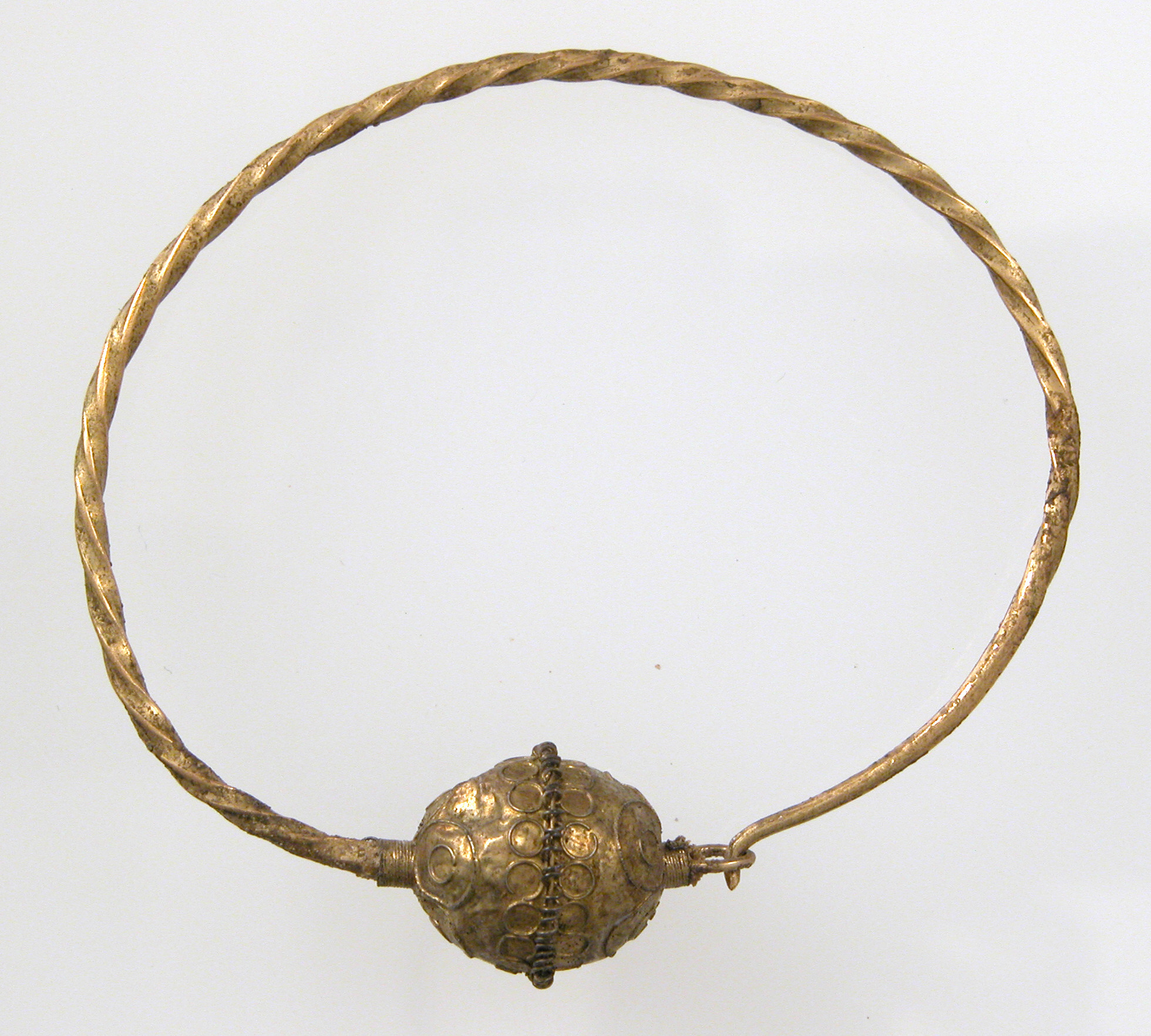
Langobardic Gold Earrings: From Grave Goods to Luxury Codes of Light and Stone
The Langobardic gold earring occupies a singular position in early medieval adornment. Produced between the sixth and eighth centuries across the Lombard territories of northern Italy and Pannonia, these objects were not merely decorative accessories but condensed statements of status, belief, and cultural hybridity. For Katherine Fashion Lab, the Langobardic earring offers a strategic bridge between archaeological authenticity and contemporary luxury language—particularly when read alongside our ongoing Mirror with Split-Leaf study, which juxtaposes polished silver mirror surfaces bearing gold-inlaid palm fronds against the cold relief narratives of stone sarcophagi. That dialectic of reflective light and funerary stone finds a direct analogue in Langobardic goldwork.
Historical Context and Material Authority
Langobardic earrings emerged from a culture in transition. The Lombards, migrating from Scandinavia through Pannonia into Italy in 568 CE, absorbed Byzantine, Roman, and steppe nomadic influences. Their goldsmiths worked with a sophisticated command of filigree, granulation, and cloisonné—techniques that transformed raw bullion into objects of talismanic density. Earrings of this period, often single rather than paired, were frequently discovered in female graves alongside brooches, amulets, and coin pendants. The gold itself carried economic weight, but its ritual value exceeded exchange: it was a material believed to hold incorruptible essence, resistant to decay, and therefore suited to accompany the body into the afterlife.
The earring’s placement—pierced through the lobe, adjacent to the head and throat—gave it a privileged relationship to the wearer’s voice, breath, and sensory perception. In Langobardic cosmology, such proximity to the body’s openings invited protective function. Gold’s incorruptibility was understood as a conduit for spiritual safeguarding, a physical anchor against malevolent forces.
Symbolic Power and Spiritual Meaning
Langobardic earrings often feature geometric and zoomorphic motifs: interlocking loops, serpentine forms, and stylized bird or animal heads. These were not ornamental accidents. The serpent, a recurring motif, signified both earthly wisdom and chthonic guardianship. Birds signaled the soul’s capacity for flight and transcendence. The circular or hoop form of many earrings encoded cyclical time—birth, death, and regeneration—while the suspended pendant elements introduced movement and sound, transforming the wearer’s slightest gesture into a subtle ritual performance.
This symbolic density aligns with the Mirror with Split-Leaf framework. The mirror’s polished silver and gold palm inlay represent the luminous, reflective self—the social persona. The sarcophagus relief represents the petrified, memorialized narrative—the enduring soul. The Langobardic earring operates at the intersection: its gold surface reflects light like the mirror, yet its funerary provenance anchors it in the stone’s gravity. It is both adornment for the living and passport for the dead.
Spiritually, Langobardic gold earrings functioned as amuletic technology. They were worn to attract fortune, deflect harm, and signal allegiance to a kin group or patron. In a world where Christianization competed with older Germanic and Roman belief systems, the earring became a site of syncretism—cross motifs might appear alongside serpentine forms, each layer adding protective efficacy.
Historical Adornment and the Body’s Architecture
From a design standpoint, Langobardic earrings demonstrate an early mastery of what we now call wearable architecture. The goldsmith calibrated weight, balance, and suspension so that the earring moved with the body rather than resisting it. Granulation created micro-textures that caught candlelight; filigree loops created negative space that allowed skin and shadow to participate in the design. This is not passive ornamentation—it is interactive adornment, requiring the wearer’s movement to complete the aesthetic effect.
Such objects were also markers of identity. Langobardic women of elevated status wore earrings that distinguished them from Roman, Byzantine, or Frankish counterparts. The specific alloy composition, the style of granulation, and the choice of motif communicated ethnicity, rank, and marital status. In this sense, the earring was a portable heraldic device—a wearable signature of belonging.
2026 High-End Luxury Strategy: Light, Stone, and the Split-Leaf Dialectic
For Katherine Fashion Lab’s 2026 collections, the Langobardic earring provides three strategic pillars.
First, material honesty. The Langobardic goldsmith did not disguise gold as something else. Contemporary luxury consumers, particularly in the high-jewelry segment, increasingly demand traceable, single-material integrity. A 2026 earring line could employ recycled 18k gold with granulation and filigree techniques revived through CAD-assisted hand finishing—honoring the original while meeting modern ethical standards.
Second, the mirror-and-stone duality. Our Mirror with Split-Leaf research demonstrates that luxury narratives thrive on contrast: reflective versus matte, luminous versus funerary, gold inlay versus carved relief. Langobardic earrings can be recontextualized as objects that hold both sides—a polished gold exterior that mirrors the wearer, and an interior or reverse surface with subtle relief or engraving that evokes the sarcophagus narrative. This double-faced construction invites intimate discovery: the public sees brilliance; the wearer knows the hidden story.
Third, spiritual minimalism. The 2026 luxury market rewards objects that carry meaning without didacticism. Langobardic motifs—serpent, bird, interlace—can be abstracted into contemporary geometry, retaining symbolic charge while shedding archaeological literalism. A single earring, worn asymmetrically, echoes the historical Langobardic practice of unpaired adornment and signals individuality within tradition.
In conclusion, the Langobardic gold earring is not a footnote to early medieval art but a sophisticated instrument of identity, protection, and memory. Its resonance with our Mirror with Split-Leaf study—light against stone, reflection against relief—offers Katherine Fashion Lab a rigorous heritage platform for 2026: jewelry that is archaeologically grounded, spiritually resonant, and strategically positioned at the intersection of luxury craft and narrative depth. The earring, like the mirror, holds two truths at once. That is its power, and our opportunity.