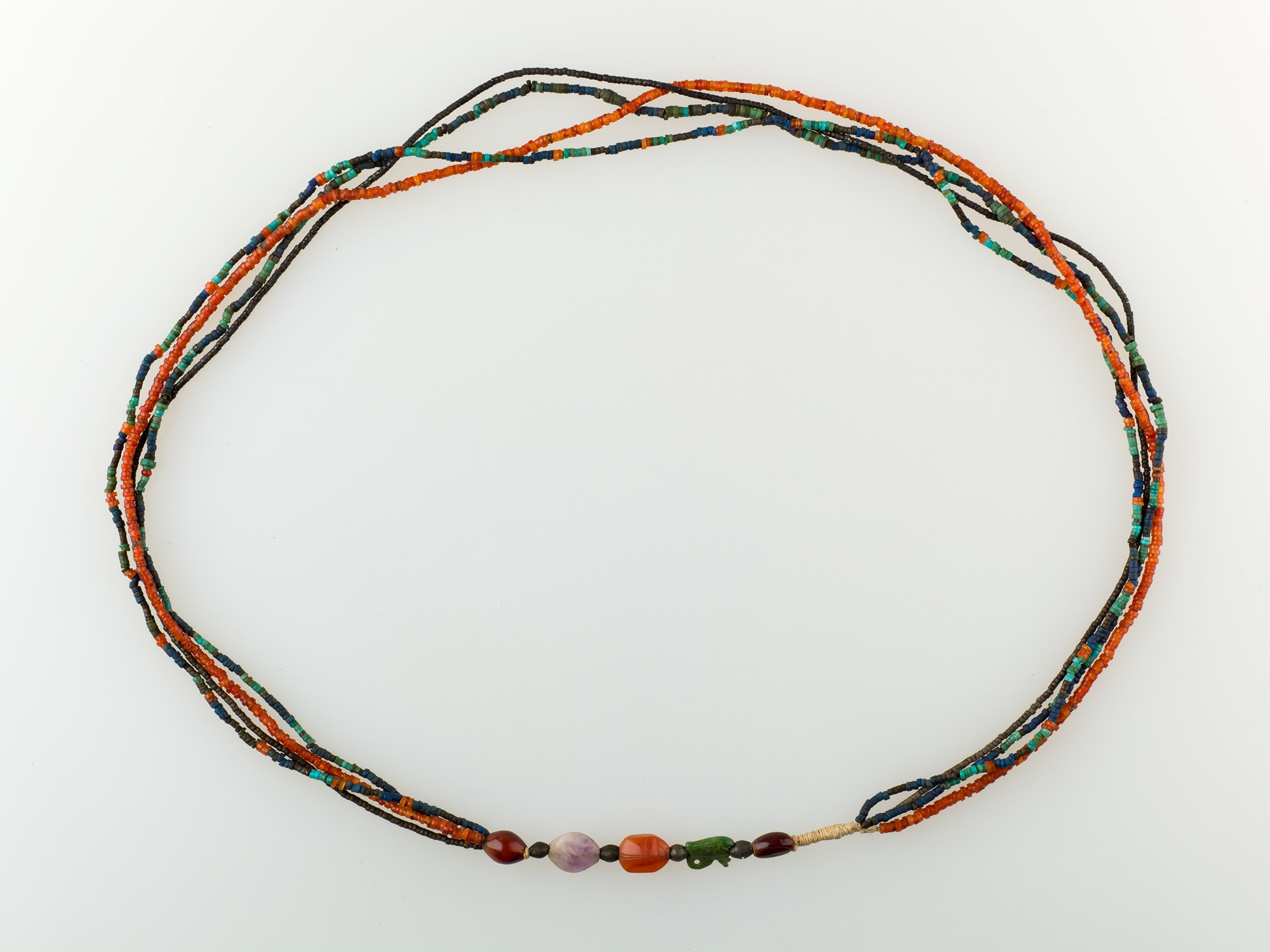
Strategic Heritage Analysis: The Four-Strand Amuletic Necklace of Ancient Egypt
Object Overview and Material Composition
The subject of this analysis is a four-strand necklace composed of turquoise, amethyst, carnelian, Egyptian blue, faience, silver, and plant resin—an assemblage that situates the object within the high material culture of ancient Egyptian adornment, likely spanning the Middle Kingdom through the Late Period (c. 2000–300 BCE). The necklace's construction reflects a sophisticated command of lapidary and composite craft: each strand functions both as an aesthetic register and as an amuletic grammar, with the four-strand format permitting the wearer to carry multiple protective and regenerative forces simultaneously. For Katherine Fashion Lab, this object represents not merely an artifact of adornment but a strategic template for how luxury can encode meaning across layered systems.
Symbolic Power and Material Hierarchies
Each material in the necklace carried codified symbolic weight in ancient Egyptian cosmology. Turquoise, sourced largely from the Sinai Peninsula, was associated with Hathor, the goddess of love, fertility, and the sky, and was believed to confer joy and protection upon the living. Amethyst, with its purple-red hue, was linked to the regenerative powers of the sun god and was frequently placed in royal and elite burials to aid rebirth. Carnelian, a red-orange chalcedony, evoked the blood of Isis and the vital force of the sun, serving as a talisman against evil and a catalyst for courage. Egyptian blue—a synthetic calcium copper silicate—was among the earliest manufactured pigments, and its use in jewelry connected the wearer to the divine light of the sun and the eternal order of ma'at. Faience, a glazed ceramic paste, offered a more accessible medium for the same symbolic repertoire, democratizing amuletic protection while retaining visual prestige. Silver, rarer than gold in ancient Egypt and associated with the moon and the bones of the gods, added a lunar, protective counterpoint. Plant resin, likely from pistacia or conifer sources, served as a binding agent and aromatic offering, linking the necklace to ritual incense and the preservation of the body.
Historical Adornment and Social Function
Necklaces of this complexity were not everyday accessories; they were instruments of social positioning and spiritual insurance. In life, they signaled the wearer's access to imported materials—turquoise from Sinai, amethyst from the Eastern Desert, carnelian from Nubia—and thus to trade networks that underwrote elite status. In death, they were placed among funerary assemblages to accompany the deceased into the afterlife, where each bead and amulet served as a passport, a petition, or a ward. The four-strand format itself may have corresponded to the four sons of Horus, the four cardinal directions, or the four canopic jars, embedding a cosmological map into a wearable object. This functional duality—adornment as both display and defense—is central to understanding why such pieces retained value across centuries and dynasties.
Spiritual Meaning and Amuletic Logic
The necklace operates on an amuletic logic that is cumulative rather than singular. Each strand, each bead, and each material contributes a discrete protective or regenerative function, and the wearer benefits from the aggregate. This is not superstition but a coherent theological technology: the ancient Egyptians believed that matter could be charged with divine presence through ritual, inscription, and correct arrangement. The necklace is therefore a portable altar, a microcosm of the ordered universe, and a statement of the wearer's relationship with the gods. For a contemporary luxury brand, this logic offers a powerful strategic insight: meaning can be layered, and the most desirable objects are those that reward both immediate visual pleasure and deeper, cumulative interpretation.
Strategic Implications for 2026 High-End Luxury
As Katherine Fashion Lab positions itself for the 2026 luxury landscape, this necklace provides a blueprint for heritage-driven innovation. First, the multi-strand format anticipates the current consumer appetite for layered, modular luxury—pieces that can be worn individually or in combination, allowing for personalization without sacrificing brand coherence. Second, the material palette—turquoise, amethyst, carnelian, Egyptian blue, faience, silver, plant resin—maps directly onto 2026's anticipated demand for traceable, spiritually resonant, and ethically sourced materials. Turquoise and carnelian are already experiencing a revival in fine jewelry, while Egyptian blue and faience offer opportunities for proprietary, lab-grown or heritage-revival materials that differentiate the brand. Third, the amuletic function aligns with the post-2024 luxury consumer's search for objects of protection, intention, and meaning—a trend accelerated by global uncertainty and the desire for talismanic luxury.
Operationally, Katherine Fashion Lab should consider a four-strand capsule collection that translates the necklace's symbolic grammar into contemporary silhouettes: one strand for protection, one for vitality, one for wisdom, and one for legacy. Each strand can be merchandised separately, with a signature clasp or connector that unites them into a single statement piece. Narrative marketing should foreground the original object's provenance, material symbolism, and funerary context, positioning the collection as a living inheritance rather than a pastiche. Finally, the use of plant resin as a binding and aromatic element invites a sensory dimension—scented or resin-finished hardware—that can become a brand signature in an era where multisensory luxury is a key differentiator.
Conclusion
The four-strand amuletic necklace is more than an ancient artifact; it is a strategic asset. It demonstrates that the most enduring luxury objects are those that combine rare materials, layered meaning, and personal agency. For Katherine Fashion Lab, the path forward is not to replicate the past but to operationalize its logic: build collections that are modular, meaningful, and materially honest, and allow the wearer to assemble their own protective narrative. In doing so, the brand can claim a position at the intersection of heritage authority and contemporary desire—precisely where the 2026 luxury market will reward those who understand that adornment has always been a form of strategy.