Introduction: The Woodcut as a Vehicle of Fashion Knowledge
The New Modelbüch allen Nägerin u. Sydenstickern occupies a singular position within the global heritage of dress and textile culture. Published in the mid-sixteenth century, this woodcut pattern book was not merely a practical manual for seamstresses and embroiderers; it was a sophisticated instrument of visual codification, a portable archive of ornamental grammar, and a commercial product that circulated across the German-speaking lands and beyond. For the modern couture analyst, the volume demands attention not as a curiosity of early modern print culture but as a foundational artefact in the genealogy of fashion design systems. Its title—translatable as “New Model Book for All Seamstresses and Embroidery Stitchers”—announces an inclusive ambition: to democratise the knowledge of structured ornament that had previously been confined to guild workshops and noble households.
As a standalone study, this analysis treats the New Modelbüch on its own terms, without subordinating it to the biography of its printer or the broader history of sixteenth-century printing. The object itself—its materiality as a woodcut, its pedagogical architecture, and its aesthetic logic—constitutes the primary evidence. What emerges is a document that anticipates modern pattern-making, surface design, and the very idea of the seasonal collection, albeit in a pre-industrial register.
The Materiality of the Woodcut: Technique, Texture, and Transmission
Woodcut as a Democratic Medium
The New Modelbüch was executed entirely in woodcut, a relief printing technique in which the design is carved into a wooden block, inked, and pressed onto paper. Unlike copperplate engraving, which allowed finer lines and deeper tonal range, woodcut imposed a graphic discipline: bold contours, stark contrasts, and a certain rigidity of line. For a pattern book intended for practical use, this limitation became an advantage. The woodcut’s emphatic outlines were easily legible to the needleworker, who needed to transfer motifs onto linen, wool, or silk without ambiguity. The very coarseness of the medium ensured that the designs could be copied, adapted, and scaled with minimal loss of essential information.
Moreover, woodcut blocks were durable and could be reprinted over decades, allowing the New Modelbüch to circulate widely and cheaply. This material resilience transformed the book from a luxury item into a working tool. The global heritage of the volume thus lies not only in its motifs but in its reproducibility—an early instance of fashion knowledge detached from the singular artefact and made available for iterative use.
Ornamental Grammar and the Logic of the Grid
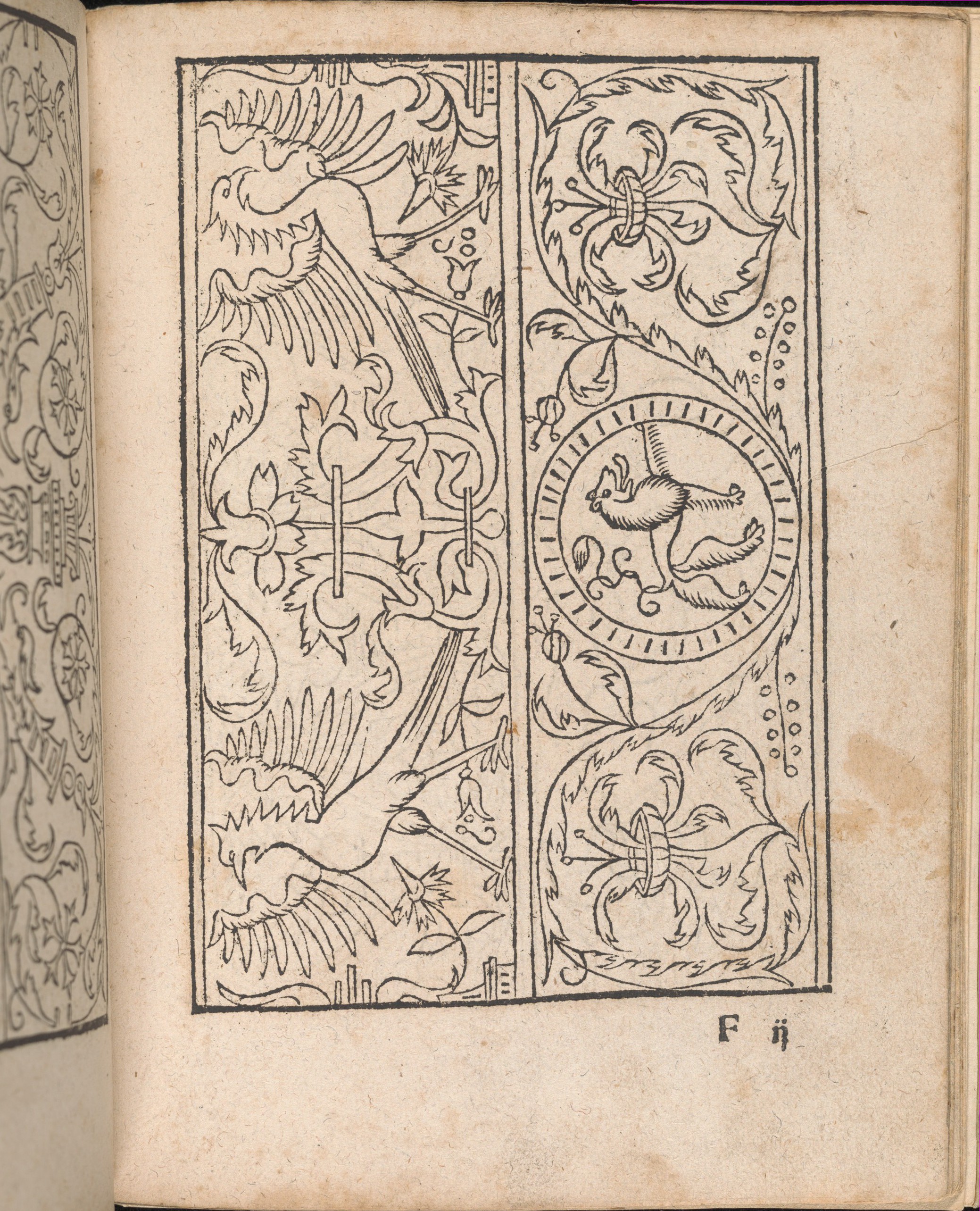
Examining the surviving pages of the New Modelbüch, one is struck by the systematic arrangement of patterns. Geometric bands, interlaced knots, foliate scrolls, and stylised animals are presented in modular units, often framed within rectangles or circles. This grid-like presentation is a form of proto-industrial standardisation. The seamstress was not expected to invent from scratch but to combine, rotate, and interpolate existing modules. In this sense, the book operates as a combinatorial design system—a precursor to the swatch book, the trim library, and the digital asset library of contemporary couture houses.
The woodcut’s tendency toward flatness and repetition also imposed an aesthetic of rhythmic consistency. Motifs recur with minor variations, creating a visual cadence that would later characterise the borders of ecclesiastical vestments, the necklines of burgher gowns, and the edges of household linens. The New Modelbüch thus encodes a grammar of ornament that is both local (rooted in German Renaissance taste) and trans-local (adaptable to any textile tradition that valued geometric and floral interlace).
Pedagogy and Professional Identity: The Seamstress as Interpreter
Instructions Without Words
Notably, the New Modelbüch contains very little explanatory text. Its pedagogy is visual and mimetic. The user is expected to read the woodcut directly: to trace the lines, count the threads, and infer the stitch. This absence of verbal instruction is significant. It presupposes a literate-in-craft audience—women and men who already possessed basic needle skills but lacked access to advanced pattern repertoires. The book does not teach sewing from zero; it teaches design from a foundation of technical competence.
This model of pedagogy has profound implications for couture. It positions the practitioner as an active interpreter rather than a passive recipient. The woodcut pattern is not a blueprint to be followed slavishly but a prompt for variation. In contemporary terms, the New Modelbüch is closer to a mood board or a technical sketchbook than to a graded sewing pattern. Its authority is suggestive, not prescriptive.
The Professionalisation of Embroidery
By addressing “allen Nägerin u. Sydenstickern” (all seamstresses and embroidery stitchers), the book acknowledges a female-dominated workforce that was often marginalised in guild records. The woodcut format allowed this workforce to access high-quality ornament without belonging to a formal workshop. In doing so, the New Modelbüch contributed to the professionalisation of embroidery as a distinct craft with its own intellectual property—patterns that could be bought, sold, and collected.
From a couture perspective, this is a crucial moment. It marks the separation of design from execution. The pattern designer (often anonymous) and the embroiderer become distinct roles, linked by the printed page. This division of labour would later underpin the atelier system in Paris, London, and Milan, where a premiere d’atelier interprets the sketches of a creative director.
Aesthetic Legacy: From Woodcut to Haute Couture
Interlace, Symmetry, and the Persistent Motif
The visual vocabulary of the New Modelbüch—interlaced bands, quatrefoils, pomegranates, and stylised vines—did not disappear with the sixteenth century. It migrated into Baroque lace, Rococo trimming, and nineteenth-century sampler culture. In the twentieth century, couturiers such as Mariano Fortuny and later Alexander McQueen drew on similar archival woodcut patterns for their textile prints and embroideries. The New Modelbüch thus functions as a deep source for the global heritage of surface design.
What makes its legacy distinct is the woodcut’s insistence on symmetry and repetition. These are not merely decorative choices; they are structural principles that align with the human body’s bilateral symmetry and the repetitive gestures of hand stitching. A pattern from the New Modelbüch applied to a sleeve or a bodice does not fight the garment’s construction; it amplifies it.
Standalone Study as Method
Treating the New Modelbüch as a standalone study—rather than as a footnote to printing history or German costume—reveals its autonomy as a fashion artefact. It is a book that produces fashion knowledge, not merely reflects it. Its woodcut materiality, its modular grammar, its silent pedagogy, and its professionalising effect together constitute a coherent system. For the contemporary couture analyst, the lesson is clear: the most enduring fashion innovations are often those that package knowledge in a reproducible, interpretable, and beautiful form. The New Modelbüch allen Nägerin u. Sydenstickern remains a masterclass in that art.