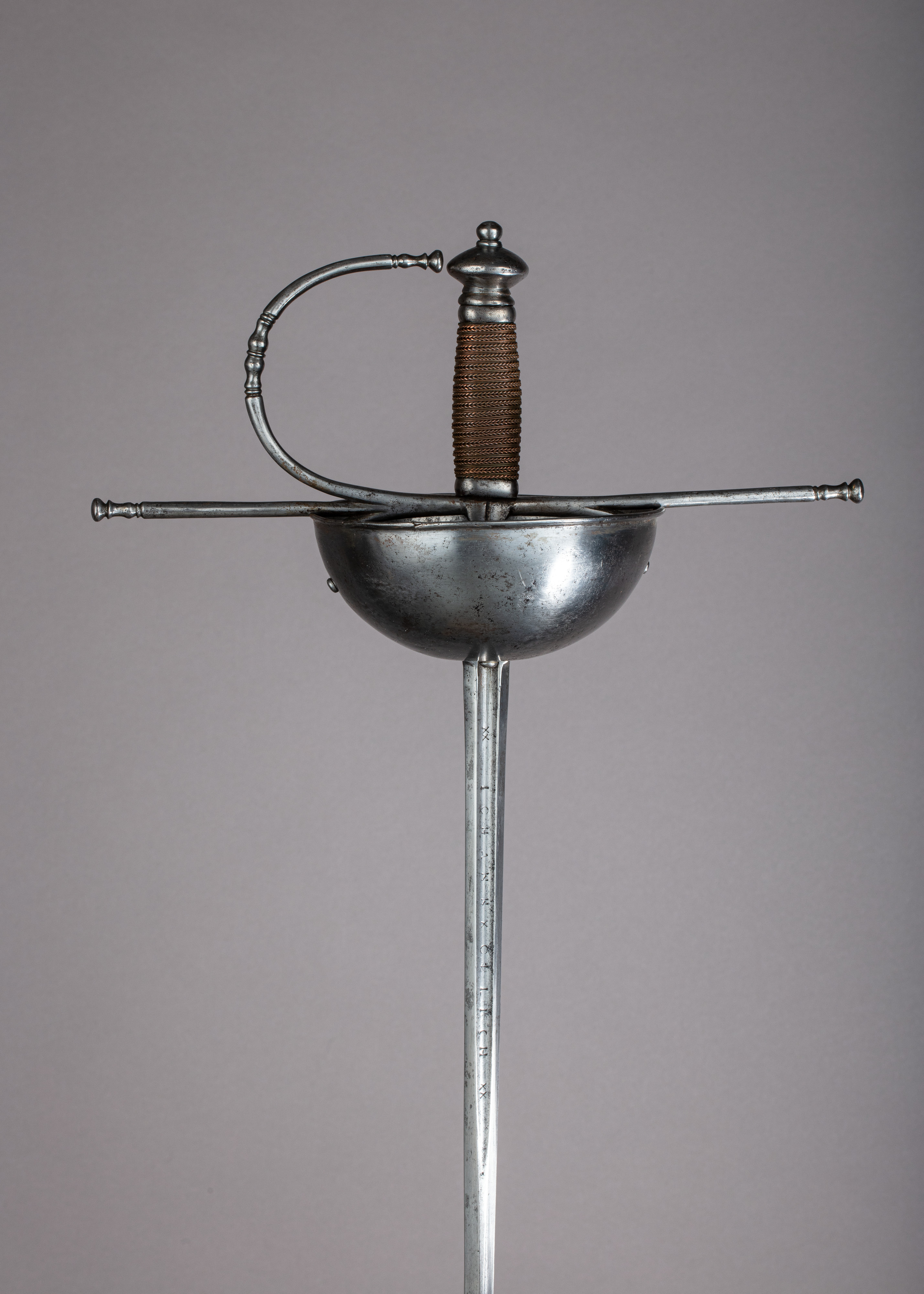
The Cup-Hilted Rapier: A Convergence of Spanish Design and German Metallurgy
Within the disciplined vocabulary of arms and armor, few objects embody the tension between elegance and lethality as completely as the cup-hilted rapier. This standalone study examines a single, highly resolved example: a weapon whose hilt is unmistakably Spanish in conception and whose blade originates from the celebrated forges of Solingen, Germany. Fabricated from steel and bound with copper wire, the piece represents not merely a functional sidearm but a sophisticated negotiation between two distinct European craft traditions. For the collector and design historian alike, it offers a masterclass in how regional specialization—Iberian hilt architecture and Rhenish blade metallurgy—could be synthesized into a single, coherent instrument of civilian defense.
Historical and Cultural Provenance
The rapier emerged in the sixteenth century as a response to changing social and martial realities. As plate armor receded from the dueling ground and the street, the need for a fast, thrust-centric weapon with reach and precision became paramount. Spain, in particular, developed a distinctive school of fence—La Verdadera Destreza—that emphasized geometric control, circular footwork, and a guard capable of both protecting the hand and trapping an opponent’s blade. The cup hilt, with its deep, hemispherical bowl, was the physical manifestation of that philosophy. It provided comprehensive coverage for the hand while allowing the wrist to articulate the subtle, circular motions central to Spanish swordsmanship.
Yet the blade of this rapier is not Spanish. It comes from Solingen, a city in the Rhineland that by the late sixteenth century had become the undisputed capital of European blade production. Solingen smiths were renowned for their ability to control carbon content, tempering, and geometry, producing blades that were light, flexible, and remarkably strong. The marriage of a Spanish hilt to a German blade was not an anomaly; it was a common practice in an era of robust international trade and reputation-driven procurement. A discerning patron might commission a hilt from a Toledo or Madrid workshop and specify a Solingen blade for its superior performance—or, more likely, purchase a complete weapon assembled by a merchant who understood that prestige and function could be sourced from different geographies.
Materials and Construction: Steel and Copper Wire
The primary material is steel, but the term belies the complexity of the object. The hilt’s cup, knuckle bow, quillons, and pommel are all forged from iron or mild steel, then chiseled, pierced, and polished to a high finish. The cup itself is often a single piece of raised metal, its surface sometimes decorated with embossed motifs or pierced in geometric patterns that reduce weight without compromising structural integrity. The quillons—the crossguard arms—are typically straight or slightly curved, providing both a parrying surface and a potential trapping mechanism for an opponent’s blade.
Copper wire plays a crucial, though often overlooked, role. It is wrapped tightly around the grip, which is usually made of wood or bone. The wire serves multiple functions: it improves traction for a sweaty or gloved hand, it reinforces the grip against splitting, and it introduces a subtle visual and tactile contrast to the cold steel. Copper, softer than steel, also patinates over time, developing a warm, brownish luster that speaks to the weapon’s age and handling. In this specific piece, the wire is applied in a tight, helical pattern, a technique that required considerable skill to execute without gaps or overlaps. The result is a grip that feels both secure and refined—a small but telling detail in a weapon designed for the hands of a gentleman.
Formal Analysis: The Cup Hilt as Sculptural Object
From a design perspective, the cup-hilted rapier is a study in controlled asymmetry and dynamic balance. The deep cup dominates the visual field, its concave interior catching shadows and its convex exterior reflecting light. The knuckle bow arcs from the quillon block to the pommel, creating a continuous line that guides the eye along the weapon’s length. The pommel, often a faceted or ovoid shape, acts as a counterweight, ensuring that the center of gravity sits close to the hand—a critical factor for the rapid point control that defines rapier play.
The copper wire grip introduces a horizontal rhythm that interrupts the vertical thrust of the blade. It is a modest but intentional interruption, a moment of warmth and texture in an otherwise austere composition. The blade itself, long and slender, is typically of diamond or hollow-ground cross-section, with a pronounced ricasso (the unsharpened section near the hilt) that allows the index finger to wrap over the quillon for added control. The transition from hilt to blade is marked by a thick, often decorated block—the ricasso—which serves as both a structural junction and a visual anchor.
Symbolism and Status
Owning a cup-hilted rapier with a Solingen blade was a statement of discernment. It signaled that the owner understood the difference between a mass-produced sword and a curated weapon. In the context of early modern Europe, where dueling was both a legal reality and a social performance, such an object was a form of personal branding. The Spanish hilt conveyed adherence to a sophisticated, almost academic martial tradition. The German blade conveyed a pragmatic trust in industrial excellence. Together, they projected an identity that was both cultured and deadly—a combination that defined the ideal of the gentleman-swordsman.
Moreover, the use of copper wire on the grip was not merely decorative. It was a subtle indicator of quality. Cheaper weapons might use leather, cord, or plain wood. Copper wire required more labor, more precision, and more expense. It was a detail that only a close inspection would reveal, which made it all the more meaningful to those who knew what to look for.
Conclusion: A Standalone Study in Synthesis
This cup-hilted rapier, with its Spanish hilt and German blade, is more than the sum of its parts. It is a physical record of a pan-European market in arms, a testament to the division of labor between design and metallurgy, and a beautiful example of how functional objects can achieve aesthetic distinction. The steel provides strength and edge; the copper wire provides grip and grace. The cup hilt protects and intimidates; the Solingen blade delivers. For Katherine Fashion Lab, this piece is not merely an antique but a precedent—a reminder that the most compelling designs often arise from the deliberate fusion of different traditions, each contributing its own expertise to a unified, purposeful whole.