Executive Summary: A Strategic Archetype for Modern Luxury
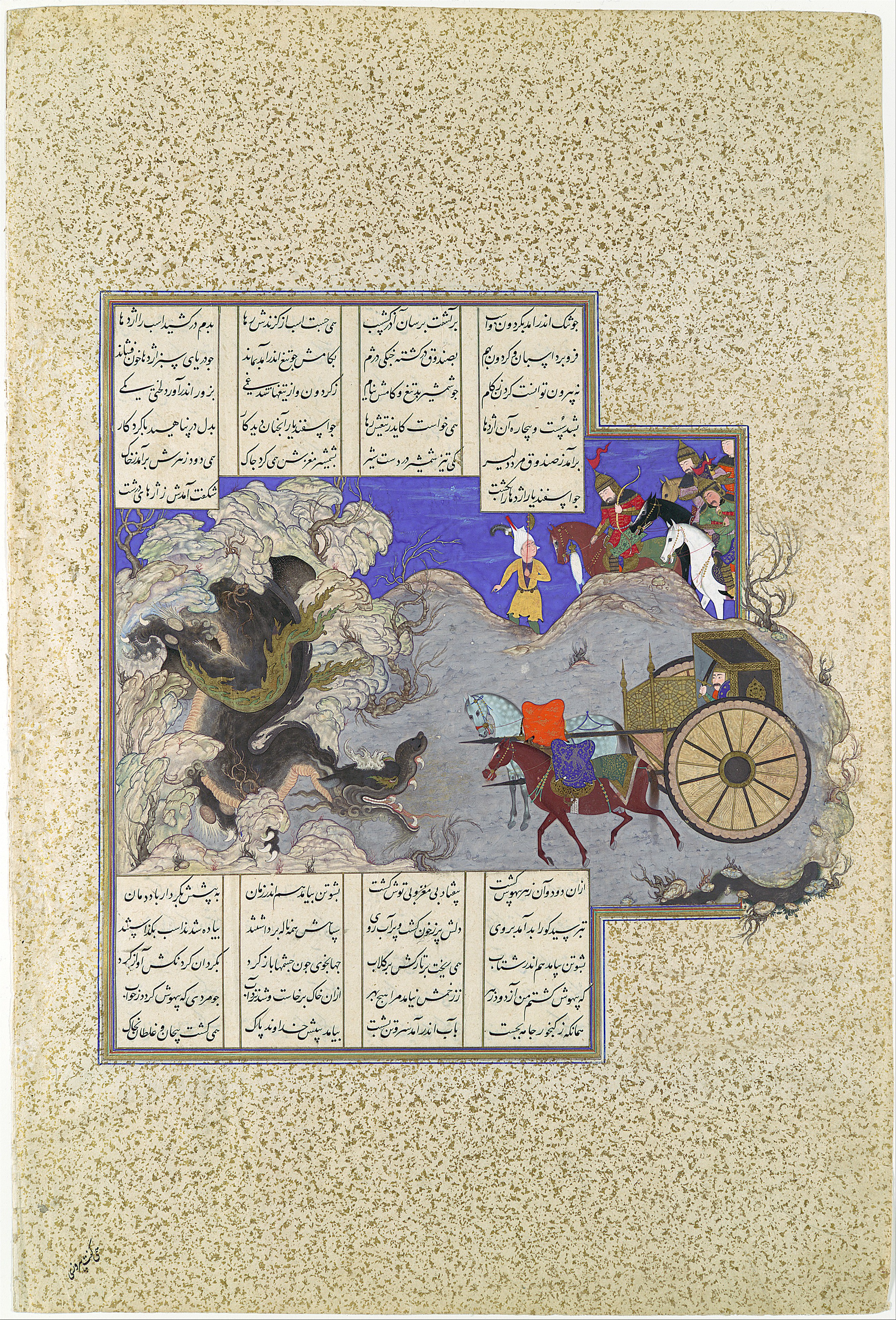
The folio "Isfandiyar's Third Course: He Slays a Dragon" (c. 1525–1535), from the pinnacle of Persian manuscript illumination, the Shahnama of Shah Tahmasp, is not merely an artifact of ancient civilization. It is a masterclass in coded power, narrative adornment, and spiritual alchemy. For Katherine Fashion Lab, this piece serves as a profound strategic blueprint. This analysis deconstructs the folio’s layered symbolism to inform a 2026 high-end luxury strategy centered on mythic resilience, talismanic craftsmanship, and narrative exclusivity. It posits that the future of luxury lies not in overt branding, but in embedding clientele within a living heritage of symbolic conquest and protection.
Decoding the Archetype: Symbolic Power and Narrative Adornment
The scene depicts the legendary hero Isfandiyar, invulnerable and divinely appointed, in his mythic labor of slaying a dragon. The composition is a deliberate orchestration of symbolic hierarchy and narrative tension, offering rich semiotic territory for brand development.
The Hero as a Vessel of Inviolability
Isfandiyar’s figure is the central anchor of power. His invulnerability, granted by a divine blessing, is his ultimate luxury—an intangible, priceless asset. This translates strategically to the concept of "mythic resilience" as a brand pillar. For 2026, Katherine Fashion Lab can curate collections that are not merely durable but are narratively imbued with the idea of protection and destined success. This moves beyond technical fabric innovation into the realm of emotional and symbolic fortification. Garments and accessories become modern "armor" for the boardroom, the gala, or the personal milestone, designed for those who perceive their journey as a series of destined conquests.
Adornment as a Language of Sovereignty
Historical adornment in this folio is precise and meaningful. Isfandiyar’s gold-embellished armor, his meticulously rendered weaponry, and the intricate patterns of his textiles are not decorative afterthoughts; they are insignia of his royal and heroic status. The lavish application of gold and silver leaf in the original manuscript physically elevates the work, mimicking the luminosity of divine favor. For our strategy, this underscores the principle of intentional materiality. Every fastening, embroidery motif, or hardware detail must "speak." A clasp is not a clasp; it is a dragon's scale subdued. A woven pattern is not mere geometry; it is a reference to the celestial gardens of Persian myth. This level of intentionality justifies ultra-luxury positioning, where every element carries a storied weight.
The Spiritual Alchemy: From Monster to Talisman
The Dragon as a Transformative Foe
Critically, the dragon is not merely a villain to be eradicated. In the spiritual cosmology of the Shahnama, it represents chaotic, untamed nature—a force that must be mastered to establish order and civilization. Isfandiyar’s victory is an alchemical act, transforming the threat into a testament to his power. This provides a sophisticated framework for design: the integration of the "conquered element." A 2026 strategy could involve motifs derived from dragon scales, textures echoing reptilian skin, or colors drawn from the mythical beast (deep emerald, venomous gold, volcanic crimson), always presented through the lens of refinement and mastery. The "monster" is aestheticized and contained, becoming a talisman of the wearer's own overcome challenges.
The Landscape as a Spiritual Arena
The rocky, blossoming landscape is not a neutral backdrop. It is a spiritual testing ground, a liminal space where divine fate is enacted. The scattered flowers symbolize life persisting amidst struggle, a poignant metaphor for elegance under pressure. This inspires a design philosophy where environment and garment are in dialogue. Collections can be presented as "equipment for modern arenas," with pieces tailored for specific, high-stakes environments—the diplomatic summit, the legacy-defining auction, the transformative journey. The clothing facilitates the wearer's heroic performance in their personal narrative.
Strategic Application: The 2026 High-End Luxury Blueprint
Translating this analysis into a concrete market strategy requires moving from curation to creation, embedding these ancient codes into a contemporary luxury lexicon.
Pillar 1: The Mythic Resilience Collection
Launch a core annual collection named for the "Seven Labors" of Isfandiyar, with the Dragon Slayer as the inaugural theme. This is not fast fashion; it is serialized myth-making. Pieces will feature technical fabrics with subtle, protective qualities (e.g., innovative weatherproof linings, discreetly reinforced structures) paired with overt, talismanic artistry. Think a cashmere trench with a hand-embroidered dragon-scale pattern along the inner lining, visible only to the wearer, or a minimalist leather glove with a knuckle plate modeled after Isfandiyar’s vambrace. The narrative is one of prepared, destined elegance.
Pillar 2: Talismanic Craftsmanship & Bespoke Iconography
Establish an ultra-bespoke "Scriptorium" service, named for the royal ateliers of Shah Tahmasp. Here, clients co-create with master artisans to embed personal symbols of conquest and protection into one-of-a-kind pieces. A client's personal "dragon"—be it a professional hurdle, a personal loss, or a geographic journey—is abstracted into a heraldic motif, woven, engraved, or embroidered into the garment. This transforms the object into a sacred personal archive, leveraging the same principle of narrative investment seen in the folio.
Pillar 3: Experiential Archeology
The launch and client engagement must eschew traditional runway shows. Instead, create immersive "Folio Experiences." Present the collection within curated environments that mirror the spiritual arena of the painting—a stark, beautiful landscape at dusk, or within a gallery where art and fashion are in direct dialogue. Clients receive not just a garment, but a vellum-bound "illuminated manuscript" detailing the heritage symbols used in their piece, their historical provenance, and their modern interpretation. This elevates the purchase to an initiation into a continuing story.
Conclusion: Heritage as a Living Conquest
"Isfandiyar Slays the Dragon" offers Katherine Fashion Lab a paradigm far beyond aesthetic appropriation. It provides a complete ecosystem of value: the symbolic power of invulnerability, the historical adornment of sovereign identity, the spiritual meaning of alchemical triumph, and the narrative exclusivity of a personalized epic. The 2026 luxury consumer seeks depth, legacy, and personal mythos. By positioning our client not as a mere buyer, but as the modern Isfandiyar—armed with talismanic craftsmanship, navigating their own epic course—we transcend fashion to furnish modern heirlooms of symbolic conquest. The dragon is not just slain; it is mastered, and its power is elegantly worn.