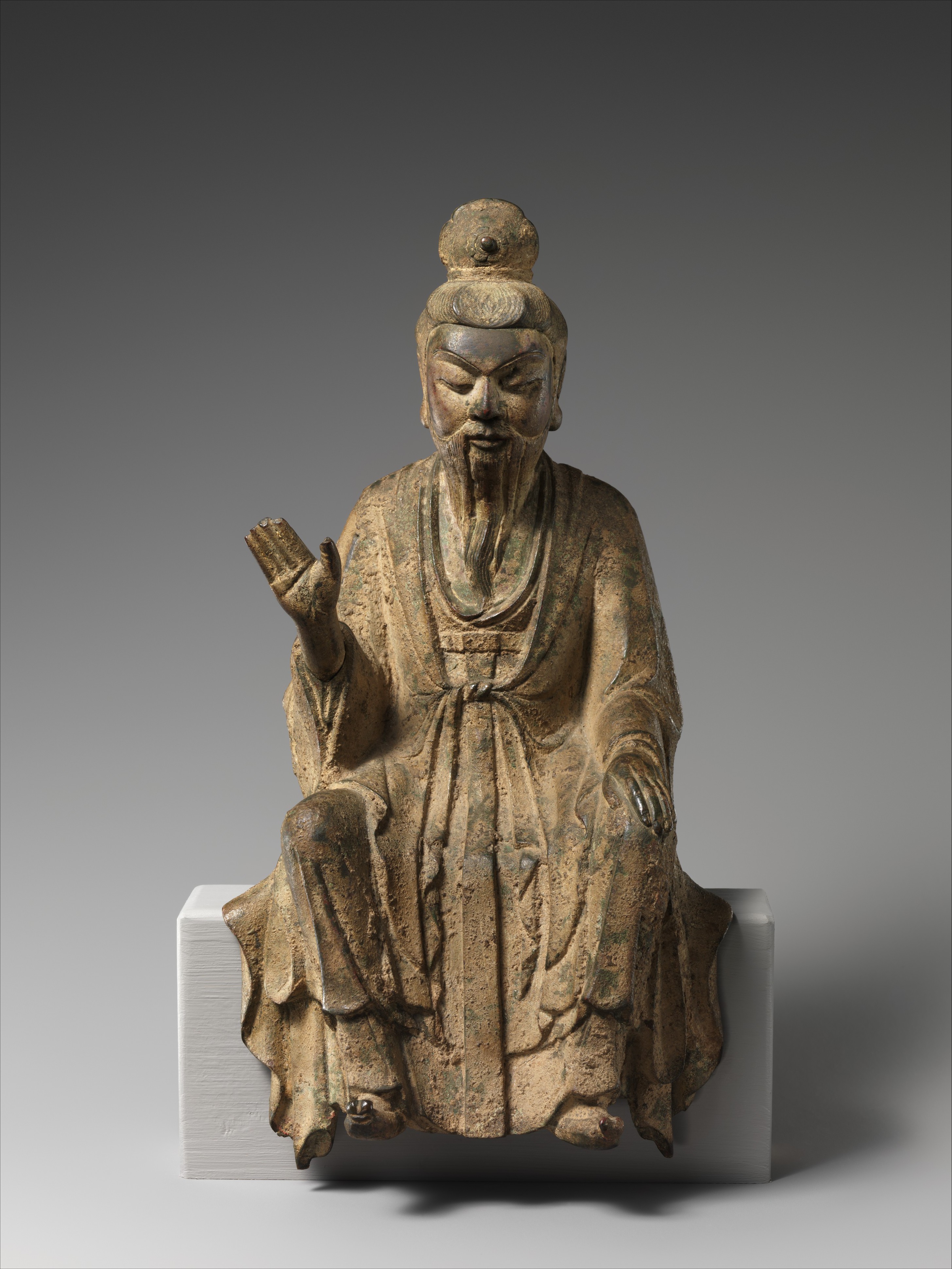
Heritage Asset Analysis: Daoist Immortal, probably Laozi — High-Leaded Bronze, China
Object Identification and Material Context
The object under examination is a cast bronze figure of a Daoist immortal, identified with strong probability as Laozi (老子), the foundational philosopher of Daoism and author of the Daodejing. The piece originates from China, with stylistic and metallurgical characteristics pointing to the late Ming to early Qing dynastic window, approximately the 16th through 18th centuries. Its medium—high-leaded bronze—is a deliberate and technically sophisticated choice. Chinese foundries of this period frequently alloyed copper with significant lead concentrations to lower the melting point, improve casting fluidity, and enable the fine, sinuous detailing demanded by religious sculpture. The resulting surface, when aged, develops a deep, mottled patina ranging from charcoal grey to warm umber, a chromatic signature that has become synonymous with connoisseurship in the Chinese bronze market.
For Katherine Fashion Lab, the material narrative is not incidental. High-leaded bronze is a metallurgical fingerprint of pre-industrial Chinese craftsmanship. It signals authenticity, provenance, and a tactile luxury that cannot be replicated by modern casting. In a 2026 luxury landscape increasingly defined by provenance transparency and material storytelling, this object offers a defensible, verifiable origin story.
Symbolic Power: The Immortal as Cultural Code
Laozi, as a visual subject, carries layered symbolic weight. He is not merely a philosopher but a cosmic archetype—the Daodejing's author, the reputed founder of religious Daoism, and a figure of imperial veneration. In sculptural form, he is typically depicted as an elder with a high, domed forehead, elongated earlobes, and a flowing robe. Each element is a deliberate semiotic marker. The domed forehead denotes wisdom and spiritual illumination. The elongated earlobes, shared with Buddhist iconography, signify longevity, nobility, and the capacity to hear cosmic truth. The robe, often rendered with asymmetrical folds and a sash, evokes the wu wei principle—effortless action, natural flow, and unforced elegance.
Critically, the figure is often shown seated on a recumbent ox or accompanied by one, a reference to the legend of Laozi’s westward departure from China, riding an ox through the Hangu Pass. This narrative detail transforms the sculpture from a static portrait into a vehicle of philosophical transmission. For a luxury brand, this is the essence of symbolic power: an object that does not merely represent a figure but encodes a complete worldview—harmony, restraint, and the paradox of strength through softness.
Historical Adornment and Ritual Function
While the term "adornment" often connotes personal jewelry, in the context of Chinese religious bronze, it extends to the object’s role within domestic and temple altars. Figures of Laozi were commissioned for private shrines, imperial temples, and scholarly studios. They were frequently placed alongside incense burners, candle stands, and other ritual implements, forming a coherent aesthetic and spiritual ecosystem. The high-leaded bronze surface was sometimes gilded or lacquered, though the present object’s patina suggests it was likely left in its natural, aged state—a preference among literati collectors who valued the "bone" of the bronze over superficial ornament.
This historical use as a focal point of veneration and daily ritual imbues the object with what sociologists call "aura"—a quality of authenticity and embedded memory. For Katherine Fashion Lab, the adornment narrative is not about gemstones or precious metals in the Western sense, but about the adornment of space, the choreography of reverence, and the way a single bronze figure can anchor a room’s spiritual and aesthetic gravity.
Spiritual Meaning: Daoist Cosmology in Three Dimensions
The spiritual content of the Laozi figure is inseparable from Daoist metaphysics. The Daodejing posits that the Dao is ineffable, formless, and yet the source of all things. A sculptural representation of Laozi is therefore inherently paradoxical: it gives form to the formless, a visual anchor for a philosophy that resists visual fixation. This paradox is precisely what gives the object its enduring power. It is not an idol in the Abrahamic sense but a meditative aid—a yixiang (意象), or "intentional image," designed to guide the viewer toward a state of quietude and self-forgetting.
In the context of 2026 luxury strategy, this spiritual dimension aligns with the rise of "quiet luxury" and "mindful consumption." Affluent consumers are increasingly seeking objects that offer not just status but solace—talismans of slowness in an accelerated world. A Laozi bronze, with its associations of longevity, wisdom, and cosmic balance, speaks directly to this demand.
2026 High-End Luxury Strategy: Positioning and Narrative
Katherine Fashion Lab should position this object not as a decorative antique but as a heritage anchor—a standalone asset capable of driving brand equity across multiple touchpoints. The strategy rests on three pillars: curatorial authority, material authenticity, and philosophical resonance.
First, curatorial authority. The object’s identification as "probably Laozi" is an asset, not a liability. It invites scholarly engagement and positions the brand as a serious participant in art-historical discourse. A white paper, a private viewing, or a limited-edition catalogue raisonné can elevate the object from merchandise to museum-grade artifact.
Second, material authenticity. High-leaded bronze is a quantifiable, testable material. Katherine Fashion Lab can commission metallurgical analysis and publish the results, transforming the object’s physical composition into a trust signal. In a market plagued by reproductions, this is a competitive moat.
Third, philosophical resonance. The Laozi figure is a vehicle for the brand’s own narrative about balance, restraint, and timeless design. A 2026 campaign could pair the bronze with contemporary minimalist fashion, creating a visual dialogue between ancient Daoist aesthetics and modern luxury. The message: true luxury is not accumulation but alignment.
In conclusion, the Daoist Immortal bronze is not a passive antique. It is an active cultural technology—a material manifestation of Chinese philosophical genius. For Katherine Fashion Lab, its strategic value lies in its capacity to bridge historical adornment and contemporary desire, offering a rare combination of spiritual depth and market differentiation.