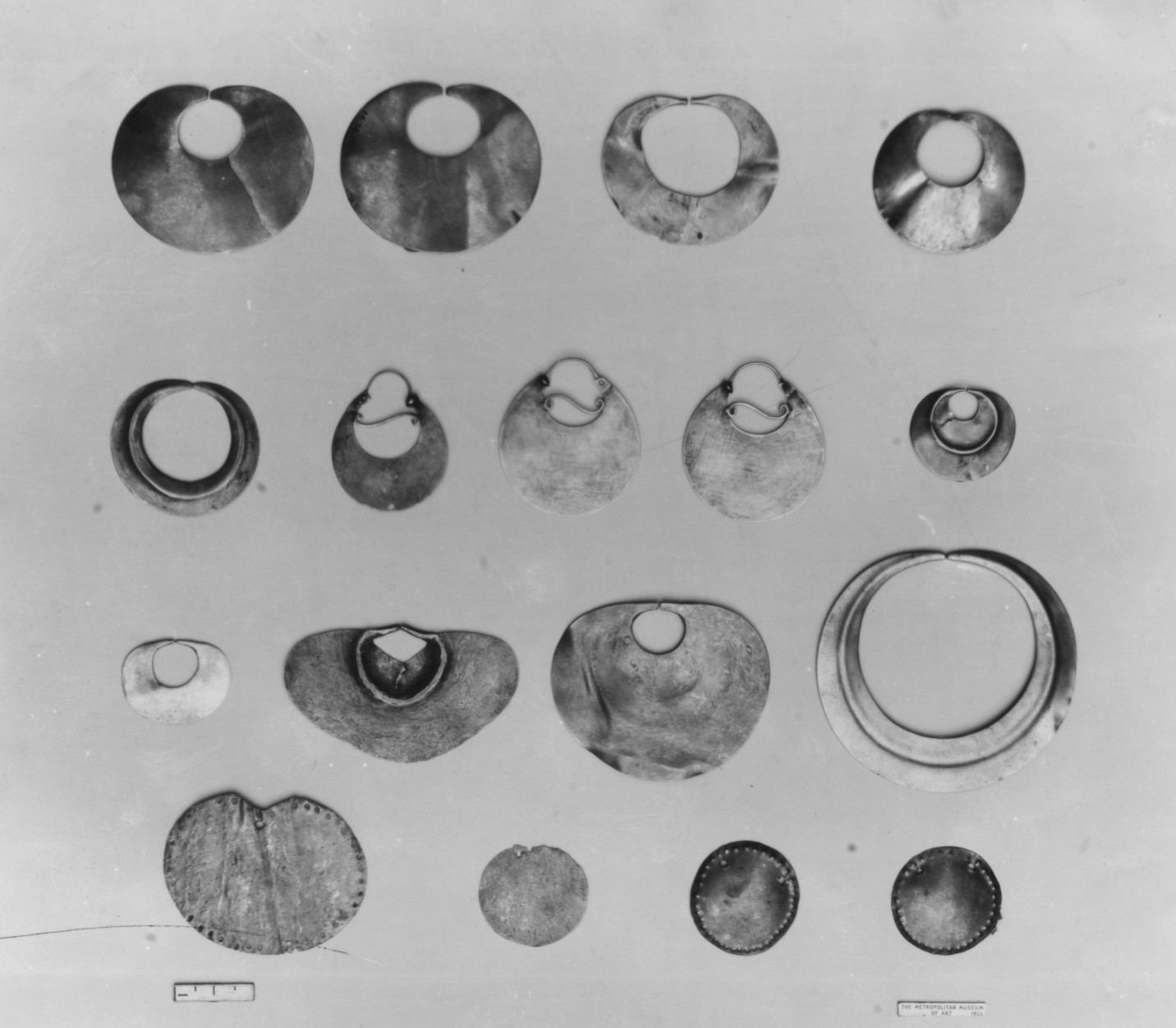
Heritage Asset Analysis: Colombian Hammered Gold Nose Ornament
Object Classification and Material Profile
The artifact under examination is a hammered gold nose ornament (nariguera) originating from the pre-Columbian goldworking traditions of present-day Colombia. Produced through cold-hammering and annealing techniques rather than casting, the piece demonstrates the metallurgical sophistication of cultures including the Quimbaya, Calima, Muisca, and Tairona, whose goldsmiths achieved remarkable control over sheet thickness, edge finishing, and surface reflectivity. The medium is gold—likely a natural alloy containing variable percentages of copper and silver, known regionally as tumbaga—which was valued not for its exchange rate but for its luminosity and perceived metaphysical density. The ornament's form, typically a broad crescent or flared plate designed to rest across the nasal septum or alae, positions it as a wearable object of high visibility and intimate bodily contact.
Symbolic Power and the Politics of Adornment
In the Andean and inter-Andean societies of Colombia, gold functioned as a material interface between the human and the sacred. The nose ornament was among the most politically charged items in the regalia of caciques and shamans, because it occupied the body's most prominent respiratory and olfactory aperture—the anatomical site of breath, scent, and life force. To wear gold across the nose was to claim command over the invisible: the ability to detect, to breathe, to speak with authority. Ethnohistorical accounts and archaeological deposition patterns indicate that such ornaments were not everyday jewellery but ceremonial instruments, worn during rituals of accession, burial, and inter-tribal diplomacy.
Critically, the ornament's power derived from its transformative visual effect. Hammered to a thin, mirror-like sheet, it caught and redistributed light across the wearer's face, dissolving the boundary between the human countenance and solar radiance. In cultures that identified gold as the physical residue of the sun, this was not metaphor but ontology. The wearer did not merely display wealth; he momentarily became a conduit for cosmic order. This distinction—between ornament as status marker and ornament as metaphysical technology—is central to any serious heritage valuation.
Spiritual Meaning and Cosmological Function
The nariguera's placement across the septum carries specific cosmological weight. In many Colombian Indigenous ontologies, the breath is a vehicle of soul-substance, and the nose is the channel through which spiritual forces enter and exit the body. Gold, being incorruptible and non-tarnishing, was understood as a material that could withstand the passage of these forces without decay. The ornament thus functioned as a ritual filter: it purified, amplified, or redirected breath-borne energies during shamanic practice.
Funerary contexts reinforce this reading. Numerous narigueras have been recovered from tomb assemblages in the Quimbaya and Calima regions, often positioned on the deceased's face in a manner suggesting continued ceremonial use in the afterlife. The object was not buried as a possession but as an instrument still required by the soul. This continuity between life and death, body and cosmos, establishes the ornament as a rare category of artifact: simultaneously personal, political, and theological.
Historical Adornment and Craft Lineage
The hammering technique itself constitutes a heritage asset. Unlike lost-wax casting, which permits replication through moulds, hammered gold requires individual, irreversible labour. Each nariguera is the product of hundreds of controlled strikes, with intermittent annealing to prevent cracking. No two are identical. This artisanal irreproducibility aligns the object with the logic of haute couture rather than industrial production—a point of significant strategic relevance.
Colonial disruption severed the transmission of these techniques, but contemporary Colombian goldsmiths and heritage institutions have begun reconstructing the knowledge through archaeological analysis and experimental archaeology. This recovery narrative provides a legitimate provenance story for luxury applications: not imitation, but continuation.
2026 Luxury Strategy: Positioning the Nariguera Heritage Code
For Katherine Fashion Lab, the strategic opportunity lies in translating the nariguera's symbolic architecture into a contemporary luxury proposition without appropriating its sacred function. Three principles should govern this translation.
First, maintain the body-site logic. The ornament's power is inseparable from its position on the face. A 2026 collection should treat the nose as a legitimate site of high jewellery expression—nasal cuffs, septum-spanning arcs, and bridge-mounted gold elements—positioned as objets de pouvoir rather than fashion accessories. This differentiates the line from conventional ear and neck categories and creates a distinctive visual signature.
Second, preserve material honesty. The heritage object is gold, hammered, and non-replicable. Any commercial interpretation should foreground hand-hammered surfaces, visible tool marks, and alloy variation. Machine-perfect finishes would contradict the source code and undermine the narrative of artisanal continuity.
Third, operate within a custodial framework. High-end consumers in 2026 are increasingly sensitive to cultural provenance. Katherine Fashion Lab should position itself not as owner of the motif but as custodian of a technique and a story, with documented partnerships with Colombian artisans and heritage authorities. Limited editions, accompanied by research dossiers and provenance certificates, convert the ornament from product into collectible cultural capital.
The Colombian hammered gold nose ornament is not a decorative curiosity. It is a compact record of metallurgical mastery, political theology, and bodily ritual. Handled with scholarly rigour and strategic discipline, its heritage code can anchor a luxury proposition that is visually arresting, ethically defensible, and historically grounded—precisely the triangulation that defines enduring high-end value in the 2026 market.