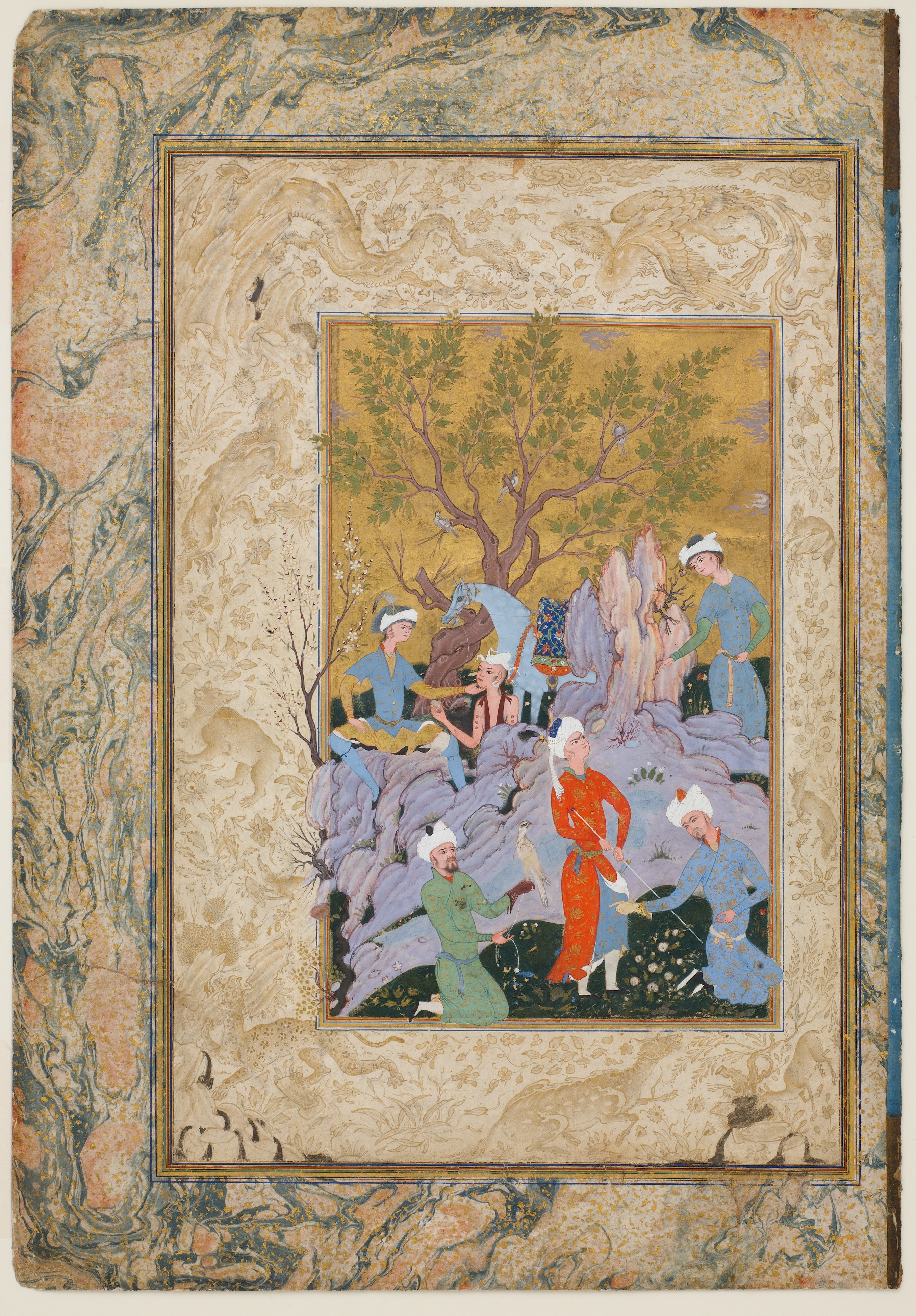
Princely Hawking Party: A Couture Analysis of Global Heritage
The Princely Hawking Party stands as a singular artifact within the Global Heritage canon—a standalone study executed in ink, opaque watercolor, and gold on paper. It is not a fragment torn from a bound manuscript, nor a preparatory sketch subordinated to a larger commission. It is a self-sufficient visual argument, and for the couture analyst it functions as something rarer still: a complete grammar of power, dress, and movement compressed into a single plane. At Katherine Fashion Lab, we read such objects not as curiosities of a distant court but as technical documents of self-presentation, and the Princely Hawking Party rewards that reading with unusual precision.
The Standalone Study as Formal Strategy
What distinguishes this work is its autonomy. A standalone study permits the image to operate without the narrative scaffolding of a manuscript cycle, meaning every decision—gesture, silhouette, ground line—must carry its own weight. The artist has therefore constructed a closed system of attention. The princely figure anchors the composition, typically mounted or striding at the center-left, while the hawk sits upon the gloved forearm as the visual and narrative fulcrum of the entire page. Around this axis, attendants, horses, and landscape elements are arranged in descending hierarchy. The opaque watercolor establishes flat, saturated fields of color; the ink supplies contour and the fine linear articulation of textile and feather; the gold operates as both illumination and index of rank. In couture terms, this is a fully resolved look, styled, lit, and accessorized, presented without the distraction of a surrounding story.
Material Intelligence: Ink, Opaque Watercolor, and Gold
The material triad is not incidental to the meaning of the image; it constitutes it. Opaque watercolor—the gouache-like pigment body used across Persian, Mughal, Ottoman, and Rajput workshops—permits the dense, matte color fields that give the textiles their weight. Where transparent wash would suggest atmosphere, opaque pigment asserts surface: the fabric reads as fabric, with a body and a nap. Ink then performs the work of the tailor's chalk and the master's hand simultaneously, drawing the crisp edges of a sash, the rhythm of a turban's wound folds, the individual barbs of the hawk's plumage. Gold is the decisive intervention. Applied as a surface, it does not merely decorate; it ranks. Gold marks the prince against his retainers, the jeweled hilt against the plain scabbard, the embroidered border against the undyed ground. For the couture analyst, gold here is the equivalent of a couture house's signature finish—the hand-work that cannot be replicated by machine and that announces, before any figure is identified, exactly where authority resides.
Silhouette, Textile, and the Choreography of Rank
The princely silhouette in such studies is engineered for legibility at distance. The turban or headdress adds vertical volume, extending the body upward and outward; the jama or robe—often crossing at the chest and flaring below the waist—creates a triangular mass that reads as stability and wealth. The sash cinches the waist, dividing the figure into upper and lower registers and providing the artist with a horizontal band on which to lavish gold. Below, the paijama or trousers taper toward the ankle, preserving the clarity of the leg line so that the stance remains dynamic rather than buried in fabric. Each attendant repeats this grammar at reduced intensity: fewer gold passages, simpler borders, flatter color. The result is a visual system in which dress alone communicates the chain of command. This is the same logic that governs a modern runway finale—principal look first, supporting looks calibrated to recede—and it is executed here with a discipline that contemporary stylists would do well to study.
The Hawk as Accessory and Attribute
The hawk deserves separate analysis because it is not merely a prop. In the iconography of princely sport, the bird of prey is an attribute of sovereignty: it signals mastery over the wild, patience, and the trained eye. Visually, it introduces a second center of energy—feather texture against textile texture, organic curve against geometric drape. The gloved forearm that carries it becomes a stage within the stage, and the artist typically renders that glove with particular care, its cuff and stitching drawn in ink over a muted ground. For the couture reader, the hawk functions as the ultimate statement accessory: it cannot be bought, only trained; it cannot be worn casually, only carried with authority. It converts the prince's body into a performance of stewardship.
Global Heritage and Contemporary Application
The Princely Hawking Party belongs to a transregional heritage of courtly painting that spans Safavid, Mughal, Deccani, Ottoman, and Rajput traditions, with related conventions appearing across Central Asia. Its materials traveled as readily as its motifs: paper, pigment, and gold leaf moved along the same routes as silk, brocade, and gemstones. That material cosmopolitanism is precisely what makes the study relevant to contemporary couture. Designers seeking to engage this heritage responsibly must attend to construction, not costume—to the logic of layering, the hierarchy of ornament, the relationship between a cinched waist and a flared hem. The lesson of the Princely Hawking Party is that authority in dress is achieved through restraint and repetition, with gold reserved for the few places where it will be read.
At Katherine Fashion Lab, we treat such standalone studies as primary sources. They preserve, in ink and pigment, the decisions of a styling intelligence operating centuries before the term existed—and they continue to set the standard for how power should be worn.